25 Sep 2026
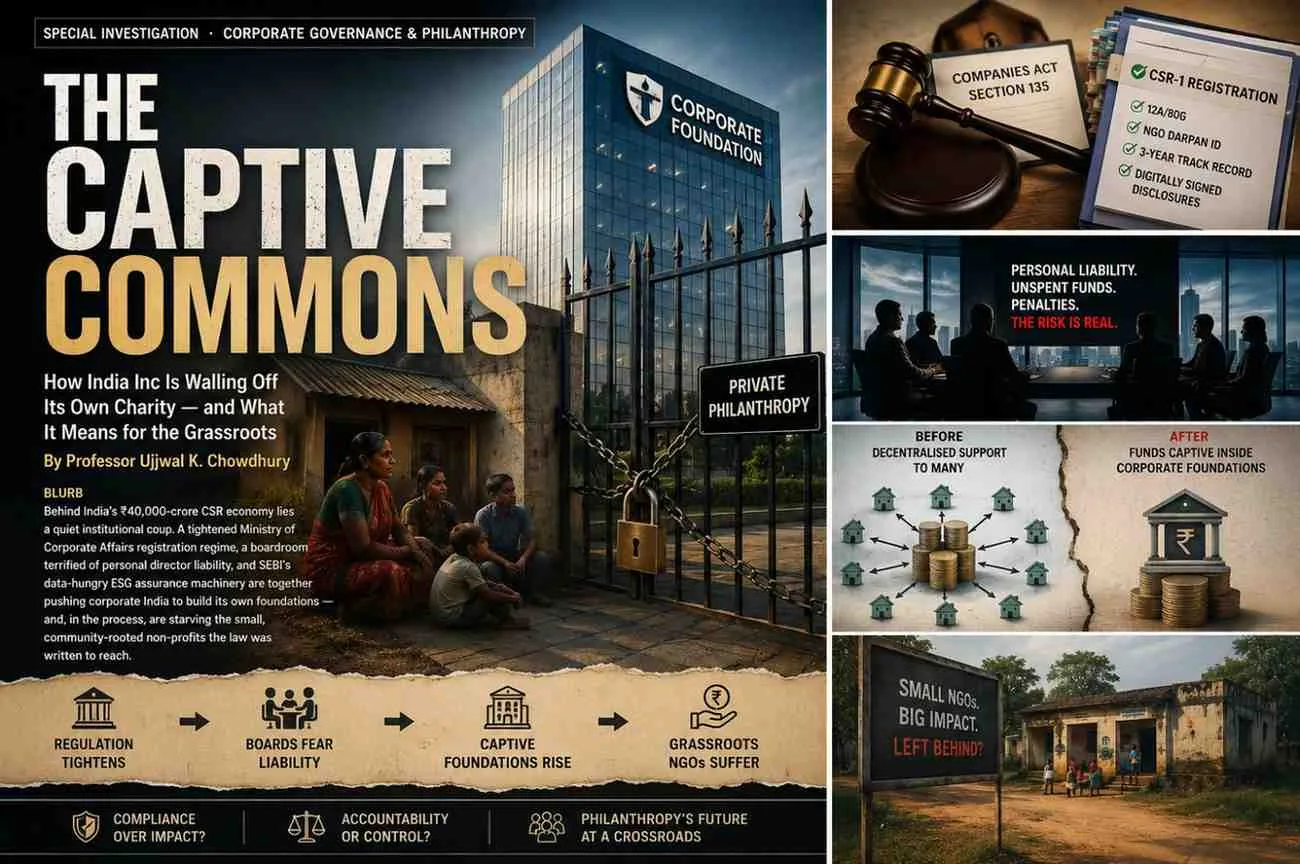
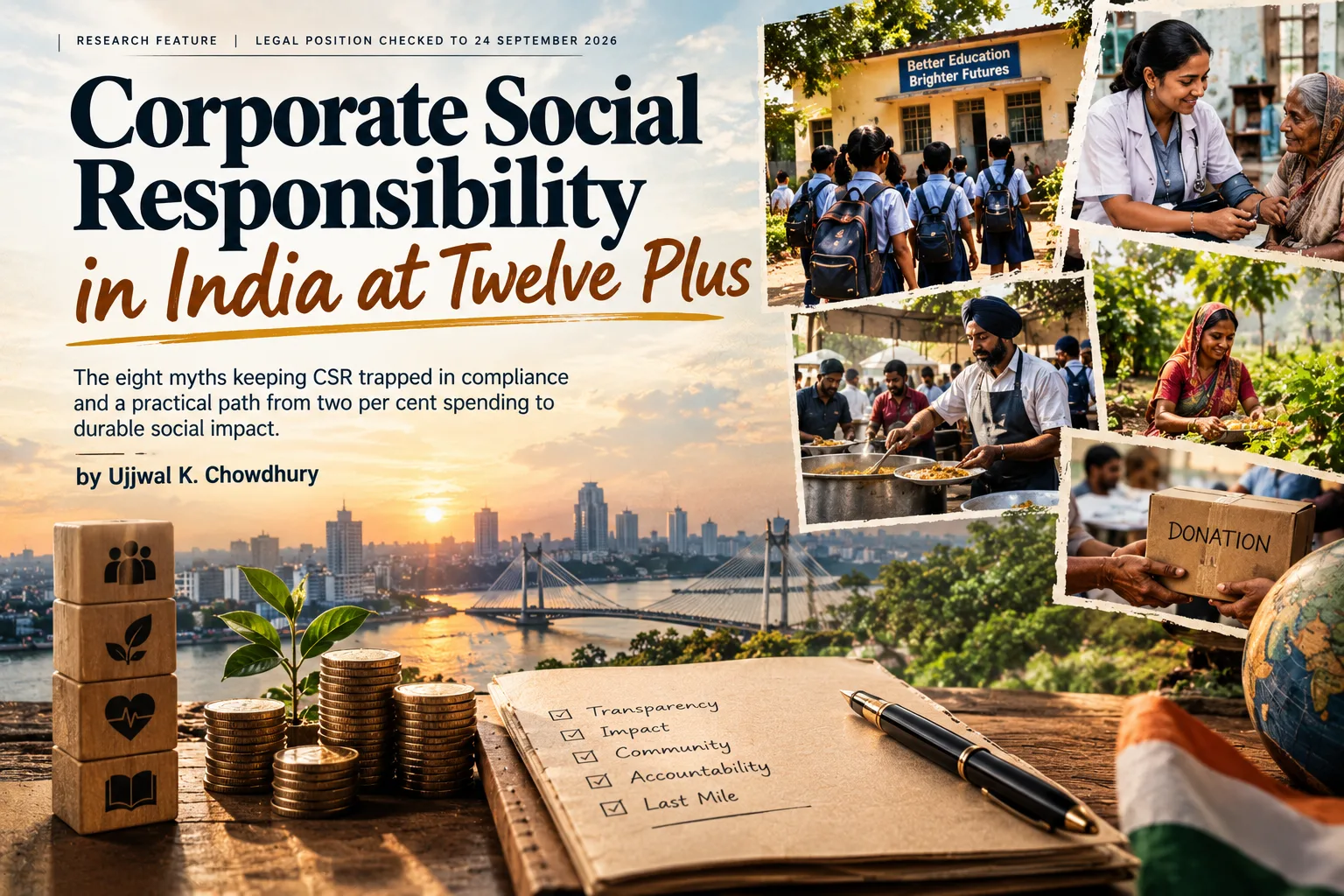
The eight myths keeping CSR trapped in compliance and a practical path from two per cent spending to durable social impact, as explored by Professor Ujjwal K Chowdhury. Twelve years later the question is no longer only how much A new school building makes a fine photograph. The harder questions arrive after the ribbon is folded away: Are the classrooms being used? Are children learning more? Can the school pay for repairs next year? Has the community helped decide what it needs? And did the company fund something that its law already required it to do?Those questions sit at the centre of India's CSR story as the Companies Act regime crosses its twelfth year. Section 135 came into force on 1 April 2014 and made India a distinctive case in corporate law: qualifying companies must spend on prescribed social-development activities, rather than leaving every contribution to voluntary philanthropy. The framework has changed since then. Board responsibility, partner registration, unspent-fund deadlines, impact assessment and new disclosure requirements have sharpened the compliance machinery. In May 2026, the Ministry of Corporate Affairs connected CSR with the Social Stock Exchange through a limited route for subscriptions to zero coupon zero principal instruments.The scale is now substantial. MCA's Corporate Data Management portal reports CSR expenditure of Rs 40,794 crore for FY 2024-25, up from Rs 34,908.75 crore in FY 2023-24. Education accounted for Rs 13,877 crore and health care Rs 8,531 crore in FY 2024-25; together they represented about 55 per cent of the reported total. Environmental sustainability accounted for Rs 3,397 crore and livelihood enhancement for Rs 2,548 crore. Separately, the Ministry told Parliament that companies reported more than Rs 1,44,159 crore in development CSR expenditure across FY 2019-20 to FY 2023-24. These are important measures of money and activity. They are not, by themselves, proof that a child learned, a river recovered or a livelihood endured. The portal's figures are based on company filings, so the next stage has to ask not only what was spent, but what changed and for whom. [6][7]A recent CSRBrief article by Pavan R. Chawla usefully names eight myths that still produce everyday mistakes: CSR confused with charity, tax, marketing, a specialist team's sole responsibility, employee welfare, local-only spending, unfiltered NGO funding and a two-per-cent box tick. This feature takes those myths as a starting point, explains how they arise, and tests them against the law and working practice. It then asks a larger question: can the next generation of CSR combine disciplined compliance with deeper social impact, sustainability policy and a more open delivery ecosystem? [1] The legal skeleton behind the shorthand A company is covered by Section 135 if, in the immediately preceding financial year, it meets any one of three tests: net worth of at least Rs 500 crore, turnover of at least Rs 1,000 crore or net profit of at least Rs 5 crore. Its annual CSR obligation is at least two per cent of the average net profits of the three immediately preceding financial years, computed under the Companies Act's prescribed method. MCA guidance treats profit before tax as the starting basis, subject to Section 198 adjustments and specified exclusions. A company that has existed for fewer than three financial years uses the years available to it. The obligation applies company by company; a holding company does not automatically make every subsidiary subject to CSR if that subsidiary fails the tests itself. Section 8 companies can also be covered when they meet the thresholds. [2][4]The law is not an unrestricted development grant. The company must choose activities that relate to Schedule VII of the Act and comply with the Companies (CSR Policy) Rules. The list is broad: it covers, among other areas, hunger and poverty, health, sanitation and safe water, education and skills, gender equality, environment and natural resources, heritage and culture, rural and slum development, sports training, research and incubators, and disaster management. Broad interpretation gives room to design useful projects, but every project still needs a credible connection to an eligible subject and must survive the exclusions in the Rules. [2][3][4]CSR is a Board-driven process. The Board approves the policy and annual action plan, selects and monitors projects, satisfies itself that disbursed funds are used as approved, and reports on the work. A CSR Committee generally recommends policy, spending and monitoring. Where the amount required to be spent does not exceed Rs 50 lakh, a separate committee is not mandatory and the Board performs those functions. The Chief Financial Officer or person responsible for financial management certifies utilisation. The annual report on CSR belongs in the Board's Report; companies also make the required MCA filings, including Form CSR-2 where applicable, and website disclosures. [2][3][4]There are also hard clocks. Unspent money committed to a duly approved ongoing project must be transferred within 30 days of the financial year-end to that year's Unspent CSR Account, then used within the next three financial years. Any balance remaining after that period goes to a Schedule VII fund within 30 days. Unspent money not linked to an ongoing project must be transferred to a Schedule VII fund within six months of year-end. Section 135(7) sets civil penalties for default in the transfer obligations: for a company, twice the amount required to be transferred or Rs 1 crore, whichever is less; for an officer in default, one-tenth of that amount or Rs 2 lakh, whichever is less. A properly disclosed shortfall handled through the statutory transfer route is different from simply ignoring the deadline. Administrative overheads are capped at five per cent of the company's total CSR expenditure for the year; direct project-design, implementation, monitoring and evaluation costs are treated separately under the Rules. Excess CSR spending may be set off against the obligation in the immediately succeeding three financial years if the conditions in Rule 7(3) are met. [2][3][4]The Rules also set a negative list. Activities in the normal course of the company's business, work outside India (apart from the narrow Indian sports-training exception), political contributions, employee-benefit activities, sponsorships designed to derive product or service marketing benefit, and activities done to meet another law's requirements do not count as CSR. An activity can be worthy and still be ineligible for the Section 135 calculation. [3][4]This legal frame matters because myths often begin with a true fragment. CSR does have a two-per-cent formula. Local areas do have a stated preference. An NGO may have done valuable work for years. A social event may raise awareness. But a fragment is not the rule. The test is what the Act, Schedule VII, the Rules and the facts of the particular project say together. The eight myths that keep returning Myth 1 CSR is charity How the idea took hold. Indian companies built a long tradition of philanthropy and institution-building well before Section 135. Business families funded schools, hospitals, arts, research and public causes; trusteeship and personal giving still shape how many leaders talk about social responsibility. That history gives CSR a human vocabulary, but it can also make a statutory obligation sound like a discretionary act of generosity. The annual report then starts to read like a donor's scrapbook.What the law actually says. For a company that crosses a threshold, CSR is a legal responsibility with a specified calculation, eligible activities, governance and reporting. The two per cent is a minimum spend obligation, not a request to the government for a suggested donation. The Board chooses a programme within Schedule VII and the Rules. It can implement activities directly, work through an eligible agency, collaborate with other companies, or contribute to specified funds. If it cannot spend the full amount, the company must explain and follow the relevant unspent-fund route. The company cannot simply say, "We were generous in spirit," and close its books. [2][3][4]The penalty point needs precision. The maximum civil penalties under Section 135(7) attach to default in the statutory unspent-fund transfer requirements. The fact that the Act permits a company to report and transfer unspent money in specified circumstances does not erase the obligation; nor does paying a penalty buy the company out of the required transfer. The intent is to turn unspent CSR from a silent year-end leftover into a disclosed and traceable obligation. [2][4]A workplace example. Imagine a company with a Rs 6 crore obligation. Its Board can choose a three-year rural learning programme, a watershed and livelihood project, or another eligible intervention based on evidence and community need. It must approve the programme, specify targets and controls, and track what happens to the money. Calling the same Rs 6 crore "our charitable gesture" cannot replace those steps. Charity may inspire a project; compliance determines whether the company has discharged its statutory duty. Myth 2 CSR is a taxHow the idea took hold. A percentage of profits, a financial-year deadline and penalties look familiar to people who manage tax, GST or statutory contributions. CSR therefore gets described as a levy paid to the state. That description is convenient for a budget meeting, but it is wrong about where the money goes and who decides how it is used.What the law actually says. CSR expenditure is deployed by the company on eligible projects or specified funds; it is not a tax remittance into general government revenue. The Board has discretion over the selection of a project within the legal framework, and the government has no routine role in approving each company's project. That discretion is bounded: the company cannot fund any activity it likes and label it CSR after the fact. It must connect its decision to Schedule VII and follow the Rules. [2][4]Tax treatment reinforces the distinction. Section 34(2)(b) of the Income-tax Act, 2025 excludes expenditure on Section 135 CSR activities from the ordinary business-expense deduction. This continues the position previously set out in Explanation 2 to Section 37(1) of the Income-tax Act, 1961. There is no general tax credit for meeting the two-per-cent CSR obligation. A separate deduction may depend on the precise fund, recipient and provision involved; it should not be assumed or folded into the CSR calculation. [5]A workplace example. If a CFO treats a Rs 2 crore CSR project as though it were ordinary deductible operating expenditure and forecasts the company's tax bill accordingly, the model is wrong. The project is a statutory social expenditure, not a government tax payment and not a blanket tax-saving device. This distinction is especially important in investment and pricing decisions, where an incorrect tax assumption can distort the real cost of a programme.Myth 3 CSR is a marketing budgetHow the idea took hold. Cause marketing is a familiar corporate tool. A brand sponsors a run, concert, school event or social-media campaign; consumers see the logo beside a worthy cause; sales teams point to the association as evidence of purpose. When the same company has a CSR obligation, it is tempting to charge the sponsorship to the CSR line as well. The good cause becomes an accounting costume.What the law actually says. The CSR Rules exclude sponsorship activities undertaken to derive marketing benefits for a company's products or services. The key question is not whether an event has a social theme, but what the activity was designed to do and what the funding buys. The MCA's CSR guidance also makes room for brand visibility as a collateral benefit of genuine work; it does not require a company to make effective projects invisible. The line is between reporting a social project honestly and paying for a promotional platform whose commercial benefit is the purpose. [3][4]A useful practical test is to imagine removing the brand placement, customer leads, product sampling and promotional rights. Would the programme still exist in substantially the same form because it answers a documented social need? If the answer is no, it is probably marketing spend. If the social intervention has a clear design, community value, budget and outcomes independent of brand exposure, communicating it does not automatically disqualify the project.A workplace example. A company that funds a year-long menstrual-health programme in public schools, trains teachers, supplies age-appropriate materials and tracks attendance may publish a factual account of the work. A product launch that gives out branded samples at a one-day "women's empowerment" event is a different proposition, even if the event raises a real issue. Similarly, a marathon fundraiser or awards night should not become CSR merely because some proceeds reach a good cause; the underlying activity must itself fit the law and be designed for social benefit. Before a communications team announces "CSR partnership", legal and CSR colleagues should check the scope, rights, budget and Schedule VII fit. Myth 4 CSR is the CSR team's jobHow the idea took hold. Organisations create CSR departments and foundations for good reason: social programmes require specialist knowledge, community relationships and continuity. The trouble begins when the rest of the company treats those specialists as the only people responsible for compliance. A project then travels through the company as an informal promise before the people who know the law have seen it.What the law actually says. The Board is responsible for approving and supervising CSR. The CSR Committee generally recommends the policy, the amount, monitoring and annual action plan; smaller obligations of up to Rs 50 lakh may be handled by the Board without a separate committee. Finance calculates the obligation and tracks deadlines. Legal and company secretarial teams confirm the statutory route, filings and partner status. Procurement tests the partner, price and conflicts. Internal audit reviews records. The programme team understands the community and implementation. Communications describes results without exaggerating them. No one department can perform all of those roles alone. [2][4]There is an additional practical trap: merely transferring money to an implementing agency does not necessarily count as CSR spending. The agency must use it for the approved project, and the Board must be satisfied that utilisation has occurred; the CFO or responsible financial officer certifies it. A year-end advance that sits unused in an agency's bank account may not close the company's spend calculation. [4]A workplace example. A regional manager visits a village school and tells the principal, "We will fund your new lab." The CSR team later discovers that the school lab has no approved project plan, the school trust is not an eligible implementing agency, and the budget deadline is three weeks away. The promise may have been well meant, but it was not an authorised commitment. Employees can identify needs and introduce partners; no one should promise company CSR money until the Board-approved process and the right eligibility checks are complete. Myth 5 Employee welfare is CSRHow the idea took hold. Health checks, scholarships, childcare, disability support and mental-health services can be valuable. They also look like familiar social programmes, and HR already knows how to organise them. The accounting temptation is to call them CSR and reduce the separate social obligation.What the law actually says. The Rules exclude activities benefiting a company's own employees, as defined through the Code on Wages, 2019. A programme for the workforce and its families remains important responsible employment practice, but it is not a substitute for the statutory CSR spend. The distinction protects the purpose of Section 135: public benefit outside a company's own employee-benefit arrangements. A company also cannot use CSR to discharge legal duties it already owes under labour, safety, environmental or other law. [3][4]The practical boundary needs care. A public health service in a plant's surrounding district may serve workers as members of the community, but the company should show that the project was genuinely designed for the wider population, not created as an employee perk with a few community beneficiaries added to the spreadsheet. Beneficiaries, eligibility and budget should be recorded transparently. If employees volunteer, the value of their volunteer time cannot be monetised and counted as CSR expenditure. [4]A workplace example. A factory pays for a creche used only by employees' children. That is a workplace benefit. A separately designed, community-run early-childhood programme open to all eligible families in a deprived block may be capable of qualifying under the relevant Schedule VII purpose, subject to careful design and review. The company should not blur the two accounts. Good employers should invest in safe jobs, fair wages and employee wellbeing from their operating budgets; CSR should add social value beyond those obligations. Myth 6 CSR must be spent near our plantsHow the idea took hold. Section 135 says companies should give preference to local areas and areas around where they operate. That direction makes intuitive sense: a mine, plant, refinery or large campus affects neighbouring communities, and local residents often experience the costs and risks of economic activity first. Over time, however, preference has been mistaken for an exclusive map boundary.What the law actually says. The local-area language is a preference, not a rule that every rupee must remain around a plant or head office. MCA's guidance says companies should balance that preference with national priorities. Some Schedule VII subjects, such as support for war widows, art and culture, or nationwide disaster response, naturally cross local boundaries. CSR must still be spent on eligible activities in India, subject to the narrow exception for training Indian sports personnel representing a state, union territory or India. [2][3][4]This is not a licence to ignore the nearest community. A company with a major industrial footprint should assess local environmental and livelihood pressures, consult residents and explain its allocation choices. A pan-India technology or financial-services company, on the other hand, may have no single plant community and may select a national education or health programme based on evidence. The Board should be able to explain its map, not merely point to its headquarters.A workplace example. A Bengaluru-based software company can support a multi-state digital-skills programme; it is not legally confined to the streets around its registered office. A mining company in a water-stressed district would need a much stronger reason to direct nearly all its CSR away from communities most affected by its operations. Local preference is a decision principle, not a prohibition on national programmes. Myth 7 Any NGO can receive CSR moneyHow the idea took hold. The word "NGO" is used as if it were a legal category. In practice it covers organisations with different legal forms, tax status, governance, track records and capabilities. A credible local group may be excellent at community work while lacking the registrations required to receive and implement CSR funds. A registration number, in turn, does not prove that an organisation is capable of delivering a project well.What the law actually says. A company may implement CSR itself or use the categories of implementing agency set out in Rule 4. These include a Section 8 company, registered public trust or society established by the company; government-established entities; statutory entities created under an Act; and qualifying independent Section 8 companies, trusts or societies with the prescribed tax registrations and at least a three-year track record in similar work. The government and statutory routes have different conditions. Implementing agencies covered by Rule 4 must register through Form CSR-1; a company carrying out its own project does not need a CSR-1 intermediary. [3][4]Section 8 companies are therefore already part of the CSR implementing ecosystem. The May 2026 Social Stock Exchange change did not newly admit them as CSR partners; it created a new funding instrument route for qualifying not-for-profit organisations listed on the exchange. This distinction matters in debates about reform. A Section 8 company is not a for-profit social business: it is incorporated for charitable or public-benefit objects and cannot distribute profits as dividends to members. [2][3][11][12]CSR-1 is a registration step, not a government quality rating, grant approval or due-diligence certificate. Companies still need to assess audited accounts, board and beneficial-control information, safeguarding policies, relevant experience, field capacity, procurement practices, related-party relationships, monitoring systems, complaints processes and ability to report actual results. They should specify the approved project, milestones, use of funds and reporting requirements in writing. The MCA portal itself describes registration as a way to establish a database and improve accountability, not as a guarantee that an agency will be funded or perform well. [4]A workplace example. A district-level trust may have deep community knowledge but no CSR-1 number; the company's CSR team cannot bypass the Rule 4 requirement because a local leader recommends it. It might build capacity, partner with an eligible agency or seek registration and funding after satisfying the rules. A Section 8 company with the required tax status, CSR-1 and track record may qualify. A women-led recycling start-up organised as a conventional for-profit company may have a strong impact idea, but it cannot simply receive a CSR grant as an implementing agency under the current Rule 4 categories. That gap is real; the next section considers how to address it without confusing eligibility with impact. Myth 8 Spending two per cent is enoughHow the idea took hold. The two-per-cent figure is measurable, auditable and easy to put on a dashboard. For an overworked finance team, closing the calculation can feel like the end of the job. For communications, the number becomes a clean headline. But it tells us how much the company reports spending, not how it earned its profits, how it treats people or whether the programme changed anything.What the law and wider policy say. The 2% is the minimum Section 135 obligation. It sits beside a larger responsible-business framework. MCA's 2019 National Guidelines on Responsible Business Conduct (NGRBC) set out nine principles covering ethical and transparent governance; safe and sustainable products and services; employee and value-chain wellbeing; stakeholder responsiveness; human rights; environmental protection; responsible public-policy engagement; inclusive growth; and responsible consumer value. SEBI requires the top 1,000 listed entities by market capitalisation to report under BRSR against the NGRBC principles; other listed entities may report voluntarily. SEBI has also introduced the more focused BRSR Core framework with phased assurance or assessment and value-chain disclosures. These disclosure rules are not the same thing as CSR spending, and BRSR does not automatically prove that a programme caused a social outcome. [8][9][10]A company can meet the CSR percentage while leaving major risks in its core operations unaddressed. A firm could fund a tree-planting programme while its own supply chain causes avoidable deforestation; run a girls' education project while tolerating harassment in the workplace; or publish a health initiative while selling an unsafe product. Those contradictions may raise legal, investment and reputational problems under other frameworks, but the important point here is simpler: a CSR spend cannot purchase moral immunity or substitute for compliance.A workplace example. A listed company funds exactly two per cent in a year and reports that it has met Section 135. That is a necessary compliance fact. Investors and workers may still ask what its BRSR says about labour conditions, emissions, human rights, products and public-policy conduct. The 2% answers one question about a company's social expenditure. It does not answer every question society has about the business. From spending lines to lasting change The first decade of CSR created reach and institutional routines. The next must strengthen the connection between money, problem definition, programme quality and public outcomes. Three distinctions help.An output is what a project delivers: 20 classrooms repaired, 500 students trained, 10,000 saplings planted. An outcome is a change in people's conditions or behaviour: attendance rises, students improve in reading, saplings survive through three dry seasons, or households gain reliable income. Impact asks whether the change is significant and durable, who benefited, what would likely have happened without the intervention, and whether the programme contributed to the change alongside other forces. Counting outputs is not useless; it is simply an incomplete account of success.Consider two familiar projects. In education, the output might be a computer lab. The outcome could be weekly student use, teacher confidence, stronger digital skills and better participation by girls. Longer-term impact might include improved completion or access to further learning, but only if the programme follows students long enough and considers other influences. In watershed development, the output might be check dams and recharge structures. Outcomes could include longer water availability, more reliable crops, reduced time spent fetching water and new livelihood options. The durability question includes who maintains the structures, who controls access and whether water extraction remains within local limits.A credible programme starts with a baseline and a theory of change: what problem is being addressed, for whom, through which activities, and why should those activities produce the intended outcome? It sets measurable milestones, disaggregates data by gender, disability, age, caste or location where relevant and lawful, and includes community feedback. It reports failures and changes in design as well as successes. An outside evaluator can test whether the results are plausible; a randomised trial is not appropriate for every project, but independent, proportionate evaluation can still be rigorous.The CSR Rules already require independent impact assessment in defined cases: companies with an average CSR obligation of Rs 10 crore or more over the three immediately preceding financial years must assess projects with an outlay of Rs 1 crore or more that have been completed at least one year before the study. The rule sets a ceiling on the impact-assessment expenditure that can be booked as CSR: five per cent of that year's CSR expenditure or Rs 50 lakh, whichever is lower. This is an important floor for larger portfolios, but it does not mean that every smaller project is automatically effective or that an assessment alone creates impact. A useful evaluation should help the Board decide whether to continue, redesign or stop a programme. [3][4][7]The OECD Development Assistance Committee's evaluation criteria offer a practical discipline for that work: relevance, coherence, effectiveness, efficiency, impact and sustainability. For CSR, relevance asks whether the project matches a locally established need; coherence whether it fits with other public, community and company efforts; effectiveness whether it achieves its targets; efficiency whether resources are used well; impact whether important change has occurred; and sustainability whether the benefits can continue. These questions are more demanding than a photo, a beneficiary count or a utilisation certificate. [15] The other ninety eight per cent CSR and ESG should be joined in corporate decision-making, but they should not be collapsed into one budget. CSR is a defined statutory expenditure regime. ESG and responsible business conduct examine how a company is governed, how it treats people and the environment, and how its products, operations and value chains create or manage risks. BRSR is a disclosure framework for listed entities, not a CSR wallet. NGRBC offers a broader conduct framework, while labour, environmental, consumer and other laws set their own legal duties.The practical connection is strategic. A cement company that understands water stress and heat risk in its operating districts can design CSR around community water security, climate-resilient livelihoods and public health, while separately investing in cleaner production and meeting environmental obligations in its own operations. A textile company can support circular-economy skills and women-led repair or reuse enterprises, while separately improving wages, safety and supplier practices in its own chain. In both cases, CSR can contribute to public benefit connected to real local priorities; it cannot pay for mandatory compliance or be used as a carbon offset for the company's own emissions.This integration should work in both directions. Sustainability teams can identify material risks and emerging transition needs. CSR teams can bring community knowledge, trusted partners and lessons from programme evaluation. Finance can make multi-year commitments manageable. The Board can review the company's core sustainability risks beside its CSR portfolio without charging the same expenditure to both. That is how CSR becomes more than an isolated year-end line: it informs corporate judgement while remaining a separate and auditable social-investment obligation. The Social Stock Exchange opening and its limits The May 2026 changes are an important institutional step, but their scope should be stated accurately. G.S.R. 416(E) added subscription to zero coupon zero principal instruments on the Social Stock Exchange to Schedule VII. G.S.R. 415(E) inserted Rule 4A into the CSR Policy Rules. A company may spend up to 10% of its total CSR expenditure for that financial year through this instrument route. The issuing organisation must be a not-for-profit organisation registered on the Social Stock Exchange; the project may run for no more than three succeeding financial years from issuance; and unspent funds when the instrument's listing ends must be transferred to a Schedule VII fund and reported to SEBI. A subscribing company is exempt from undertaking impact assessment for projects funded through that instrument. [11][12]The rule creates a channel for a company to support a listed NPO's stated social project through a standardised security that offers no coupon and no return of principal. It is not an ordinary investment. The 10% cap is a ceiling, not a quota or a forecast. As a scale comparison, ten per cent of the Rs 40,794 crore reported for FY 2024-25 would be about Rs 4,079 crore if the same proportion applied across the national aggregate. That arithmetic does not mean the market will absorb that amount, and the legal cap applies separately to each company.SEBI has also adjusted the early-stage Social Stock Exchange framework. In April 2026 it extended the period for an NPO to remain registered without fundraising from two years to three, with the additional year subject to exchange approval, and reduced the ZCZP minimum subscription threshold from 75% to 50% under stated due-diligence conditions. These adjustments make fundraising more workable while keeping the exchange's review role. They also show that an instrument and a listing do not themselves solve demand, project readiness or social-impact measurement. [14]There is a regulatory tension to watch. The MCA's 2026 rule exempts companies subscribing through ZCZP from the statutory impact assessment of the funded projects. That can reduce duplication for the corporate subscriber, but it should not become a reason to accept thin evidence. Companies can still require clear baselines, progress reports and an independently credible impact narrative in their subscription decisions. SSE and SEBI disclosures can help, but the public should be able to understand what results were claimed and how they were measured. The new route also does not automatically open the CSR pool to for-profit social businesses. A wider delivery ecosystem without blurred money The case for a broader ecosystem is strong. A small enterprise may be closer than a national NGO to the problem of converting crop residue into useful products, collecting and repairing electronics, building affordable clean-energy services, producing low-impact alternatives to single-use goods or connecting women artisans to fair markets. A livelihood-focused business may keep services alive through earned revenue after the initial grant period. These models can create jobs, improve local value chains and make more sustainable ways of living practical.But a social purpose label is not a safeguard. A for-profit company can overstate its impact, underpay workers, capture public funds for ordinary expansion, displace community-owned solutions or prioritise customers who can pay over those most in need. A CSR programme can unintentionally subsidise the same supplier whose product it is supposed to evaluate. The reform question is not whether all social businesses are good; it is whether law can distinguish a public-benefit project from an ordinary private investment and make the distinction auditable.Current law provides some routes, but not the broad direct-grant route that the attachment proposes. A company can undertake an eligible CSR project itself and, where project design supports it, buy goods or services from a small social business through a documented, fair and arms-length procurement process. An eligible Section 8 company, trust or society can implement a Schedule VII project and work with a for-profit provider as a project contractor or technical partner. Universities and hospitals can take part where their legal status fits an eligible agency category or through a company-led project; corporate foundations also need to satisfy the applicable implementing-agency rules. A for-profit social enterprise may qualify for recognition under SEBI's Social Stock Exchange framework if it meets the applicable social-primacy conditions, including the 67% test measured through specified revenue, expenditure or target-population criteria over the prescribed look-back period. That recognition is separate from CSR implementing-agency eligibility. The new CSR-to-ZCZP channel is for NPO issuers; it is not a direct CSR-equity or grant route for a for-profit enterprise. [3][4][11][12][13]Here lies a correction to a common reading of the 2026 reform: Section 8 companies were not newly admitted as CSR implementers by the ZCZP amendments. They were already eligible under Rule 4, subject to the applicable tax registrations, CSR-1 registration and, for independent agencies, the three-year track record in similar work. The newer change adds a way for a qualifying NPO to raise project funds through the Social Stock Exchange. It does not abolish the difference between nonprofit and for-profit forms. [3][4][11][13]A next-generation regime could make the distinction clearer and more useful through two lanes.Lane one would strengthen existing nonprofit and direct-delivery routes. Section 8 companies should be recognised in company CSR policies as a full-fledged partner form, alongside eligible trusts and societies. Companies can use consortiums and pooled funding for larger programmes, and smaller community-based agencies can build capacity under a qualified lead partner while gaining a track record. CSR procurement can invite micro and small social businesses to supply solutions where their service is relevant to an approved project. Grants and project contracts should carry clear scopes, fair rates, milestones, use-of-funds reporting and quality checks. This lane can widen access without changing the core principle that CSR money funds a Schedule VII public-benefit activity.Lane two would be a carefully bounded future route for mission-led for-profit social enterprises. If India decides to let companies provide direct project grants or CSR-funded contracts to qualifying for-profit social enterprises as implementers, MCA should define that route explicitly rather than expect auditors to stretch Rule 4 by analogy. The definition could borrow evidence from the SEBI social-primacy test but should not treat that test as sufficient by itself. A business should show that its activity serves a defined underserved population or environmental outcome, and that the project would not simply finance its ordinary expansion.A direct project-funding route could require a separate project ledger; publicly disclosed beneficial ownership and related parties; competitive or independently reviewed selection; project-specific outcomes; milestones and staged release of funds; grievance access for beneficiaries; independent verification proportionate to ticket size and risk; and clawback where money is diverted or promised outputs are not delivered. It could cap individual awards and require an asset or benefit covenant where CSR money creates a publicly funded asset. Payment for verified project services should be distinguished from equity investment, working capital or dividend-generating finance. Any mechanism that lets CSR money support equity returns or first-loss vehicles would need explicit statutory authority and protections against private capture.The approach should neither pretend that grants are always sustainable nor assume that revenue makes an enterprise socially useful. Grant-funded projects can disappear when a cycle ends; businesses can survive while excluding the people they were meant to serve. The test is additional public benefit. For a handloom enterprise, that might mean artisan income, order stability, women in decision-making and transparent pricing. For a waste-recycling microbusiness, it might mean waste safely diverted, workers protected, emissions measured and livelihoods improved. For a solar service, it might include reliable energy access, affordability and local maintenance. Revenue is evidence of a business model, not proof of impact. A practical reform agenda for the second decade India does not need to replace the two-per-cent mandate to make CSR more ambitious. It needs to connect the spending rule to stronger decisions, better evidence and a clearer ecosystem. Six moves would help.1. Treat CSR as a multi-year public-purpose portfolio. Companies should make fewer, better designed commitments with identifiable start and end dates, annual budgets and community priorities. Current rules already allow ongoing projects within a maximum project timeline of the year of commencement plus three succeeding financial years. Boards can pool CSR resources with other companies. These provisions can support district-wide work in early learning, nutrition, water resilience, clean energy access or circular livelihoods instead of scattering money among disconnected one-off activities. [3][4]2. Make outcome reporting ordinary, not exceptional. Every programme should state a baseline, target population, outputs, near-term outcomes, key risks and a plan for maintenance or exit. The reporting system should distinguish people reached from people whose conditions changed. It should show who was missed and what will be adjusted. A community health programme might publish service coverage and follow-up, not only camp attendance. A skilling programme might follow job placement, wages, job quality and retention. A biodiversity project might track survival, habitat quality and local stewardship, not only saplings planted.3. Use proportionate independent assessment. The existing impact-assessment rule sensibly focuses on larger portfolios and projects. A stronger next phase would encourage smaller companies to share evaluation resources, use common sector measures and commission pooled independent studies for similar projects. Evaluation should be designed for learning as well as compliance. If evidence shows a model is not working, changing it is a sign of governance, not failure. If evidence is weak, the company should say so rather than turn a plausible story into a causal claim. The OECD's evaluation criteria can help companies compare relevance, effectiveness, efficiency, impact and sustainability without pretending that all projects need the same research design. [4][15]4. Connect CSR strategy with material ESG risks while keeping accounts separate. CSR and sustainability committees can share risk assessments, community consultations and outcome data. Each company's CSR portfolio should respond to relevant public needs and may sensibly connect to the company's technical competence. But expenditure required to meet environmental permits, labour laws or product-safety rules is not CSR. Nor should a community project be reported as an offset for the company's own pollution. The public benefit and the company's own footprint both belong in the story, with separate budgets and honest reporting. BRSR creates an existing disclosure bridge for the top 1,000 listed entities, and wider voluntary adoption could help smaller companies build better practice. [8][9][10]5. Lower the access barrier for capable small partners without removing safeguards. CSR-1 is a useful entry requirement, but it does not assess delivery quality. Companies and public institutions can provide shared compliance support, training, model agreements, outcome-measurement tools and access to fiscal hosts for young organisations. A graduated route might allow a small pilot through an eligible lead agency, then increase ticket size after transparent delivery. An independent local organisation should not be excluded only because its accounting language is weaker than that of a national intermediary; nor should it receive a large commitment before its controls and capacity are understood.6. Publish a more useful national CSR picture. India has an unusually valuable public database of company filings and project information. The next iteration should make it easier to compare approved amount, actual utilisation, project duration, geography, beneficiary group, implementing agency and available outcome evidence. Data should identify whether a number is self-reported, independently assessed or verified through a specific method. Common definitions would help stop the same person being counted several times across projects. The Social Stock Exchange can add a disclosure pathway for NPOs, while the wider MCA portal can remain the everyday public map of CSR. Data without context can produce rankings; data with methods can support better choices.The 2026 ZCZP route deserves a measured evaluation of its first years before its cap is expanded. The exemption from corporate impact assessment makes it particularly important that project-level evidence remain visible through the NPO's disclosures, SEBI requirements and the subscriber's due diligence. After several years, MCA and SEBI can review who raised funds, whether projects were completed, what changed for communities, what happened to unspent balances and whether the route improved access for organisations outside the largest cities. What a company can do on Monday The practical message of the eight-myths article remains useful. Read the company's CSR policy. Before calling an activity CSR, identify the Schedule VII subject and test all exclusions. Do not promise funds on behalf of the Board. Verify the proposed implementing agency and the project design before money moves. Confirm that funds have actually been utilised in the financial year or are handled under the correct unspent-fund rule. Keep the annual report and public claims aligned with the evidence. [1][3][4]One further question belongs beside the compliance checklist: if the programme ended tomorrow, what would remain? A functioning local institution, new skills, a maintained water system, a reliable social business, a stronger public service, a healthier ecosystem or a better-informed community? The answer does not need to be grand. It needs to be specific enough to measure and meaningful enough for people to recognise. The mandate has grown up Twelve years is long enough for a legal experiment to reveal both its strengths and its blind spots. Section 135 has created a large, visible pool of corporate social expenditure and a Board-level process where earlier many companies had only ad hoc philanthropy. It has also created incentives to focus on the percentage, the year-end deadline and the photograph. The eight myths are reminders that compliance fails when employees do not know where the boundaries sit, and social impact fails when the company treats a rupee spent as a change achieved.The next paradigm should retain the law's discipline and deepen its ambition. CSR can become one part of a broader corporate sustainability policy, while remaining distinct from business compliance and ESG disclosure. It can make better use of Section 8 companies, registered nonprofits, universities, hospitals, community institutions and social enterprises as appropriate to the law. It can create a route for micro and small sustainability businesses, but only with rules that protect public purpose from private capture. It can reward long-term outcomes, community voice, transparent data and honest learning.The right measure of maturity is not whether every company has spent exactly two per cent by 31 March. It is whether that legal floor helps communities gain durable capabilities, whether the company can explain what changed, and whether the rest of its business behaves consistently with the public benefit it claims to support. India has built the spending architecture. The second decade is its chance to build the impact architecture around it.This feature is explanatory. CSR eligibility and tax treatment depend on the law in force and the facts of each project; company-specific decisions require current legal and tax review. Sources and notes: [1] Pavan R. Chawla, “CSR at Work: Eight myths about CSR in India, busted,” CSRBrief.com, 23 September 2026. Open source [2] Government of India, Companies Act, 2013, Section 135 and Schedule VII, India Code. Open source [3] Ministry of Corporate Affairs, Companies (Corporate Social Responsibility Policy) Rules, 2014, as amended, including Companies (CSR Policy) Amendment Rules, 2021, G.S.R. 40(E), 22 January 2021. Open source [4] Ministry of Corporate Affairs, National CSR eXchange Portal, FAQs on CSR implementation, disclosures, local-area preference, implementing agencies, unspent amounts and impact assessment. Open source [5] Government of India, Income-tax Act, 2025, Section 34(2)(b), Income Tax Department. Open source [6] Ministry of Corporate Affairs, Corporate Data Management Portal, CSR data as at 31 March 2026, FY 2024-25. Open source [7] Press Information Bureau, Ministry of Corporate Affairs, annual CSR expenditure reported for FY 2019-20 to FY 2023-24, 10 February 2026. Open source [8] Ministry of Corporate Affairs, National Guidelines on Responsible Business Conduct, 2019. Open source [9] Securities and Exchange Board of India, Business Responsibility and Sustainability Reporting by listed entities, Circular SEBI/HO/CFD/CMD-2/P/CIR/2021/562, 10 May 2021. Open source [10] Securities and Exchange Board of India, BRSR Core framework for assurance and ESG disclosures for value chain, Circular SEBI/HO/CFD/CFD-SEC-2/P/CIR/2023/122, 12 July 2023. Open source [11] Ministry of Corporate Affairs, Companies (Corporate Social Responsibility Policy) Amendment Rules, 2026, G.S.R. 415(E), 27 May 2026, Rule 4A on CSR through zero coupon zero principal instruments. Official notification links available through the PIB release. Open source [12] Ministry of Corporate Affairs, amendment to Schedule VII, G.S.R. 416(E), 27 May 2026, adding subscription to zero coupon zero principal instruments on the Social Stock Exchange. Official notification links available through the PIB release. Open source [13] Securities and Exchange Board of India, SEBI (Issue of Capital and Disclosure Requirements) Regulations, 2018, last amended 8 March 2025, Chapter X-A on Social Stock Exchange and social enterprises. Open source [14] Securities and Exchange Board of India, review of NPO registration period on Social Stock Exchange and minimum subscription requirement for ZCZP instruments, Circular HO/49/14/(10)2026-CFD-POD1/I/9380/2026, 15 April 2026. Open source [15] OECD Development Assistance Committee, Better Criteria for Better Evaluation, 2019. Open source ...Read more