11 Oct 2026
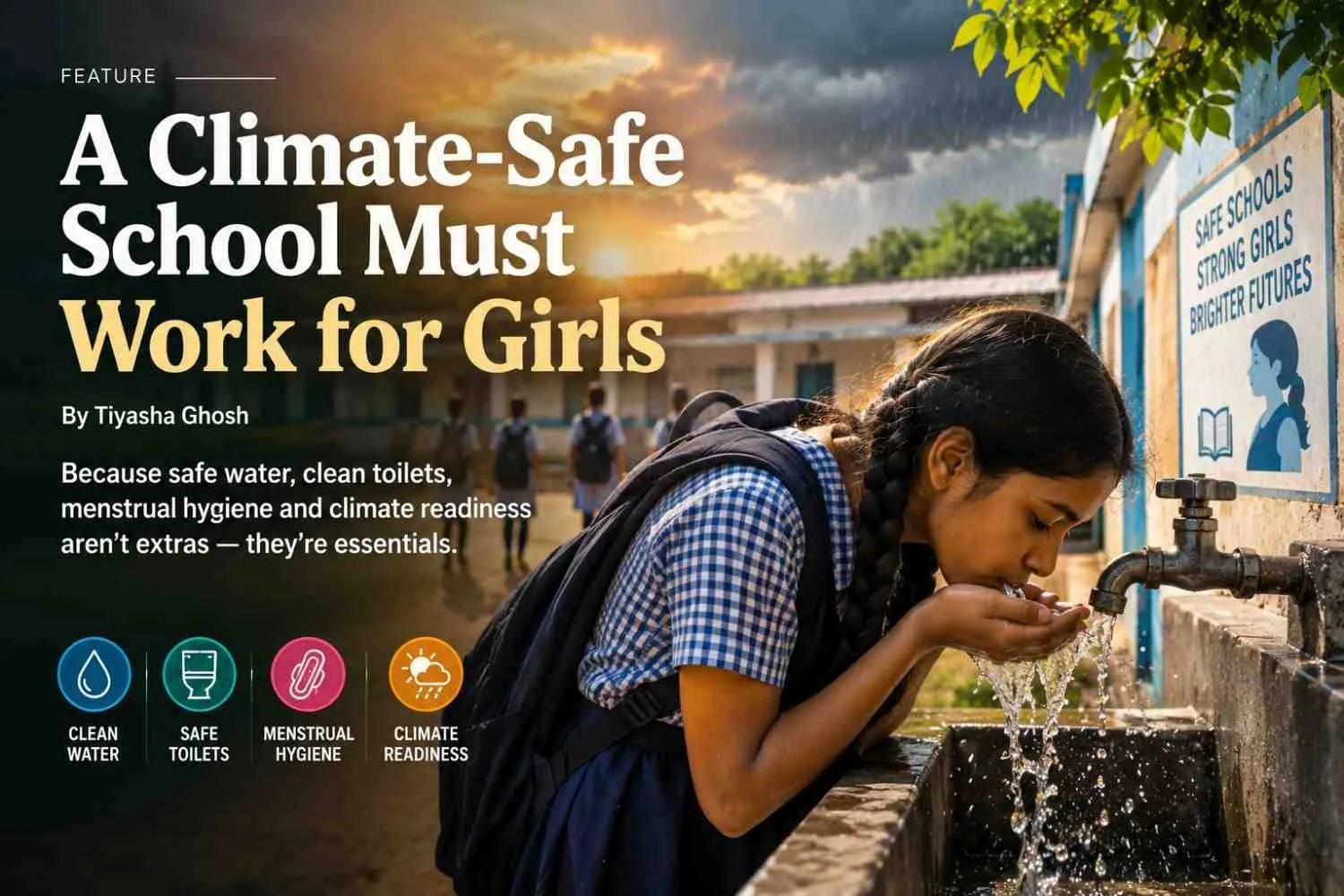
October 11, 2026 | Kolkata India has made significant investments in school infrastructure, but the presence of facilities alone cannot guarantee girls’ safety, dignity or uninterrupted education. Safe drinking water, functional toilets, menstrual hygiene support and climate preparedness must work together to ensure that schools remain safe and accessible, even during extreme weather. SummaryA school may appear well-equipped, yet leave students vulnerable when heatwaves, floods or water scarcity disrupt essential services. This feature examines whether school facilities are not only available but also safe, functional, accessible and properly maintained. By looking at drinking water, sanitation, menstrual hygiene and learning continuity during weather extremes, it explores how infrastructure gaps can affect girls’ dignity, attendance and ability to learn—and what schools must do to close them. What does a climate-safe school look like when a girl needs it most? Imagine a school day during a prolonged heatwave: classrooms become unbearably hot, drinking water runs low, yet lessons are expected to continue as usual. Now imagine a girl arriving at school during her period, only to find a toilet without running water, privacy or safe facilities for menstrual waste disposal. During heavy rainfall, route to home gets disrupted and the risks extend beyond the school gates. Together, these challenges raise a crucial question: Can a school truly protect its students if its infrastructure fails when they need it most? These are not hypothetical scenarios: they demonstrate the connection between school infrastructure and the health, dignity, safety and learning of girls. The International Day of the Girl Child, observed annually on 11 October, aims to promote girls’ rights and highlight the challenges they face. The United Nations’ 2026 theme, “End Child Marriage,” calls for greater action to protect girls’ rights and futures. It also reinforces a wider message: girls’ education must be a priority, and learning cannot thrive when girls lack access to safe toilets, clean water and other essential facilities. Climate education is gradually becoming part of the discussion about what children should learn, from weather patterns and water conservation to waste management, food production and environmental protection. But is this knowledge being reflected in school infrastructure? Does a lesson on water conservation carry greater meaning when students can see how their school uses or wastes - water? And would a lesson on heatwaves feel more relevant if the classroom itself struggles to cope with rising temperatures? The next logical step is to assess not only what is being taught about climate change, but also whether the school environment and infrastructure are prepared to deal with the consequences or not! The Numbers Show Progress, but Do They Tell the Whole Story? India has made considerable investments in school infrastructure, with encouraging results. According to NITI Aayog’s School Education System in India: A Temporal Analysis and Policy Roadmap for Quality Improvement (2026), based on UDISE+ 2024–25 data, 93.8% of schools nationally had functional girls’ toilets. West Bengal reported 99.6%, while several other states also recorded near-universal coverage. The UDISE+ 2024–25 data also show that 99% of schools reported having functional drinking-water facilities. These figures indicate significant progress in improving access to essential school infrastructure. However, they do not necessarily establish whether water is available whenever students need it, whether it is safe to drink or whether the facilities are accessible to every child. This distinction is important. The figures do not need to be dismissed to recognise their limitations. A toilet may be present but have a faulty tap, inadequate privacy, poor maintenance or no running water. Similarly, a school may have a drinking-water facility that has not been tested recently or lacks clear procedures for dealing with contamination. Accessibility presents another concern. Standard facilities may be inadequate or impossible for children with disabilities to use. According to NITI Aayog’s analysis, only 33.4% of schools had functional toilets for children with special needs in 2024–25. This highlights a significant gap between the presence of infrastructure and its usability by all students. The statistics point to progress, but they cannot tell the entire story. A facility recorded as functional on paper must also work in practice. A field audit can help establish whether the conditions students encounter on the ground match the published figures. Why Water, Toilets and Menstrual Hygiene Must Be Examined Together? Water and sanitation are often discussed under separate administrative headings. For girls, however, these facilities are closely connected. A toilet without water cannot serve its purpose effectively. Without privacy and appropriate disposal facilities, it may fail to meet menstrual hygiene needs. Water shortages can also affect handwashing and cleanliness. If flooding or water damage forces a school to close, these challenges become even more pressing. UNICEF India’s guidance on school WASH—water, sanitation and hygiene—identifies clean, age-appropriate toilets, safe drinking water, handwashing facilities, menstrual hygiene management and regular maintenance as essential components of a healthy school environment. These facilities must be clean, functional and properly maintained to serve students effectively. India also has a National Menstrual Hygiene Policy for School-going Girls, approved by the Ministry of Health and Family Welfare in November 2024. The policy sets out objectives relating to menstrual product availability, gender-responsive facilities, safe disposal mechanisms and age-appropriate education. It also emphasises coordination between ministries rather than treating menstrual hygiene as an isolated issue. The policy provides a framework, but its effectiveness depends on implementation. Are menstrual products consistently available? Is there a private space where girls can change? Is water accessible? Can waste be disposed of safely? Is support available when a facility is out of order? Schools must also ensure that teachers are equipped to respond sensitively. A girl should not be embarrassed or penalised because she cannot manage her period due to a lack of water, an inaccessible toilet or inadequate facilities. These conditions cannot be assessed through policy documents alone. Even the presence of a sanitary-product vending machine does not guarantee that it is stocked or that students know how to use it. A proper audit must examine the entire system—from product availability and privacy to disposal, maintenance and staff training. If even one essential element is missing, girls may continue to face the same barriers. When Extreme Weather Turns Infrastructure Gaps into Climate Risks Hot weather can increase students’ need for drinking water, shaded spaces and adjustments to outdoor activities. Heavy rainfall and flooding can disrupt journeys to school, damage classrooms and lead to prolonged closures. UNICEF India’s Education on the Edge article, published in January 2025, discusses the effects of climate change on school attendance and learning, particularly among girls and marginalised communities. It highlights how floods, heatwaves and cyclones can interrupt education and undermine learning continuity. The impact can accumulate over time. Repeated weather-related closures may disrupt learning far more than an isolated missed school day, particularly when students struggle to catch up after classes resume. The scale of potential exposure is significant. According to UNICEF India’s Climate Change and Environmental Sustainability material, 55% of India’s nearly 472 million children are estimated to be at risk from multiple overlapping climate hazards, including heatwaves, drought and air pollution. This is not a direct estimate of how many children are affected by weather-related school closures. Rather, it indicates the scale of climate-related risks facing children and the systems responsible for their education. A climate-safe school therefore needs plans both to reduce the likelihood of disruption and to manage it when extreme weather makes closures unavoidable. Before an event, staff should know how to communicate weather alerts, which activities may need to be cancelled and who is responsible for decisions concerning student safety. During a flood or storm, evacuation procedures and communication with families become priorities. Once the immediate danger has passed, schools must determine how to resume classes, replace damaged materials and support students who have fallen behind. The National School Safety Policy Guidelines provide a starting point for school safety. However, procedures are effective only when staff understand them, students know how to respond and the necessary arrangements are in place. A field audit should therefore examine the school’s extreme-weather procedures, the resources available to implement them and the alternative learning arrangements that can be activated when classes must be suspended. Should Schools Close During Dangerous Weather or Keep Learning Going? This question requires a careful balance between educational continuity and student safety. Closing a school during dangerous weather may be the right decision. Keeping students in classrooms or requiring them to travel through flooded streets or dangerously high temperatures simply to avoid a closure can expose them to unnecessary risks. Learning continuity remains important, but schools cannot be expected to absorb the full impact of climate-related disasters. They cannot cancel classes indefinitely or ignore practical considerations such as examinations, staff availability and the condition of damaged buildings. School leaders must also manage the financial and logistical consequences of prolonged closures. They may need to balance repair work, water and sanitation supplies, staff availability, examination schedules and limited budgets. Some problems, such as inadequate drainage, flooded roads, disrupted water supplies and wider disaster management, fall partly or entirely within the responsibilities of local authorities. Recognising these constraints does not excuse poor maintenance. It acknowledges that climate-safe education requires coordination beyond the school gates. A field audit should examine whether clear closure and reopening procedures exist, whether students and staff can remain safe and whether the school has the resources needed to resume learning as soon as conditions allow. It should also consider the financial and administrative barriers that may prevent a school from implementing its plans. Learning continuity cannot simply mean shifting classes online. Some students may lack devices, reliable electricity or internet access, while online lessons may not meet every learner’s needs. Depending on the circumstances, printed materials, telephone support from teachers, community learning centres and flexible arrangements for submitting work may offer more practical alternatives. UNICEF India’s Education on the Edge article discusses the effects of climate-related school closures and points to low-tech and non-digital approaches, including community learning centres. The emphasis is on finding solutions that remain workable when resources and connectivity are limited. What Should a Proper School Audit Examine? The proposed investigation calls for a comparison of five schools across urban and rural settings, including government and private institutions. Each school should be assessed using the same core questions so that differences and similarities can be examined consistently. The first stage should involve a physical inspection of essential facilities. This includes drinking-water points, toilets, handwashing stations, menstrual hygiene arrangements, shaded areas and classroom ventilation. The inspection should establish whether facilities are working at the time of the visit, whether all students can access them and whether maintenance records support the school’s claims. Drinking-water safety deserves particular attention. Claims that water is safe should be checked against available water-testing records rather than inferred from the mere presence of a tap or storage tank. The second stage should involve reviewing relevant documents. These may include school safety procedures, heat and flood management plans, attendance records, maintenance logs, repair requests, infrastructure budgets and emergency-drill records, where available. These documents should be compared with on-site observations to determine whether the written procedures reflect actual conditions and account for the needs of all students, including children with disabilities. Attendance records must be interpreted carefully. Changes in attendance may be linked to weather, illness, transport difficulties or other factors. They should not automatically be attributed to inadequate toilets or water facilities. The investigation should examine the relevant time period and compare attendance patterns with weather records or school-closure data, where available. Further reporting should explore alternative explanations before drawing conclusions. The third stage should examine whether students can use school facilities without fear, discomfort or embarrassment. An anonymous feedback mechanism may reveal problems that a physical inspection cannot identify, including concerns about menstrual hygiene, accessibility and safety. Children’s privacy must remain central throughout this process. No student should be pressured to discuss personal experiences publicly, and names, photographs or other identifying details should not be published without appropriate safeguards. The investigation should present its findings in context. A single inspection cannot establish that an entire school is unsafe, but it can identify gaps, document specific problems and highlight areas for improvement. The focus should remain on how schools can protect girls’ dignity and support their education, where school-level responsibility lies and which barriers require action from local authorities or other institutions. A School Risk-and-Dignity Checklist for Principals Drinking water: Is safe drinking water available throughout the school day? Are water storage, cleaning and quality-checking procedures documented? Toilets: Are girls’ toilets clean, private and accessible to all students? Are water and basic hygiene facilities available? Menstrual hygiene: Are menstrual products, private changing spaces and safe disposal arrangements available and accessible? Can students seek assistance without stigma? Heat preparedness: Are drinking water, shaded areas, adequate ventilation and weather alerts available? Can outdoor activities be adjusted during extreme heat? Flood and emergency planning: Are evacuation procedures, safe dismissal arrangements, family communication systems and reopening plans in place? Accessibility: Can students with disabilities safely reach and use classrooms, toilets, drinking-water points and emergency exits? Learning continuity: If the school closes, are realistic online or offline learning options available? Do teachers have the resources and arrangements needed to support students? Maintenance and accountability: Are there procedures for inspecting, repairing and replacing facilities? Do staff understand emergency protocols? Are attendance patterns reviewed alongside relevant weather and closure records? The checklist should be reviewed and updated regularly, particularly after extreme weather events, infrastructure failures or changes in student needs. The goal is not simply to confirm that facilities exist, but to establish whether they are safe, accessible, functional and ready when students need them. Sources: United Nations — International Day of the Girl Child: https://www.un.org/en/observances/girl-child-dayOfficial date and 2026 theme.NITI Aayog — School Education System in India: A Temporal Analysis and Policy Roadmap for Quality Enhancement (2026): https://www.niti.gov.in/node/2288UDISE+ 2024–25 figures on functional girls’ toilets and accessible facilities.Ministry of Education — UDISE+ 2024–25 infrastructure tables: https://dsel.education.gov.in/sites/default/files/infocus/ext2425.pdfOfficial figures for drinking water, handwashing and accessibility infrastructure.National Health Mission — National Menstrual Hygiene Policy for School-Going Girls:https://www.nhm.gov.in/images/pdf/guidelines/index1.php?lang=1&level=3&lid=859&sublinkid=1531Policy framework for menstrual products, gender-responsive facilities, education and safe disposal.UNICEF India — Clean India, Clean Schools: https://www.unicef.org/india/what-we-do/clean-india-clean-schoolsSchool water, sanitation, handwashing, menstrual hygiene and maintenance guidance.UNICEF India — Education on the Edge: Battling Climate Change in India’s Classrooms (23 January 2025): https://www.unicef.org/india/blog/education-edge-battling-climate-change-indias-classroomsEvidence and analysis on climate-related school disruption and learning continuity.UNICEF India — Climate Change and Environmental Sustainability: https://www.unicef.org/india/what-we-do/climate-changeNational context on children’s exposure to overlapping climate risks.Government of India — National School Safety Policy Guidelines: https://dsel.education.gov.in/sites/default/files/rte/Guidelines_feb.pdfFramework for school safety, disaster preparedness and education continuity. ...Read more