12 Oct 2026
Oct 12,2026
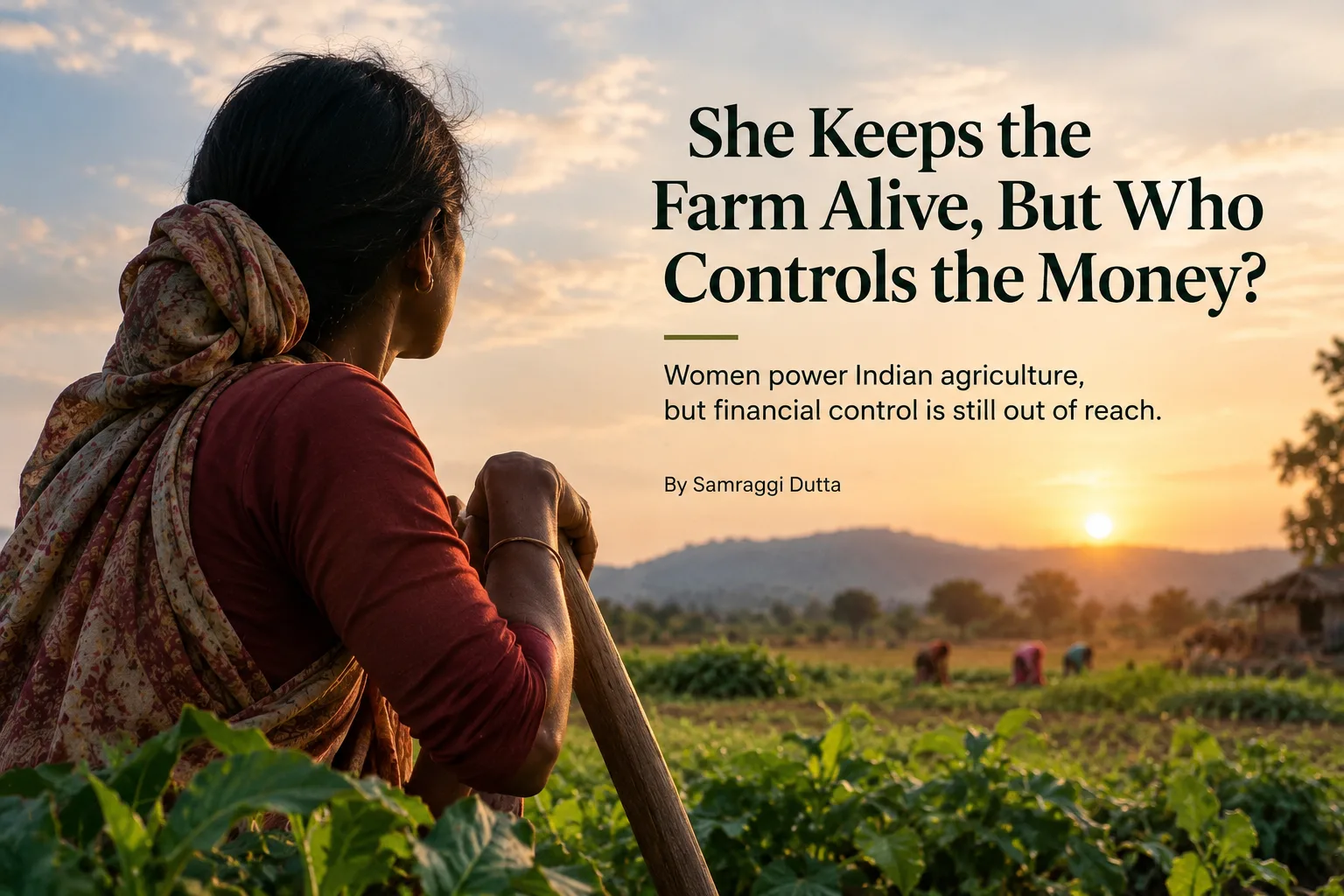
Across rural India, women are protecting farms from droughts, unpredictable rainfall and rising agricultural costs. But the people keeping agriculture alive do not always control the land, credit or income that could make it more resilient. From women-led farming collectives to watershed development, their experiences suggest a critical gap between participation and financial power. If women are expected to secure the future of Indian agriculture, we must ask ourselves whether they have the resources to shape it.
Summary:Rural women are central to India’s climate adaptation efforts, but land ownership, credit, technology, and market access barriers continue to diminish their financial independence. Drawing on Indian examples, this article explores women’s collectives, watershed programmes, and financial protection, and examines why participation cannot guarantee economic empowerment.
Introduction: The missing link in climate-ready farming
When we talk of climate-resilient agriculture, we tend to think of better seeds, water conservation, and changing farming practices. But we should also be asking a fundamental question do the women implementing these changes have control over the resources and income that would make them work?
Across rural India, women sustain agricultural production while facing barriers to land, credit, and decision-making. Without financial agency, climate resilience will only be partial.
Who is keeping India’s farms climate-ready?
Women are involved in every stage of agricultural production – sowing, transplanting, and harvesting, livestock management and post-harvest processing. In many rural households, they also preserve seeds, keep kitchen gardens, manage household food supplies, and collect water. For these women, the extra work associated with agriculture is amplified when droughts, floods and heat disrupt agricultural livelihoods.
As climate patterns become less predictable, women often must adapt their work to changes in agriculture. A delayed monsoon may alter sowing schedules, while prolonged dryness may lengthen the time for obtaining water for household use and livestock. A crop failure can need reconsidering food expenditure, seek added employment and borrow to finance the next season. But we cannot automatically assume that a person doing agricultural work is a ‘farmer’ or has an equal say in agricultural decisions. Women may contribute their labour to family-owned land without their names appearing on land records or work as tenant cultivators or agricultural labourers.
India’s Agriculture Census 2015–16 recorded approximately 20.4 million female operational holders, representing around 13.96% of all operational holders. These numbers are important, but they do not capture every woman contributing to agricultural production. We must distinguish between people officially recorded as operational holders and the many women whose labour sustains farming households.
Recognition matters because official documentation can influence access to certain benefits, institutional credit, and support programmes. Eligibility varies across schemes, but women whose farming contributions are not formally recognised may face extra administrative hurdles. If we want to know who is keeping India’s farms climate-ready, we must look not only at the number of women taking part in agricultural activities, but at who makes decisions, controls productive assets, and receives the financial returns.
Recognising women as farmers is therefore not only a question of representation, but of ensuring that their agricultural knowledge translates into greater security, influence, and economic independence.
What stops women from controlling land, credit, and agricultural income?
The barriers women face is interconnected. Limited land rights can affect access to finance, while restricted access to finance can prevent women from investing in climate-resilient practices. Even when women receive training, their ability to implement what they learn depends on decisions made by other household members. Land is one of the most key factors.
Secure land rights can strengthen a woman’s ability to decide which crops to cultivate, invest in soil improvement and plan for future agricultural seasons. They may also help set up eligibility for government benefits or loans, depending on the applicable rules.
But we should not assume that a land title automatically guarantees independence. A woman may legally own land but have limited control over the crops grown, the sale of produce, or the income generated. Similarly, tenant farmers may make day-to-day agricultural decisions while lacking the documents required to access some formal support mechanisms.
Access to agricultural equipment is equally crucial. Tools for irrigation, processing, and storage can reduce labour and improve productivity, but their benefits depend on affordability, availability, and practical training. A woman may understand how a technology could help her farm, but she may not have the money or the authority to obtain it.
Market access decides whether agricultural production translates into income. Farmers need reliable information about prices, buyers, transport costs, and demand. When women cannot negotiate directly with traders or access suitable storage and processing facilities, they may have fewer opportunities to secure favourable prices.
Finally, we must examine who controls the money earned. A woman may contribute to cultivation, but another household member may manage the sale proceeds or decide how the income is spent. Increased agricultural productivity does not necessarily translate into greater financial independence for women. This is why we cannot measure empowerment by counting training sessions, loans distributed, and women enrolled in a programme. We must ask whether women can access resources independently, make meaningful decisions, and keep a fair share of the benefits generated by their work.
Where are we seeing women-led climate resilience in India?
India has examples of programmes and community institutions linking women’s participation to agricultural development, natural resource management, and livelihood security. These initiatives suggest pathways to increased resilience, but their outcomes depend on implementation, local conditions, and the extent to which women exercise real decision-making power. Watershed development and women’s participation. In rain-dependent agricultural regions, the development of watersheds can help communities manage rainfall through water harvesting, groundwater recharge, soil conservation, and improvements in local water management.
Such measures can support farmers facing irregular rainfall, declining water availability, and soil degradation. The National Bank for Agriculture and Rural Development (NABARD) supports watershed development and climate-adaptation initiatives across India. These programmes can connect environmental improvements with livelihood development, where communities take part in planning and managing shared natural resources.
This creates an opportunity for women to influence decisions about water use, soil conservation, and agricultural priorities. Women often have detailed knowledge of household water requirements, livestock care and the added work caused by water scarcity. Including this knowledge in local planning can make interventions more responsive to community needs.
A NABARD-supported climate-proofing project implemented with the Centre for Integrated Rural Health and Education Project (CIRHEP) in Tamil Nadu documents women’s participation in self-help groups and livelihood activities in watershed villages. The project report discusses access to institutional finance, participation in local decision-making and activities such as floriculture, nursery development, and other income-generating enterprises.
These examples suggest how natural resource management can be linked with women’s economic opportunities. But we must not assume that every watershed programme leads to the same results. We must examine whether women influence decisions about water, whether landless households benefit, and whether new income opportunities are practical after project support ends.
Women farmers and collective livelihood programmes -
The Mahila Kisan Sashaktikaran Pariyojana (MKSP), implemented as a part of the Deendayal Antyodaya Yojana–National Rural Livelihoods Mission, was designed to strengthen women’s participation in agriculture and support sustainable livelihood opportunities.
The programme’s significance lies in recognising women as agricultural producers, rather than treating their contribution as an extension of household labour. By supporting agricultural knowledge and collective organisation, such initiatives can help women improve farming practices and explore more sustainable livelihoods. But the presence of a collective does not automatically guarantee financial independence. A group may provide training but lack working capital, dependable buyers, or suitable storage facilities. We must assess whether members experience measurable improvements in income, asset ownership, and control over agricultural decisions.
Self-help groups and financial inclusion -
Self-help groups offer another route towards greater financial inclusion. Through regular savings, internal lending and links with formal banking institutions, women can develop financial relationships and explore income-generating activities. When connected with agricultural programmes, these groups can help women finance seeds, livestock, small enterprises, or processing activities. They can also provide a platform for sharing information about government schemes and local livelihood opportunities.
The benefits, however, depend on how financial resources are used and controlled. A woman may receive a loan without deciding how it is spent. If an agricultural season fails, she may still handle repayment, when she has little control over the factors affecting the household’s income. We should look beyond the number of groups formed or loans distributed. Effective programmes should help women understand loan terms, name practical enterprises, access markets, and make independent decisions about the money they borrow and earn.
Crop insurance and financial protection in Chhattisgarh
The experience of Lakshmi Rathiya, a farmer in Mauhar village in Chhattisgarh’s Korba district, presents another perspective. In a March 2026 account, the United Nations Development Programme highlighted the role crop insurance can play in protecting women’s farming livelihoods against agricultural risks.
Crop insurance cannot prevent droughts, floods, or crop damage. Nor can it resolve every problem related to land ownership or unequal decision-making. But when coverage and claims processes work well, insurance can help farmers recover from losses, without relying entirely on new debt or selling productive assets.
For women farmers, access to insurance must be practical. They need clear information about eligibility, enrolment, documentation, premiums, and claims. We should also examine whether compensation reaches the person responsible for restoring the farm and whether the support arrives in time to help finance the next agricultural season.
Together, these Indian examples highlight why climate adaptation should connect environmental protection with financial inclusion and livelihood security. Their effectiveness must be measured by what changes for women, not simply by the existence of a programme.
When climate shocks hit, who bears the financial losses?
Climate shocks can transform an already uncertain agricultural season into a budgetary crisis. Delayed rainfall may disrupt sowing, extreme heat can affect agricultural labour and livestock, and intense rainfall can damage standing crops or stored produce. The consequences extend beyond the immediate loss of agricultural output.
For a woman with limited savings, a poor harvest may mean borrowing money to buy food, finding more employment, or reducing expenditure on essential needs. If the household has already borrowed, lower agricultural earnings make repayment harder and leave little money for the next sowing season.
The goal should be to ensure that climate shocks do not repeatedly push women into financial insecurity. Protecting agricultural production is essential but protecting the livelihoods and decision-making power of the people who sustain that production is equally important.
Why must financial independence become part of climate adaptation?
Climate adaptation requires investment, which depends on access to money and the authority to decide how it is used. This makes women’s financial independence an integral part of climate-resilient agriculture.
Consider a woman farmer who learns that mulching, improved soil management, and efficient irrigation could help her farm keep moisture. She may understand the benefits of these practices, but adopting them can require materials, equipment, labour, and upfront expenditure. Without access to savings or affordable credit, she may be unable to implement the changes.
The same challenge arises when women want to diversify into crops suited to the local conditions. Diversification may require new seeds, cultivating techniques, processing facilities and buyers willing to buy the harvest. Without reliable market information, changing crops can present more financial risks, rather than alleviate them.
We must connect agricultural training with financial services, land rights, and market development. Agricultural extension programmes should provide practical knowledge about climate risks, while financial institutions should develop suitable products that account for seasonal income and the uncertainties of farming.
Public programmes must also consider women whose contributions are not reflected in formal land records. Depending on the scheme, documentation requirements may prevent cultivators of family or leased land from accessing particular benefits. Clear eligibility rules and accessible documentation support can reduce these barriers.
At the same time, we should not assume that credit automatically creates empowerment. Loans can support productive investments, but they can also increase vulnerability when crops fail, buyers are unavailable and repayment terms do not reflect agricultural realities. Credit must go with risk protection, practical support, and realistic repayment arrangements.
We need to measure climate adaptation through both environmental and economic outcomes. Improved soil health, reduced water consumption, and lower crop losses matter. So do women’s earnings, ownership of productive assets, access to affordable credit and control over agricultural decisions. If we want to know whether a farming system has become genuinely climate-resilient, we must examine whether the people managing it have the resources and authority to sustain those improvements.
How can India turn women’s participation into real financial power?
Moving from participation to financial agency requires action at several levels: Government agencies, banks, agricultural institutions, local organisations, and farming communities all have a role.
First, we need stronger recognition of women as agricultural decision-makers. Where proper, land documentation and joint ownership can strengthen women’s position, while policies must also account for tenant cultivators and landless workers. Secure access to land should not be the only route through which women can obtain agricultural support.
Second, financial services must reflect the realities of rural livelihoods. Women need access to affordable credit, savings facilities, suitable insurance, and clear information about government benefits. Financial products should account for seasonal earnings and climate-related risks, rather than if every farmer has a stable monthly income.
Third, agricultural training must lead to practical opportunities. If women learn about drought-resilient crops, water conservation, or sustainable soil management, they should also be able to access suitable inputs, tools, technical support, and buyers. Otherwise, training may raise awareness without changing what women can do.
Fourth, market access must be given greater attention. Collective marketing, local processing, storage facilities, and reliable price information can help women explore better opportunities for their produce. Partnerships with farmer producer organisations and cooperatives may be particularly useful when they are inclusive and transparent.
Fifth, women must have a meaningful role in community-level institutions. Water committees, watershed organisations, and agricultural collectives should not merely include women, but enable them to influence planning, allocation of resources and the evaluation of local projects.
Finally, programmes must measure outcomes that reflect real empowerment. We should ask whether women have gained control over income, improved their access to productive assets, reduced their financial vulnerability, or increased their influence over agricultural decisions. These outcomes tell us much more than attendance figures.
Conclusion: Climate resilience cannot rely solely on women’s labour
India’s agricultural future depends not only on how successfully we can adapt to climate change, but also on whether the people who sustain farms have the means or power to do so. Although rural women already contribute to agriculture through their work, natural resource management, household food security and community institutions, their contribution cannot be divorced from their access to resources, technology, markets, and the income generated from their labour.
Examples from watershed development, women’s livelihood programmes, self-help groups, and crop-insurance initiatives prove how adaptation to environmental change can be married with an increase in economic opportunities. They also serve as a reminder that programme participation does not necessarily translate into financial independence for women. We need to consider whether women can access and control resources, make decisions over agriculture and keep a significant share of the benefits. We also need to ensure that landless women and tenant cultivators are not overlooked merely because they do not officially own land.
The future requires collaboration between government bodies, banks, agricultural organisations, and communities to provide women with accessible finance, markets, training, and representation in decision-making. Most importantly, it requires us to measure success in terms of increased financial security and agency for women. The resilience of women should not be viewed as an infinite resource that can offset inadequate support. Their ability to withstand the effects of climate change should not rely on how much stress they can endure.
For women to be able to keep India’s farms in the face of climate change, they must also have the power to decide how those farms are managed and how the money they generate is spent. Climate resilience will be incomplete so long as the people who sustain it are denied a voice in important financial decisions.
India’s agricultural future not only depends on whether our farms will survive a changing climate, but also on whether the women who sustain them will have the freedom and resources to do so.
References and Sources
Press Information Bureau, Government of India. Women Farmers in the Country (2021). Agricultural statistics and information about female operational holders. https://www.pib.gov.in/PressReleasePage.aspx?PRID=1780263&lang=2&reg=48
Press Information Bureau, Government of India. Feminization of Agriculture (2019). Background on women farmers and the Mahila Kisan Sashaktikaran Pariyojana https://www.pib.gov.in/PressReleasePage.aspx?PRID=1577924&reg=48&lang=2
Department of Agriculture and Farmers Welfare, Government of India. Agriculture Census Scheme. Background on agricultural holdings and data collection. https://agcensus.gov.in/AgriCensus/
NABARD. Resources on watershed development, climate adaptation, soil conservation, and sustainable agriculture. https://www.adaptation-fund.org/wp-content/uploads/2024/05/India.pdf
...Read more