Total Articles 231+

Best Practices

Highlights proven strategies, models, and success stories that drive effective sustainability outcomes.

Showing 12/50

13 Oct 2026

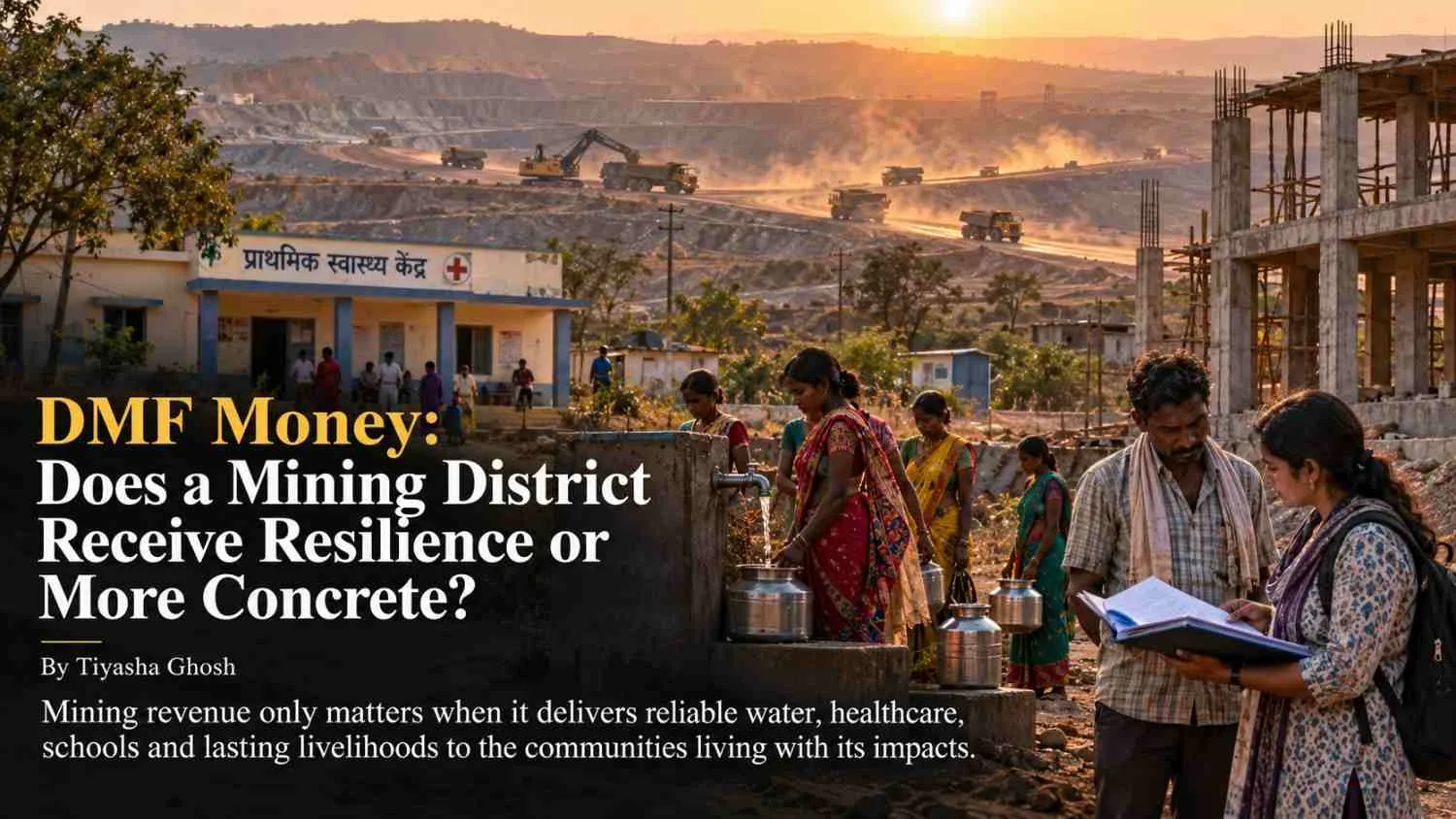
13 October, 2026 | Kolkata Mining generates public revenue, but the real test is whether that money delivers reliable water, better healthcare, stronger schools and lasting livelihoods for the communities living with its impacts. SummaryDistrict Mineral Foundation (DMF) funds are meant to improve the lives of people affected by mining. Yet money sanctioned for a project does not automatically mean that the project is complete, functional or benefiting the intended community. Starting with Keonjhar, Odisha, this investigation traces public records from fund collection and approvals to expenditure, completed work and services on the ground. If a district receives mining revenue, how can residents know whether it is improving their lives? The money is collected. What happens next? Mining brings revenue to the government, but it can also place pressure on local water resources, land, health and livelihoods. For communities living close to mining operations, the benefits of mineral wealth should therefore extend beyond the value extracted from the ground. The District Mineral Foundation was created under the Mines and Minerals (Development and Regulation) Act, 1957, through its 2015 amendment. DMFs are non-profit trusts established in mining-affected districts to work for the benefit of affected people and areas. Their funds come from statutory contributions by mining leaseholders. The Pradhan Mantri Khanij Kshetra Kalyan Yojana (PMKKKY) provides the framework for using this money for development and welfare. The intended priorities include drinking water, healthcare, education, environmental protection, sanitation, support for women and children, skills and livelihoods. Under the revised 2024 guidelines, at least 70% of DMF funds must be directed towards directly affected areas and high-priority sectors. But a policy commitment is only the starting point. To understand whether DMF spending is delivering its intended benefits, the financial trail must be followed beyond the approval stage. A large fund, but what does the spending show? The scale of DMF funding makes public scrutiny important. According to the Ministry of Mines, by November 2024, DMFs across India had collected ₹1,02,083.03 crore. Of this, ₹87,357.28 crore had been sanctioned for 3.60 lakh projects, while ₹54,892 crore had been spent. The ministry also reported that 2.01 lakh projects had been completed. These figures are a dated national snapshot, not a current total for every district. Each number answers a different question. Collections show how much money has entered the system. Sanctions indicate the amount approved for projects. Releases show how much has been transferred to implementing agencies, while expenditure records indicate reported spending. Completion records show whether a project has been declared finished. None of these figures, on its own, proves that a service is working or that the intended beneficiaries are receiving it. For example, a sanctioned water-supply scheme may still be awaiting construction. A completed facility may lack electricity, staff, maintenance or a dependable water source. A livelihood programme may report participants trained without showing whether they secured sustained income. The investigation must therefore distinguish money approved, money released, money spent, work completed and outcomes achieved. Why Keonjhar is the starting point Keonjhar has a public-facing DMF website with project-level information, including project names, locations, sanctioned amounts, released amounts and status. Its records provide a starting point for matching financial documents with individual projects. The portal is a useful discovery tool, but its existence does not settle the accountability question. The reporting task is to test whether the information is sufficiently complete, current and consistent with supporting documents—and whether the projects listed can be verified on the ground. The first step is to select one project in a high-priority area, such as drinking water, healthcare, education or livelihoods. Its approval should be matched with the annual action plan, administrative sanction, tender, work order, release records, expenditure statements and completion certificate. Dates and amounts must be reconciled rather than assumed to match. The next step is physical verification. If the project is a water-supply scheme, for example, the investigation should check whether the infrastructure exists, whether water is available reliably, whether the equipment works and who can access the service. If it is a health or education project, the relevant checks may include operating hours, staffing, facilities and maintenance. This is where the difference between a project being built and a public service being delivered becomes visible. The accountability question is bigger than construction DMF spending can produce visible infrastructure, including roads, buildings and water pipelines. These may be necessary, but the presence of concrete structures does not establish that the spending has addressed the most urgent needs of mining-affected communities. In a 2025 assessment, iFOREST reported that DMFs had collected more than ₹1.03 lakh crore over their first decade and argued that weak planning, implementation and community participation were limiting their potential. Its analysis raised concerns about underutilised funds and investments that may not adequately address the needs of affected people. These are findings and arguments from an independent research organisation; they should be examined alongside district records and the government’s account. There are also questions about who decides which projects receive funding. The revised PMKKKY guidelines provide for Gram Sabhas and local bodies to contribute to planning, while requiring stronger monitoring and accountability measures. The investigation should establish whether affected communities had a meaningful role in identifying priorities, rather than simply being counted as beneficiaries after a project was selected. An official response may point to the number of projects approved, completed or funded. That information matters, but it must be tested against expenditure documents, the condition of the assets and evidence of who benefits. An independent expert may identify gaps in planning or participation, but such claims should also be checked against the relevant records. The purpose is not to assume that every project has failed—or that every official figure is misleading. It is to establish what the evidence supports. From public spending to public benefit The final assessment should follow one project from its financial approval to its actual use. Where records agree and the service functions, that should be reported clearly. Where money has been released but work remains incomplete, the ledger should show the gap. Where a project is marked complete but its functionality cannot be established, that distinction should remain visible. Missing records also matter. If a release order, expenditure statement or completion certificate cannot be found, the investigation should document the gap, ask the responsible authority for clarification and avoid treating an unanswered question as proof of wrongdoing. A district-level spending ledger can make this process repeatable. Each entry should include the project name, location, sector, sanctioned amount, amount released, reported expenditure, completion status, on-site functionality, beneficiary evidence, source documents and date of last verification. The wider lesson is straightforward: mining-affected communities should be able to see not only how much money their district receives, but also what that money delivers. A project list is useful; a verified account of spending, functioning services and community benefit is far more meaningful. The real measure of DMF money is not how much concrete a district can show. It is whether the people meant to benefit can rely on the services the money was supposed to provide. Sources: Ministry of Mines, Government of India — District Mineral Foundation and PMKKKY overview, including the revised 2024 guidelinesPress Information Bureau, Ministry of Mines — National DMF collection, sanction, expenditure and project figures up to November 2024DMF Keonjhar, Odisha — District Mineral Foundation portalDMF Keonjhar, Odisha — Phase-wise project details, including sanctions, releases and statusiFOREST — Assessment and discussion on the first decade of District Mineral FoundationsiFOREST — “A missed opportunity for social justice in mining regions” ...Read more

13 Oct 2026

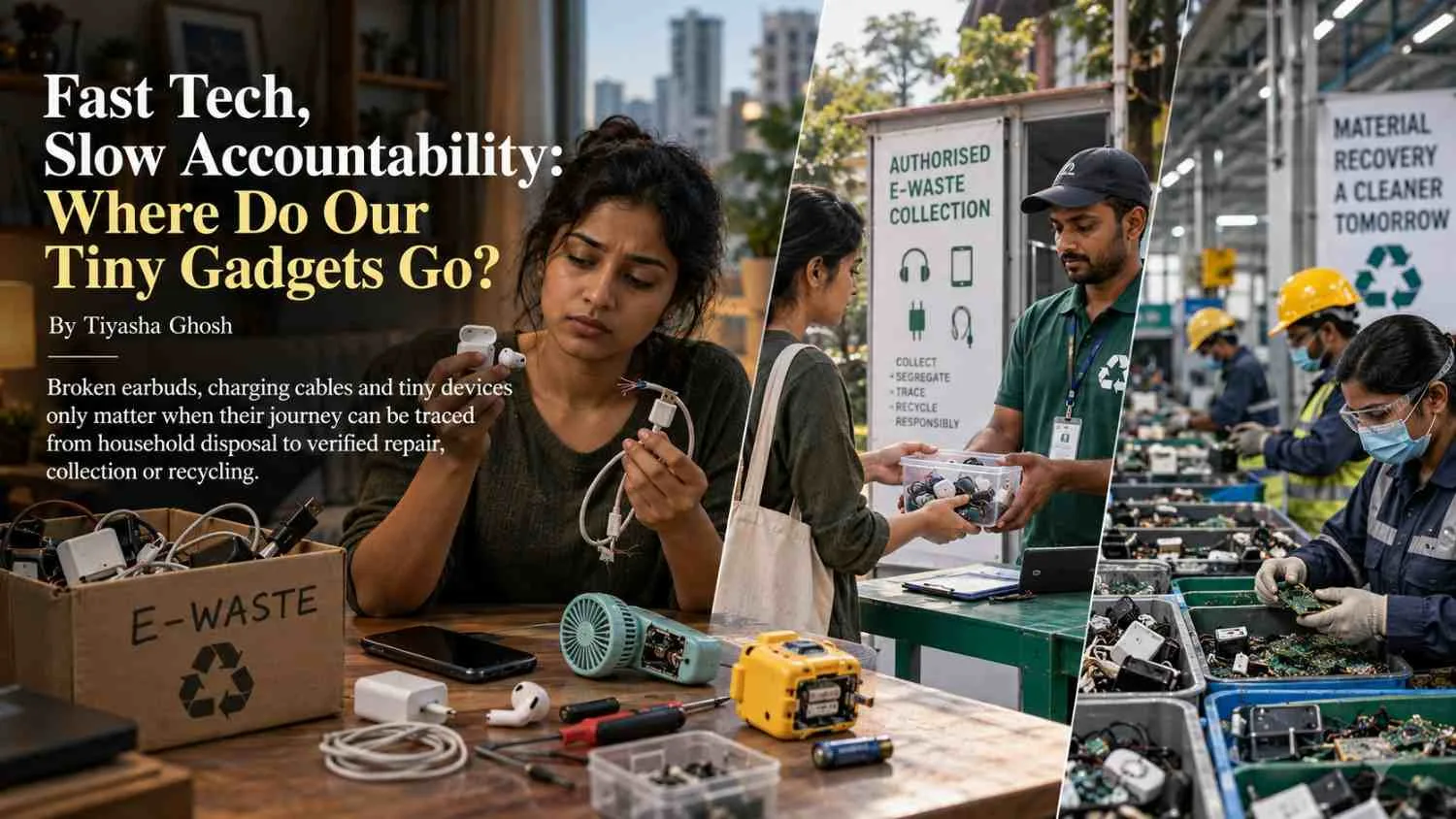
13 October 2026 | Kolkata Earbuds, charging cables and electronic toys are easy to replace. But when they stop working, their journey towards repair, collection or recycling is far less visible. Summary: Small electronic devices are an overlooked part of the e-waste problem. India has a formal e-waste management framework, but responsible disposal depends on accessible collection, accountable recycling and products that can be repaired. The real test is whether a discarded gadget can be traced from a household to its verified destination. If a Broken Earbud or Charging Cable Leaves Your Home, Can You Trace Where It Goes Next? A pair of earbuds stops working. A charging cable becomes unreliable. A small electronic toy breaks, or a mini fan is replaced by a newer model. These items are often too small to attract much attention, and their relatively low prices can make replacement seem easier than repair. Yet their size does not make them insignificant. Devices containing plugs, cables, circuit boards or batteries can become electronic waste when discarded. Some contain valuable materials that can be recovered, while others contain components that require careful handling. The problem is not simply how much electronic waste is generated. It is whether discarded devices enter a traceable system that can demonstrate what happens to them after they leave a household. The Global Numbers Reveal a Blind Spot The Global E-waste Monitor 2024, produced through the International Telecommunication Union and the United Nations Institute for Training and Research, estimated that the world generated 62 million tonnes of e-waste in 2022. Only 22.3% was documented as formally collected and recycled in an environmentally sound manner. Small equipment, including electronic toys and other household devices, accounted for 20.4 million tonnes, of which only 12% was documented as formally collected and recycled. India generated an estimated 4.137 million tonnes of e-waste in 2022, according to the Global E-waste Statistics Partnership. This is a historical estimate, not a measure of India’s current annual output or of the amount generated by small gadgets alone. These figures establish the scale of the problem, but they do not tell us how many earbuds or cables are collected in Kolkata, how much is processed locally or how much reaches its final destination. National estimates cannot substitute for evidence from a local collection chain. What Do India’s E-Waste Rules Require? India’s E-Waste (Management) Rules, 2022, which came into force on 1 April 2023, establish responsibilities for manufacturers, producers, refurbishers, dismantlers and recyclers handling electrical and electronic equipment covered by the rules. The framework includes extended producer responsibility (EPR), under which producers have specified obligations linked to e-waste management. The rules cover equipment listed in Schedule I and related components, parts and spares. Waste batteries are governed separately under the Battery Waste Management Rules, 2022. The Central Pollution Control Board operates an e-waste portal as part of the regulatory framework. Registration and compliance records provide an important starting point for checking whether an operator is authorised and what responsibilities apply to it. However, a regulatory framework does not prove that every household can conveniently return a small device. Nor does an authorised recycler’s stated annual capacity establish how much e-waste it actually receives or processes. Capacity, collection, processing and verified recovery are different measures. The key question is whether records connect these stages - and whether the information is accessible enough for consumers to make informed choices. Repair, Recycling and the Informal Sector Repair can extend a device’s useful life and delay the need for replacement. However, access to spare parts, repair information, compatible components and affordable services can influence whether a product is repaired or discarded. India’s Right to Repair portal, maintained by the Department of Consumer Affairs, provides information on warranty terms, spare parts, service details and repair options across several product categories. It is a useful consumer resource, but its existence does not guarantee that every component will be available or that every independent repair will be possible. There are competing concerns. Manufacturers and authorised service providers may emphasise product safety, quality control and the need for trained handling. Independent repairers and consumer advocates focus on affordability, access to parts and the ability to repair products without unnecessary restrictions. These concerns should be examined through actual repair costs, product policies and spare-part availability rather than assumptions about every company or repair shop. The collection stage raises another question. Informal collectors and dismantlers can help recover discarded materials and provide convenient collection services. However, where handling practices are unsafe or downstream destinations are unclear, both workers and the environment may face risks. The solution is not to overlook informal workers, but to improve safe working practices, traceability and access to accountable systems. From a Broken Gadget to Its Final Destination Tracing a discarded device means looking beyond the first collection point. A gadget may be repaired, reused, stored, handed to a collector or transferred to a recycling facility. Each route requires different evidence, and collection alone does not establish that materials have been recovered. The Afterlife of a Small Gadget What happens after your electronics stop working? StageWhat to checkRepairCan the gadget be repaired and used again?CollectionWas it handed over to an appropriate e-waste collection channel?ProcessingWhich recycler or other facility received it?Final destinationIs there evidence that it was properly processed, recycled or reused? The Accountability Gap A collection claim is not the same as proof of recycling. To trace a gadget’s journey, look for the receiver’s identity, a handover receipt, transfer records and evidence of its final destination. This is a reporting checklist, not a verified account of Kolkata’s current e-waste routes. A credible local audit should record the type and weight of items collected, the date and location of handover, the receiving operator’s identity, available receipts or transfer records, and any evidence of subsequent processing. This information would help distinguish between a collection drive that gathers devices, a facility capable of processing them and a system that can demonstrate actual recovery. A directory of collection points is useful only when locations, accepted items and operator details have been verified. What Can Consumers Do Now? The immediate steps are practical. Consider repair where feasible, keep discarded electronics out of ordinary household waste, and check with an appropriate authorised collection or recycling channel before handing them over. Devices containing lithium-ion batteries, including some wireless earbuds and small gadgets, should not be thrown into general waste. Damaged batteries can create fire risks during collection, transport and processing. Consumers can also check warranty conditions, ask whether spare parts are available and compare repair costs with replacement costs. These choices will not solve the e-waste problem alone, but they can help extend product life and reduce unnecessary disposal. The larger responsibility remains shared among producers, regulators, collection systems, repair businesses and recyclers. Each has a role in making repairs accessible, collection convenient and the final destination of discarded devices more transparent. The challenge is to make responsible disposal as convenient as buying a replacement. Small gadgets may be easy to overlook, but accountability should not disappear with them. A device’s journey should not end at the collection box; it should end with evidence of where it went and how it was handled. Sources: 1. WEEE Forum — International E-Waste Day 2026: “Fast Tech” Read the campaign brief 2. International Telecommunication Union — Global E-waste Monitor 2024 Read the report and key findings 3. Global E-waste Statistics Partnership — India, 2022 data View country statistics 4. Ministry of Environment, Forest and Climate Change — E-Waste (Management) Rules, 2022 Read the official rules (PDF) 5. Central Pollution Control Board — E-Waste Management System Visit the official portal 6. Department of Consumer Affairs — Right to Repair India Portal FAQs · About the initiative 7. Repair Café — International Repair Day, 17 October 2026 Read the announcement ...Read more

09 Oct 2026

9 October, 2026 | Kolkata Cotton is natural, familiar and widely used - but that does not automatically make every cotton shirt environmentally responsible. World Cotton Day highlights the need to look beyond sustainability labels and examine the water use, chemical management, farmer earnings, fabric quality and supply-chain transparency behind cotton clothing, especially when making festive purchases. SummaryIndia’s cotton industry supports farmers, textile workers and export businesses. But a shirt’s sustainability depends on more than its fibre label. Water availability, pesticide use, textile processing, durability, organic certification and the income farmers retain all matter. Following World Cotton Day on 7 October, the question is whether brands can prove their sustainability claims from the farm to the finished garment. If cotton is natural, what makes a cotton shirt sustainable? World Cotton Day, observed every year on 7 October, recognises cotton’s role in livelihoods, trade and the global textile industry. The 2026 observance highlighted the theme “Cotton for Good: Building Prosperity Through Trade, Transformation and Partnership”, placing economic opportunity and sustainability within the same conversation.  But the conversation should not end with celebrating cotton as a natural fibre. It should also ask how it is grown, how much water and how many chemicals are involved, whether farmers earn enough, and what happens when the fibre reaches textile factories. These questions matter when consumers begin buying clothes for Durga Puja, Deepawali and other festive occasions. A label may describe a shirt as cotton, organic or sustainably sourced, but each term tells us something different. None of them automatically proves that the entire garment has a low environmental footprint. The Food and Agriculture Organization (FAO) identifies cotton as an important source of income and employment for millions of smallholders and people across the textile value chain. Cotton also competes with fibres such as polyester, while manufacturers face pressure to control costs and meet buyers’ quality requirements. Sustainability therefore involves environmental protection, economic viability and the livelihoods of people who grow and process the crop.  The Hidden Water Cost of Your Cotton ShirtCotton is often criticised for its high water requirements, but its impact varies depending on where and how it is grown. Rain-fed cotton, irrigated cotton and cotton cultivated under different soil and weather conditions cannot be treated as though they have the same water footprint. A 2025 study of cotton production in central India examined water use, runoff and soil loss under rain-fed and drip-irrigated conditions between 2019 and 2022. The researchers reported that 51% of the average annual rainfall during the study period was lost through runoff. They estimated crop water use at 541 millimetres under rain-fed conditions and 624 millimetres under drip irrigation. The study also found that drip irrigation improved lint yield and reduced the calculated water footprint compared with the rain-fed system examined. These findings highlight why local conditions and the methods used to measure water consumption matter. However, they should not be treated as representative measurements for every cotton farm in Vidarbha. For this investigation, the reporting must trace the cotton back to where it was grown and establish whether the farm relied on rainfall, groundwater, canal water or another source. Farm records, irrigation details, local rainfall data and water-stress assessments can help provide this context. If a brand claims that its cotton uses less water, it should clearly explain the method, assessment boundary and comparison behind that claim. The investigation must also follow the material beyond the farm. Ginning separates cotton fibres from seeds, spinning turns the fibres into yarn, and weaving or knitting converts the yarn into fabric. Dyeing, washing and finishing can require additional water and chemicals. Therefore, lower water use during cultivation does not automatically mean that the finished shirt has a lower overall environmental footprint. Organic cotton: does certification tell the whole story? Organic certification can provide useful evidence about how cotton was grown under a defined standard. It helps buyers distinguish certified material from cotton for which an equivalent claim has not been demonstrated. India has a voluntary Standard for Chain of Custody for Indian Organic Fibres and Products, introduced under the National Programme for Organic Production. The system sets requirements for certified fibre, processing, handling and documentation, including transaction certificates for consignments moving through different processing units. It is designed to help maintain the integrity of organic material as it moves through the supply chain.  However, certification should not be treated as proof of every environmental benefit a brand might claim. A certificate does not automatically establish the water footprint of a finished shirt, the full chemical profile of its processing, its durability or the income received by the farmer. A 2025 systematic review of 20 cotton life-cycle assessment studies highlights why the distinction matters. The review found that organic cotton farming could have lower environmental impacts per unit of cultivated area, but higher impacts per unit of cotton mass in some comparisons, partly because organic systems may produce lower yields. The result depends on the measurement unit, farming conditions and impact being assessed. The review also identifies processing and consumer care, including washing and drying, as important parts of the wider lifecycle.  This does not mean organic cotton is inherently worse or that certification is unhelpful. It means that a single label cannot answer every question. Certification specialists may argue that standards and audits provide a practical foundation for accountability. Brands may point to certification as a way to manage complex supply chains. But maintaining records and separate material flows can involve costs, particularly for smaller suppliers. The reporting should examine what certification proves, what it leaves unmeasured and whether its requirements are practical for farmers and businesses. The key question is whether the claim on the garment is supported by the relevant records - and whether the brand explains the limits of that claim. Pesticides and farmer income: who bears the cost of cotton? Cotton farmers must manage pests, weeds, unpredictable weather and production costs. Their decisions are shaped by available advice, labour, seeds, inputs and reliable buyers. Reporting on pesticide use must recognise these pressures rather than treating farmers as the sole cause of environmental harm. Pesticide use can create risks for farm workers, nearby communities, soil and water when products are applied or handled improperly. Yet pesticide runoff at a particular location must be established through appropriate sampling and testing, not inferred from the mere presence of cotton cultivation. Research offers evidence that alternative approaches can be worth examining. A field study conducted during the 2022–2024 rainy seasons in Khandwa district, Madhya Pradesh, evaluated integrated pest management in Bt cotton. It reported a 46.55% reduction in pesticide sprays, a 25.38% increase in seed-cotton yield and net returns more than 56% higher than under the farmers’ usual practices. The findings support further investigation of integrated pest management, but they do not establish that the same outcomes have already been achieved across Vidarbha.  For farmers, however, the question is not simply whether a method is environmentally preferable. It must also be practical and financially viable. An alternative may require new equipment, training, additional labour or different timing. Farmers need to know whether the expected benefits outweigh those costs and whether buyers will reward the effort. This is why farmer net returns deserve particular attention. A higher selling price does not necessarily mean a higher profit. Seed, fertiliser, pesticide, irrigation, labour, transport, interest and other costs affect what remains after harvest. The investigation should compare production costs with sale receipts and, where possible, payments under procurement arrangements. It should ask whether certified cotton earns a premium, whether that premium reaches the farmer after intermediary costs, and whether growers face additional expenses to meet sourcing requirements. A brand may describe its sourcing as responsible, but the claim means little economically if the farmer cannot demonstrate a fair or reliable return. Equally, a sourcing programme should not be dismissed simply because it has documentation costs. The relevant question is whether the arrangement provides verifiable environmental and livelihood benefits, and who bears the cost of achieving them. From Vidarbha to the export house Cotton may pass through several businesses before it becomes a shirt. It can be sold to a ginner, processed into fibre, spun into yarn, woven or knitted into fabric, dyed and finished, cut and stitched into a garment, and then supplied to a retailer or export house. At each stage, material may be combined, processed or transferred to another operator. This makes chain-of-custody evidence central to claims that a garment contains cotton from a particular farm, region or certified source. India’s Kasturi Cotton Bharat programme is one example of an effort to strengthen traceability and certification. A Ministry of Textiles backgrounder reported that, as of 30 June 2026, 3,29,550 bales had been certified under the programme and 116 units had renewed registration. The initiative describes QR-based certification and blockchain technology as part of its traceability approach. These figures show activity within the programme; they do not prove that any particular retail shirt contains cotton from a named farm. Product-level claims require product-level evidence.  For this story, the evidence trail should connect the farm or producer group to the ginner, spinner, fabric maker, processor, garment manufacturer and exporter. Purchase orders, invoices, batch identifiers, processing records, certification documents and transaction records can help establish whether the material remained traceable through these stages. It is also important to distinguish physical traceability from systems that reconcile certified inputs and outputs through records. A company must explain which system it uses and what that system proves. A certificate may establish compliance with a particular standard, but it should not be presented as proof of every environmental or social benefit. Different stakeholders may judge the same sourcing system differently. Exporters may prioritise consistent quality, timely delivery and competitive pricing. Weavers may focus on yarn quality, fabric performance and reliable supply. Farmers may be concerned with crop risks, production costs and the price received. Certification specialists may emphasise standards, documentation and auditability. These priorities can overlap, but they can also conflict. Stronger traceability may improve accountability while increasing administrative costs. A sustainability premium may help farmers, but only if it is passed through transparently. A certified material may satisfy a buyer’s sourcing requirements without establishing that every stage of processing has a lower environmental impact. The reporting should test these competing perspectives against documents and evidence rather than assuming that either a certificate or a criticism settles the question. Blends, Durability and the Clothes We Keep The fibre content of a shirt is another important part of its sustainability profile. A garment marketed as cotton may contain a blend of different fibres, making its exact composition important. Blended fabrics can offer practical benefits, including stretch, better shape retention and reduced creasing. However, their environmental impact depends on the materials used, how the garment is constructed, how long it lasts, how it must be cared for and what options are available when it reaches the end of its useful life. Cotton is not automatically the best choice for every purpose, just as a synthetic blend is not automatically the worst. A meaningful comparison must consider what the garment is designed to do, how long it is likely to last, how frequently it will be worn and what happens when it is no longer usable. Durability deserves greater attention during festive shopping. A shirt that is worn repeatedly and repaired when needed may offer better value than one that loses its shape, tears or is discarded after only a few uses. However, durability claims should also be examined rather than accepted at face value. Fabric specifications, seam strength, shrinkage, colourfastness, care instructions and repair options can all help indicate how well a garment is likely to last. The same scrutiny should apply to claims about recycled content or easy recyclability. A fabric’s composition can determine how easily its fibres can be separated and recovered. Consumers should not assume that a blended garment can be recycled simply because one of its materials is recyclable on its own. The wider life cycle matters too. A garment’s environmental footprint extends beyond cotton cultivation. Processing, manufacturing, transport, washing, drying, repair and disposal all contribute to its overall impact. A 2025 systematic review of cotton life-cycle assessments highlights the importance of examining these stages together rather than judging sustainability by the raw material alone. What Should Shoppers Ask Before Buying Festive Clothes? Consumers cannot inspect an entire supply chain while shopping, but they can ask more informed questions: What is the exact fibre composition? Check whether the garment is made from pure cotton or a blend of different fibres.Is the organic or sustainability claim certified? Look for a valid certificate and understand what it actually covers.Can the brand explain its sourcing? Ask whether the cotton can be traced from the farm to the finished garment.What is known about water and chemical management? Look for specific evidence rather than broad environmental promises.Is the garment built to last? Consider the fabric quality, stitching, care instructions and availability of repair options.Does the company explain the returns to farmers? Responsible-sourcing claims should not overlook the economic realities faced by growers.What happens when the garment is no longer usable? Check whether repair, reuse or recycling options are realistically available. Brands should explain the scope of their sustainability claims in clear, accessible language. Where supporting evidence is unavailable, that limitation should be acknowledged rather than concealed behind terms such as “green”, “natural” or “conscious”. For businesses, stronger traceability can be more than a compliance exercise. Reliable records can help identify supply-chain risks, respond to buyer requirements and distinguish documented performance from marketing claims. However, the cost of certification and documentation also matters. A credible sourcing model should consider whether smaller farmers and suppliers can participate without facing a disproportionate financial or administrative burden. Following World Cotton Day, the central lesson is clear: cotton may be natural, but its sustainability must be demonstrated. It depends on how the crop is grown, how farmers and workers are treated, how the material is processed, how long the garment lasts and whether its environmental claims can be verified. The next time a shirt carries a sustainability label, the most useful question is not simply what the label says. It is what evidence stands behind it.Sources FAO — Cotton: Markets and Trade. Background on cotton’s role in livelihoods, employment, trade and competition with other fibres. https://www.fao.org/markets-and-trade/commodities-overview/fibres/enFAO — World Cotton Day, 7 October. Background on the annual observance and the 2026 theme, Cotton for Good: Building Prosperity Through Trade, Transformation and Partnership. https://www.fao.org/world-cotton-day/world-cotton-day-7-october/3/enAPEDA / National Programme for Organic Production — Chain of Custody for Indian Organic Fibres and Products. Requirements for certified organic fibre and supply-chain documentation. https://npop.apeda.gov.in/sites/default/files/announcements/Notifications_organic_textiles_1402202011032020.pdfVitale et al., Journal of Agriculture and Food Research (2025) — “Environmental sustainability of cotton: a systematic literature review of life cycle assessments.” Review of environmental impacts across cotton cultivation, processing and use. https://doi.org/10.1016/j.jafr.2025.102069Bhargavi, Blaise and Nalayini, Cleaner Water (2025) — “Water footprint, runoff and soil loss assessment of cotton production in central India.” Study of rain-fed and drip-irrigated cotton under the conditions examined. https://www.sciencedirect.com/science/article/pii/S2950263225000572Kumar et al., The Indian Journal of Agricultural Sciences — “Field validation of integrated pest management strategy in Bt cotton under farmers’ participatory mode in central India.” Study of integrated pest management in Khandwa, Madhya Pradesh, during the 2022–2024 rainy seasons. https://epubs.icar.org.in/index.php/IJAgS/article/view/168748Press Information Bureau, Ministry of Textiles (2026) — Kasturi Cotton Bharat programme background. Programme information and certification figures reported as of 30 June 2026. https://www.pib.gov.in/PressReleasePage.aspx?PRID=2286497 ...Read more

07 Oct 2026

AI is accelerating the world's appetite for computing. But behind every new server, GPU, laptop and smartphone lies a material chain of metals, energy, labour and waste that rarely appears in the AI conversation. The Big QuestionCan the AI Economy Become More Productive Without Making the Electronics Economy More Disposable? Artificial intelligence is usually discussed as a story of algorithms, models and computing power. But every AI system ultimately depends on physical infrastructure: processors, GPUs, memory, storage, networking equipment, servers and the devices through which users access these services. As AI workloads expand and hardware generations change faster, the sustainability question is moving beyond how much electricity these systems consume. It is increasingly becoming a question of what happens to the machines that are replaced. That matters because the electronics waste problem already exists at an enormous scale. India generated an estimated 1.40 million tonnes of e-waste in 2024–25, up from about 1.25 million tonnes the previous year, according to CPCB estimates cited by the Government of India. The reported share collected, dismantled and recycled or disposed of also increased from 61.94% to 70.71%. These figures, however, are based on sales data from registered producers and the estimated average life of covered equipment. They do not represent a complete account of every device entering India’s formal and informal waste streams. Globally, the scale is even larger. The UN’s Global E-waste Monitor 2024 estimated that the world generated 62 million tonnes of e-waste in 2022, while only 22.3% was documented as formally collected and recycled. If current trends continue, global e-waste could reach 82 million tonnes by 2030. AI is entering this already expanding system. Follow One Machine, Not an Abstract Tonne The easiest way to understand the problem is not to begin with millions of tonnes. It is to follow one machine through its entire lifecycle. Consider a laptop purchased by a school or a small business. It is procured, assigned to a user, maintained and eventually upgraded. Over time, its battery begins to deteriorate. Its processor may no longer be capable of handling newer software. Its memory may be expandable - or it may not be. Eventually, a newer device enters the procurement cycle and the old machine is declared obsolete. At that point, however, its environmental story has only just begun. Is it repaired? Is it transferred to another employee or student? Is it sold to a refurbisher? Is its data securely erased before resale? Does the organisation maintain a record of where the device goes? If it cannot be reused, does it reach a registered recycler? And even if it does, can the material be traced beyond that first handover? The same sequence exists inside a data centre, although the equipment and scale are radically different. A server or accelerator system can become economically unattractive long before every component has physically failed.    THE LIFE OF ONE MACHINEProcurement → Use → Upgrade → Repair → Secure data wipe → Resale/refurbishment → Dismantling → Recycling → Final material destination. This is where AI changes the conversation. The rapid evolution of computing architectures can create pressure for faster hardware turnover. Research published in Nature Computational Science estimated that generative AI-related e-waste could accumulate to 1.2–5.0 million tonnes between 2020 and 2030 under different development scenarios. The study identifies rapid server turnover and operational cost considerations as factors that could intensify the waste stream, while also finding that circular-economy interventions could significantly reduce it. That figure is a modelled scenario, not a measurement of future waste. It should therefore not be reduced to the simplistic claim that AI will produce five million tonnes of e-waste. The more useful question is what happens to the hardware chain when demand for computing accelerates. The Replacement Problem Replacing older technology is not automatically environmentally irresponsible. Newer hardware can deliver substantially greater computing capacity and, in some cases, improved energy efficiency. Keeping inefficient equipment in operation indefinitely is not necessarily the greener choice. The real question is whether the environmental benefits of new equipment justify the material and waste consequences of replacing hardware more frequently. Answering that requires looking beyond a single metric and considering the full life cycle of the equipment. A new server may consume less electricity per unit of computation. But manufacturing it still requires raw materials, components, energy and complex global supply chains. And when the old server leaves the data centre, it does not simply disappear. It may be refurbished, resold, dismantled, recycled or exported. The environmental cost of manufacturing that equipment does not vanish simply because its accounting value has fallen to zero. This is why hardware life needs to become part of the AI sustainability conversation. The Material Hidden Inside the Machine The word “cloud” makes computing sound almost weightless. The hardware that powers it is anything but. Electronic equipment contains metals, plastics, circuit boards, batteries and other components. Some contain valuable materials that can be recovered, while others may contain substances that pose environmental and health risks when handled improperly. India’s e-waste framework therefore treats collection, refurbishment, dismantling and recycling as regulated activities rather than leaving discarded equipment to an undefined waste market. This creates an important contradiction. An obsolete device can simultaneously be waste, a security risk, a source of recoverable materials and a functioning product with potential second-life value. What it ultimately becomes depends on the system around it. A laptop that is repaired and used for another three years follows a fundamentally different environmental pathway from one that is dismantled immediately for material recovery. Recycling is essential, but preserving the value of a functioning product represents a different form of circularity from breaking that product down into materials. That makes repair and reuse the first tests of a genuinely circular AI hardware economy. The School and SME Test The difference becomes particularly visible outside large technology companies. A major corporation or data-centre operator can negotiate procurement contracts, maintenance arrangements, take-back programmes and asset-disposition services at scale. A small business or school often cannot. For a school operating under tight budgets, replacing an ageing laptop may appear easier than paying for diagnostics, spare parts and repairs. For a small business, the cost of repair can approach the machine’s remaining economic value. If replacement is cheaper and faster, an old device can begin its journey towards the waste stream even when it still contains useful components or could serve another user. This is where the sustainability conversation has to move beyond blaming consumers. The more relevant question is what the system makes economically rational. If repairs are expensive, spare parts are difficult to access, software support ends early and replacement devices are readily available, disposal can become the predictable outcome of an otherwise ordinary purchasing decision. Data Security Can Complicate Circularity There is another reason perfectly usable electronics may never reach a second life: data. Corporate laptops and servers can contain confidential information, customer records, intellectual property and other sensitive material. An organisation therefore cannot simply hand a discarded machine to a reseller and assume that reuse automatically follows. Secure data erasure becomes a critical link between disposal and circularity. The challenge is whether an organisation can demonstrate that sensitive information has been securely removed while keeping the physical machine reusable. If destruction is chosen simply because it offers an easier way to guarantee that data cannot be recovered, security procedures can unintentionally work against the circular economy. An effective asset-disposition process should therefore be able to answer two questions at the same time: Was the data securely erased? And was the hardware given the longest feasible useful life? From Refurbisher to Recycler When a machine remains functional, refurbishment can preserve considerably more of its value than dismantling it. India’s regulatory framework recognises refurbishment as part of the e-waste system, with registered producers, recyclers and refurbishers operating through the CPCB’s EPR framework. CPCB also requires recyclers to maintain records of e-waste collected, dismantled, recycled and transferred to other registered recyclers, making documentation an important part of the formal chain. But once reuse is no longer viable, dismantling becomes unavoidable. That is where the material value of electronics becomes important. Metals and other recoverable components can return to productive use rather than being lost through dumping or poorly controlled processing. Yet the existence of an EPR certificate or a recycling claim does not, by itself, reveal the complete physical journey of an individual device. A responsible investigation therefore has to follow the chain further. Who received the equipment? How much did they receive? What weight entered the recycling facility? What materials were recovered? Which downstream recycler handled the fractions the first facility could not process? Were batteries treated separately? Where did the recovered material eventually go? And if material crossed a national border, what happened after export? The Worker Cannot Disappear from the Story There is also a labour system behind every tonne of e-waste. Someone dismantles the machine. Someone separates its components. Someone handles batteries and circuit boards. Someone works around dust, sharp components and potentially hazardous substances. That is why e-waste cannot be assessed only through recycling rates. A system that reports impressive material recovery while shifting health risks onto poorly protected workers cannot be considered fully circular. CPCB’s environmentally sound recycling guidelines specify occupational and environmental controls for recycling and refurbishment facilities, including dust control, ventilation and the management of hazardous fractions. The question, therefore, is not simply: “Was this device recycled?” It is: “Was it recycled safely, and can that be demonstrated?” The Global Problem Is Bigger Than AI It is important not to turn AI into the sole explanation for the e-waste crisis. The global e-waste problem predates generative AI and is driven by broader patterns of consumption, shorter technology cycles, rising device ownership and inadequate collection and recycling systems. The Global E-waste Monitor shows how far the existing system remains from a genuinely circular model. AI is better understood as a potential accelerator. More computing can mean greater demand for specialised hardware. More specialised hardware can create greater pressure for upgrades. Faster upgrades can shorten the effective lifetime of equipment. And shorter equipment lifetimes can increase the volume of devices entering repair, resale, refurbishment and recycling systems. The question is whether those downstream systems can scale quickly enough to keep pace. One AI Prompt, One Material Chain This is where the sustainability discussion needs to become more precise. It is tempting to calculate the environmental impact of a single AI prompt and assign it a neat number of grams of e-waste. But there is no universal figure that can responsibly be applied to every prompt. The hardware involved, the model being used, the workload, server utilisation, equipment lifetime, allocation of embodied impacts and several other factors can change the result. A more useful way to understand the issue is to follow the physical chain: ONE AI PROMPT → COMPUTE DEMAND → GPU/CPU → MEMORY & STORAGE → SERVER CAPACITY → DATA-CENTRE HARDWARE → UPGRADE/REPLACEMENT → REUSE OR DISMANTLING → MATERIAL RECOVERY The prompt is digital. The chain is physical. And that is the material story of AI that often remains hidden behind the cloud. ONE AI PROMPT → ONE MATERIAL CHAINAI prompt → compute → GPU/CPU → server → data centre → upgrade → repair/reuse → recycling → material recovery.Do not assign a fabricated e-waste figure to a single prompt. What Would a Genuinely Circular AI Hardware System Look Like? A genuinely circular AI hardware system would begin before the equipment is purchased. A company should know the expected lifespan of its servers and devices, whether components can be upgraded, how easily spare parts can be sourced, how the equipment will be maintained and what will happen when it reaches the end of its useful life. When equipment is replaced, the organisation should also be able to document why the replacement was necessary. The next question is what happens before a machine becomes waste. Was repair considered? Was the data securely erased? Could the equipment be transferred to another user, refurbished or otherwise given a second life? If it was no longer usable, did it enter an authorised recycling chain? The process should not end when the equipment is collected. A genuinely circular system should be able to demonstrate where the machine went, what happened to it and what was recovered from it. That means asset registers, replacement policies, secure-erasure certificates, refurbishment records, EPR documentation, weight tickets, recycler details, worker-protection evidence and downstream material trails should not be treated as routine paperwork completed after the fact. They are the evidence that allows a circularity claim to be tested. If the chain cannot be documented, the circularity cannot simply be assumed.    THE CIRCULARITY TEST LAST LONGER → REPAIR → REUSE → RECYCLE → TRACE A device passes the circularity test only when its journey can be documented across the chain. The Evidence Trail The final test is not whether a company can say that it “recycles responsibly.” It is whether the organisation can prove what happened to its equipment after it was replaced. For every corporate or institutional case, the reporting should seek the asset register, replacement policy, repair records, secure-erasure certificates, resale or refurbishment records, EPR documentation, weight tickets, recycler details, worker-protection evidence and downstream material trail. Together, these records can establish whether a device was actually repaired, whether it was given a second life, whether its data was securely erased, how much material reached a recycler and what happened to that material afterwards. If equipment or recovered material was exported, the investigation should follow the trail as far as the available documentation allows. If the chain ends at the first recycler, that limitation should be reported rather than filled with assumptions. Because in a circular economy, the evidence trail is not a supporting detail. It is the proof that the circle was actually completed. THE E-WASTE ACCOUNTABILITY LEDGER StageWhat must be provedProcurementAsset registerReplacementDisposal/replacement policyData securitySecure-erasure certificateReuseResale/refurbishment recordEPREPR documentationRecyclingWeight ticketDismantlingRegistered downstream entityLabourWorker-protection evidenceExportCustoms/downstream trail THE REAL TEST The future of AI will be measured by computing power, productivity, energy use, water consumption and economic value. But one measure must not remain outside the frame: how long its hardware lasts before it becomes waste. That answer will determine whether AI deepens the world’s e-waste crisis—or helps build a more circular, traceable and responsible electronics economy. AI does not need to stop advancing. But the physical infrastructure powering that progress can no longer remain invisible. Because the real sustainability test of AI is not simply how much intelligence we can generate from machines, but how responsibly we design, use, repair, reuse and finally dismantle the machines that make that intelligence possible. If AI is shaping the future, its hardware must not become the waste of that future. Primary Sources Central Pollution Control Board — E-Waste Management Rules / FAQ[https://cpcb.nic.in/uploads/Projects/E-Waste/FAQ_ewaste_23012024.pdf]Government of India / PIB — National E-Waste Generation and Recycling Data[https://www.pib.gov.in/PressReleasePage.aspx?PRID=2147876&lang=2&reg=48]CPCB — E-Waste Management / EPR Framework[https://cpcb.nic.in/e-waste/]CPCB — Environmentally Sound Management of E-Waste[https://cpcb.nic.in/uploads/Projects/E-Waste/Guidelines_Environmentally_Sound_Recycling_E-Waste.pdf]UN / UNITAR / ITU — Global E-waste Monitor 2024[https://ewastemonitor.info/the-global-e-waste-monitor-2024/]Nature Computational Science — E-Waste Challenges of Generative AI[https://www.nature.com/articles/s43588-024-00712-6]  ...Read more

06 Oct 2026

6 October, 2026 | Kolkata India wants to turn crop residue from a seasonal pollution problem into a rural fuel economy. But the real test begins after harvest: who collects the straw, who pays the farmer, who bears the transport cost, and what happens to the soil when the residue leaves the field? SummaryIndia already has hundreds of Compressed Biogas (CBG) projects either operational or under development, while government policy is gradually pushing biomethane into the transport and gas ecosystem. But crop residue is not an ordinary raw material. It is available only during a short harvest window, varies in moisture and quality, can be costly to collect and transport, and plays an important role in maintaining soil health.This makes the economics of CBG more complicated than simply building more plants. The success of India’s CBG economy will depend on whether farmers can reliably move crop residue from fields to processing plants at a cost that works for farmers, aggregators and plant operators alike - without creating new environmental costs in the process.The real question, therefore, is not how many CBG plants India can announce or build but whether India can make crop residue economically valuable without making its removal financially or ecologically costly. Can India’s Crop-Residue Economy Work at the Farmgate, Not Just at the Plant Gate? After the paddy harvest, the clock starts ticking. A farmer in Punjab or Haryana may have only a narrow window before the next crop has to be planted. The straw left behind is bulky, difficult to handle and expensive to move. Burning remains attractive precisely because it offers a fast solution to a time-sensitive problem. That is what makes Compressed Biogas (CBG) such an interesting proposition. Instead of treating paddy straw as something to dispose of, a CBG plant can treat it as a feedstock. Straw is collected, baled, transported and processed through anaerobic digestion. The resulting biogas is upgraded into biomethane and compressed for use as fuel, while the process can also generate organic manure. On paper, it is an elegant circular-economy story. But the field is much less tidy. The straw has to reach the plant on time and meet quality requirements. Trucks have to travel. Bales have to be stored. Farmers and aggregators need to be paid or compensated. The plant needs to remain operational. The gas needs a reliable buyer. Digestate needs to meet applicable standards and find a credible agricultural use. And all of this has to happen within a highly compressed agricultural season. That is the farmgate test. India’s CBG Sector Is Moving Beyond the Pilot Stage India’s policy architecture is no longer treating CBG as an experimental fuel. The Sustainable Alternative Towards Affordable Transportation (SATAT) initiative was launched in 2018 to build an ecosystem for producing CBG from waste and biomass. Oil and gas marketing companies including IOCL, BPCL, HPCL, GAIL and IGL have been inviting producers to supply CBG, while the government says long-term offtake agreements at assured prices are being executed. The policy push is becoming stronger as well. India’s CBG blending obligation has entered its mandatory phase, with a requirement of 3% for FY2026–27, rising to 4% in FY2027–28 and 5% from FY2028–29. As of 27 January 2026, the GOBARdhan portal reported 189 functional CBG projects across India. Uttar Pradesh had 37, Gujarat 25, Haryana 20, Karnataka 20, Maharashtra 20 and Punjab 10. That points to a rapidly emerging industry. But there is an important distinction: A functional CBG plant is not automatically a successful crop-residue supply chain. A plant can have the technology, an offtake agreement and the ability to produce gas. The harder question is whether it can secure enough suitable biomass, at a workable cost, year after year. THE SEASONAL RESIDUE FLOW Create a horizontal seasonal flow: Paddy harvest → Straw collection → Baling → Village aggregation → Storage → Transport → CBG plant → Biomethane → OMC/fuel buyer Under each stage, show the potential friction point: 15 –20 day harvest window | Moisture | Quality | Farmer payment | Storage loss | Transport cost | Downtime | Methane loss | Offtake Crop residue is a moving, seasonal supply chain - not a static national tonnage figure. Punjab Shows Both the Promise and the Problem Punjab is a natural laboratory for this question. The state has been promoting both in-situ and ex-situ crop-residue management. ICAR reported in September 2026 that Punjab has around 31.76 lakh hectares under paddy and nearly 20 million tonnes of straw generation, while stakeholders have been calling for stronger biomass aggregation, transportation, storage and assured offtake. That discussion reveals where the challenge is moving. The question is no longer simply how to convince farmers not to burn residue. It is how to build a system capable of handling the material once it is removed from the field. Punjab Energy Development Agency currently lists 57 allocated CBG projects, with a combined capacity of about 815.68 tonnes per day, based on paddy straw and other agricultural residues. Six projects, totalling around 107.48 tonnes per day, are operational, while another five projects with a combined capacity of 37.5 TPD are expected to become operational during FY2026–27. That immediately raises a larger question: Where will all the straw come from? Following the Straw to Lehragaga One of the most useful case studies is the Verbio biorefinery at Lehragaga in Sangrur district, Punjab. The plant began producing biomethane from agricultural residues in 2022. The company says the facility was designed to process around 100,000 tonnes of agricultural residue annually, with BioCNG production capacity of up to 33 tonnes per day, alongside large-scale production of humus fertiliser. Its gas is supplied into IndianOil’s retail network in Punjab. This is precisely the kind of plant the investigation should follow. Not because it should automatically be presented as a success story, but because it allows the reporting to examine the entire chain. Where does the straw come from? How far does it travel? Who aggregates it? What does the farmer actually receive? Is the farmer paid for the straw, or does the economic benefit primarily come from free collection? How much does baling cost? What happens when the straw is wet? What happens when the plant needs more feedstock than nearby farms can provide? What happens when the plant is not operating? And what happens to the material that comes out at the other end? Verbio has described its model as providing farmers with free straw collection while creating rural economic value. That is useful evidence. But “free collection” is not the same as a measured increase in farmer income. The reporting therefore needs the actual ledger. The Farmer’s Income Cannot Disappear Behind the Word “Waste” This is where the CBG story needs greater precision. Crop residue is often described as waste. For the farmer, however, it is not necessarily worthless. Depending on the farming system, residue can be incorporated into the soil, used for livestock-related purposes, sold into biomass-energy or industrial markets, or directed towards other value chains. In some cases, it may also represent a cost rather than an income opportunity. The relevant economic question is therefore not: “How much does a tonne of straw cost?” It is: “What is the farmer’s net position after the residue leaves the field?” That calculation should account for: payment received for residue, if any;baling and handling arrangements;transport responsibility;time saved;machinery costs avoided;alternative value of the straw;impact on field preparation;possible soil-nutrient replacement costs;and the reliability and timing of payment. A farmer receiving ₹X per tonne is not necessarily better off if removing the straw creates ₹Y of additional costs elsewhere. The article should therefore avoid using a headline straw price as a proxy for rural prosperity. FARMER NET-INCOME CARD FARMER NET OUTCOME Straw payment+Collection / handling savings+Avoided field-management cost−Transport or other deductions−Nutrient / soil-management cost=NET FARMER VALUE Use actual numbers from one documented farmer or FPO account. Do not present a modelled figure as observed farmer income. The Soil Cannot Become the Invisible Stakeholder There is another side to removing residue from the field. ICAR’s recent crop-residue work continues to emphasise in-situ management, including the incorporation of straw into soil. Its field programmes have highlighted potential benefits related to soil organic carbon, fertility, water conservation and nutrient retention. That creates a genuine competing viewpoint. One argument says: Take the residue away and turn it into fuel. The other says: Not all residue should be removed because some of it belongs in the soil. The article should not automatically choose one side. The more useful question is: How much residue can be sustainably removed from a particular farming system without undermining soil health? That answer will not be identical everywhere. Soil type, crop rotation, irrigation, organic-carbon levels, residue quantity, local machinery and competing uses can all influence the answer. A CBG plant therefore cannot simply define its feedstock requirement and assume surrounding fields can sustainably supply it. The field has an ecological budget too. The Logistics Problem Starts Long Before the Plant A bale of straw is not a pipeline commodity. It has to be collected from scattered farms and moved to aggregation points before reaching the plant. That creates a collection-radius problem. The farther a plant has to travel for its feedstock, the more complicated the economics become. The physical chain may look like: Field → Baler → Tractor/trailer → Aggregation point → Storage → Truck → Plant Every additional movement consumes time, fuel and money. There is also a seasonal mismatch. The plant may need feedstock throughout the year, while farms produce most of their straw within a narrow harvest window. Storage therefore becomes part of the business model. The investigation should seek: daily weighbridge records;bale counts;source-village records;average collection distance;storage duration;rejected loads;moisture readings;quality specifications;transport bills;and plant feedstock inventories. If those records cannot be provided, that absence is itself relevant evidence. Moisture Can Decide Whether the Economics Work Biomass is not uniform. Moisture affects its weight, storage behaviour and usable energy content. Poorly managed biomass can deteriorate during storage and create operational problems. That means two farmers delivering apparently similar bales may not be delivering the same usable feedstock. This makes moisture and quality rejection central to the investigation, not minor technical details. The plant’s contract should establish: What moisture level is acceptable?What happens when a load exceeds it?Is the farmer penalised?Is the aggregator penalised?Who pays for rejected material?Is the material returned?How frequently does rejection occur?How is moisture measured? A feedstock contract that looks attractive on paper can behave very differently once quality deductions enter the calculation. The Gas Is Only Half the Story CBG is not the end of the process. The plant also produces digestate or organic manure, creating the possibility of another circular-economy loop. Residue enters as agricultural feedstock. Gas leaves as fuel. Digestate can potentially return to agriculture. But that loop only works if the digestate is safe, compliant, usable and actually accepted by farmers. A previously reported case at the Lehragaga plant highlighted moisture-related concerns around manure specifications, showing why the by-product can become a commercial and regulatory issue rather than an automatic benefit. The investigation should therefore seek digestate analysis, not simply photographs of manure being loaded onto tractors. It should examine: moisture;nutrient content;contaminants;compliance with applicable standards;storage;farmer uptake;price;and actual field application. The circular-economy claim is incomplete if the digestate has nowhere credible to go. Methane Leakage Is the Other Side of the Climate Claim CBG can only deliver its intended climate benefit if the entire system performs properly. Methane is the product being captured and sold. It is also a powerful greenhouse gas if it escapes before capture, during processing, storage or upgrading. That makes methane leakage one of the most important evidence gaps in the story. A production number tells us how much methane became a commercial product. It does not automatically tell us how much methane escaped. The investigation should therefore ask for: Leak-detection methods, testing frequency, maintenance records, fugitive-emission data and corrective-action logs. If methane-leak testing is unavailable, the article should say so. Missing measurement should never be replaced with a generic claim that biogas is “clean”. The climate claim needs a boundary, a baseline and a measurement method. The Buyer Matters as Much as the Farmer The CBG business does not end when gas leaves the plant. Someone has to buy it. SATAT provides a potential route through oil and gas marketing companies, while the CBG blending obligation creates a growing policy-driven demand signal. But the reporting should still establish: Who is the actual buyer? What does the contract guarantee? What happens when production falls below contracted volumes? Who bears quality risk? How is the price determined? What happens if the plant cannot produce for several days? This is where the distinction between an announcement and an operating business becomes critical. A plant with a signed offtake agreement is not the same as a plant delivering gas reliably every day. Downtime Is the Number Nobody Wants to Headline A CBG plant can have impressive installed capacity and still produce far below its theoretical maximum. The reasons can range from feedstock shortages and equipment failures to maintenance, quality problems, transport disruptions, storage issues or market constraints. That is why the investigation should calculate: Actual uptime = Operating hours ÷ Available operating hours It should then compare: Installed CBG capacity with Actual average production That comparison is more informative than the nameplate number alone. The same principle applies nationally. India reported 189 functional CBG projects as of January 2026, but that figure does not tell readers how much each plant actually produces, how consistently it operates or what proportion uses crop residue as feedstock. Functional is not the same as fully utilised. CBG Is Not the Only Destination for Straw The market for crop residue is becoming more competitive. Straw can be directed towards CBG, biomass power, pellets and briquettes, biofuels and other industrial applications. The Commission for Air Quality Management has also directed Punjab and Haryana to increase the use of paddy-straw-based pellets or briquettes in brick kilns, with the mandated co-firing share rising to 30% from 1 November 2026, after 20% from November 2025. That means new CBG plants are entering a market in which multiple users may compete for the same seasonal material. This could benefit farmers. More buyers can mean more choices. But it can also create instability for plants that require predictable feedstock volumes. The investigation should therefore map the local residue market, rather than treating all available straw as if it automatically belongs to CBG. Perhaps the Answer Is Not One Technology This is where the story should resist a simple conclusion that CBG will “solve stubble burning”. ICAR’s work shows that in-situ residue management can reduce burning while supporting soil-related outcomes. Its work also stresses that machinery availability, maintenance and region-specific solutions matter. At the same time, ex-situ options such as CBG can create a market for residue that farmers otherwise struggle to manage. The stronger policy answer may therefore be a portfolio rather than a winner-takes-all technology race. Some residue can remain in the field. Some can feed CBG. Some can support industrial biomass demand. Some can move into other value chains. The right mix should be determined by soil science, economics, logistics and local conditions. Not by the number of CBG plants announced. What Would a Genuinely Working CBG Farmgate Model Look Like? A strong plant should be able to demonstrate at least ten things: 1. A defined collection radiusNot a vague reference to “nearby farmers”, but a documented sourcing geography. 2. Transparent farmer economicsWhat the farmer receives, what the farmer saves and what costs remain. 3. A functioning aggregation systemWho collects the bale, who owns it and who bears transport risk. 4. Quality controlsMoisture, contamination and rejection records. 5. High and documented plant uptimeNot just installed capacity. 6. Verified methane managementLeak testing and corrective action. 7. A credible digestate pathwayTesting, compliance, price and actual agricultural use. 8. A contracted buyerWith clear price, volume and quality terms. 9. Soil safeguardsEvidence that residue removal does not undermine local soil-health needs. 10. An independently checkable ledgerThe plant should be able to show what entered, what was produced, what was rejected, what was sold and what returned to agriculture. THE CBG ACCOUNTABILITY LEDGER Build a single-page dashboard connecting four stages: FARMGATE → PLANT → OUTPUT → FIELD Track: Farmgate Tonnes collectedFarmers coveredAverage collection distanceFarmer net valueTransport cost Plant Tonnes receivedRejected loadsMoisturePlant uptime Output CBG producedMethane leakageBuyer/offtake Field Digestate returnedFarmers using manureSoil indicatorNutrient balance Every number should carry a date, unit and source. The Documents Should Decide the Story The investigation should not depend on a company presentation deck. The reporting file should seek: feedstock contracts;farmer agreements;FPO and aggregator agreements;weighbridge logs;bale movement records;farmer payment records;transport invoices;moisture and quality-rejection logs;plant production records;downtime records;offtake contracts;methane-leak testing;digestate laboratory reports;fertiliser-compliance documentation;soil assessments;air-quality data;environmental permissions;pollution-control records;and maintenance records. If an operator refuses a document, record the request and the response. If a government agency holds the document, seek it there. If a number cannot be independently verified, label it accordingly. The reporting standard should remain clear: announced, commissioned, operational, maintained and measured are not interchangeable terms. A plant is not a success because it was announced. A capacity figure is not production. A contract is not delivery. And a climate claim is not an outcome until the underlying result can be measured. The Real Test Begins When the Harvest Ends The CBG story is often told from the plant backwards. Look at the digester. Look at the gas. Look at the cylinders. Look at the truck leaving with fuel. But the real story begins much earlier. It begins with a farmer standing in a field after harvest and asking what to do with the straw before the next crop goes in. If CBG gives that farmer a dependable alternative to burning—while protecting soil health, keeping transport costs manageable and creating a genuine economic return—then the technology becomes more than a clean-fuel project. It becomes rural infrastructure. But if the plant depends on expensive long-distance transport, inconsistent feedstock, weak storage, uncertain payments, low utilisation or an unproven digestate market, then the problem has simply moved from the field to the supply chain. And that distinction matters. India does not need more tonnes of theoretical biomass. It needs working contracts, working logistics and working economics. Punjab’s latest crop-residue discussions already point towards this next challenge: nearly 20 million tonnes of paddy straw, a growing network of CBG projects and an urgent need to solve aggregation, transportation, storage and assured offtake while replenishing nutrients where straw is removed. That is why the future of CBG will not be decided inside the digester alone. It will be decided at the farmgate. The Final Farmgate Test When the crop is harvested, does the residue become fuel, income and soil-safe value—or does it simply become another expensive material that someone has to move? That is the question the CBG economy must answer. And it should answer it with evidence—not projections. CAN THE MODEL PASS? FARMER — Is net value positive? FEEDSTOCK — Is supply reliable? PLANT — Is uptime proven? CLIMATE — Is methane leakage measured? SOIL — Is residue removal sustainable? A CBG model should not be called successful until there is evidence on all five.Primary Sources Ministry of Petroleum & Natural Gas (MoPNG) — Compressed Bio Gas / SATAT[https://mopng.gov.in/en/refining/compressed-bio-gas/1000]Punjab Energy Development Agency (PEDA) — Bio-CBG Projects[https://www.peda.gov.in/bio-cbg-compressed-piogas-projects.php]Ministry of New and Renewable Energy (MNRE) — Waste-to-Energy Schemes[https://mnre.gov.in/en/waste-to-energy-schemes/]MNRE — Bio-Energy Programme[https://mnre.gov.in/en/bio-energy-overview/]ICAR — Punjab Crop Residue Management Action Agenda[https://www.icar.gov.in/en/punjab-stakeholders-forge-integrates-action-agenda-crop-residue-management]Punjab Agricultural University (PAU) — VERBIO India, Lehragaga CBG Plant[https://pau.edu/index.php?DO=viewEventDetail&_act=manageEvent&dataE=datae&intID=7702]PIB / Ministry of Jal Shakti — GOBARdhan Scheme and CBG Projects[https://www.pib.gov.in/PressReleasePage.aspx?PRID=2222150&lang=1&reg=3]PIB / Ministry of Petroleum & Natural Gas — CBG Blending Obligation[https://www.pib.gov.in/PressReleasePage.aspx?PRID=1989226&lang=2&reg=48]CAQM / PIB — CBG and Crop Residue Management[https://www.pib.gov.in/PressReleaseIframePage.aspx?PRID=2187847&lang=2&reg=48]National Green Tribunal — Punjab Crop Residue Management Status Report[https://www.greentribunal.gov.in/sites/default/files/news_updates/Status%20Report%20by%20State%20of%20Punjab%20in%20OA%20No.%20632%20of%202023%20%28In%20Re%20News%20item%20published%20in%20The%20Hindu%20dated%2006.10.2023%20titled%20Pollution%20takes%20a%20front%20seat%20as%20Stubble%20Fires%20Spike%20in%20Punjab.pdf] ...Read more

06 Oct 2026

India is building the machines that could power its green-hydrogen ambitions. But the harder test is whether those machines can deliver competitive efficiency, genuine localisation and dependable performance long after the factory gates open. SummaryIndia is rapidly building a domestic electrolyser manufacturing base to support its green-hydrogen ambitions, backed by the National Green Hydrogen Mission and ₹4,440 crore in manufacturing incentives. But approved factory capacity is only the starting point. The real test lies in how much equipment is actually produced, how much of its supply chain is truly local, how efficiently it operates, and whether it can remain reliable and commercially competitive over time. This feature examines the gap between manufacturing promises and operating reality - through localisation, critical minerals, system costs, efficiency, degradation, renewable-power requirements and the evidence buyers should demand before calling an electrolyser truly “Made in India.” THE BIG QUESTION Can India turn electrolyser manufacturing capacity into a genuinely competitive industrial supply chain? India’s green-hydrogen story is gradually becoming a manufacturing story. The country is no longer viewing electrolysers simply as imported equipment required for future hydrogen projects. Through the National Green Hydrogen Mission and its Strategic Interventions for Green Hydrogen Transition (SIGHT) programme, India is seeking to establish a domestic manufacturing base for the equipment that splits water into hydrogen and oxygen. The scale is significant. The National Green Hydrogen Mission aims to position India as a global hub for green hydrogen and targets production of 5 million tonnes per annum by 2030. Under the SIGHT programme, the government has allocated ₹4,440 crore for domestic electrolyser manufacturing. The official MNRE SIGHT portal lists 3,000 MW per year of approved electrolyser manufacturing capacity across two manufacturing tranches: 1,500 MW under Tranche-I and another 1,500 MW under Tranche-II. The headline, therefore, is no longer whether India intends to manufacture electrolysers. It does. The more important question is what exactly “manufacturing” means when the system is examined component by component. INDIA’S ELECTROLYSER MANUFACTURING PUSH Infographic: National Green Hydrogen Mission → SIGHT → Tranche-I: 1,500 MW/year → Tranche-II: 1,500 MW/year → 3,000 MW/year approved capacity Callout: How much of that capacity will translate into actual production? Note: Clearly label 3,000 MW as approved/awarded manufacturing capacity, not equipment produced. FROM HYDROGEN TARGET TO FACTORY FLOOR An electrolyser is deceptively simple in principle. Electricity is passed through water, triggering an electrochemical reaction that separates hydrogen from oxygen. But the machine performing that reaction is a sophisticated industrial system involving a stack, electrodes, catalysts, membranes or diaphragms, bipolar plates, power electronics, pumps, heat-management systems, controls and other balance-of-plant equipment. And not every electrolyser is the same. Alkaline, PEM, solid-oxide and emerging AEM technologies use different materials, designs and operating characteristics. Their supply chains can therefore look very different. This matters because a factory producing an electrolyser system is not necessarily producing every critical component within it. A system can be assembled domestically while some of its most specialised inputs remain imported. That distinction lies at the centre of India’s manufacturing challenge. The policy objective, therefore, is not simply to increase the number of machines carrying a “Made in India” label. It is to build an industrial ecosystem capable of producing reliable equipment at competitive cost while reducing vulnerable import dependencies. The editorial brief for this feature identifies precisely these tests: quality, localisation, minerals, efficiency and after-sales performance—not factory ribbon-cutting. CAPACITY IS NOT THE SAME AS OUTPUT The first number any manufacturing story tends to celebrate is capacity. But capacity is only the beginning. A manufacturer may announce a plant with a particular annual nameplate capacity. A government tender may award manufacturing capacity. A facility may be constructed. Equipment may be installed. Production may begin. These are different stages. For this story, the useful ladder is: ANNOUNCED → AWARDED → BUILT → COMMISSIONED → PRODUCING → SOLD → INSTALLED → OPERATING → MAINTAINED → MEASURED The MNRE portal lists eight Tranche-I projects with scheduled commissioning dates in August 2026, while the listed Tranche-II projects have a scheduled commissioning date of 26 March 2027. As of October 2026, however, a scheduled commissioning date should not automatically be interpreted as evidence of actual commercial output. The evidence threshold must be higher. India’s electrolyser manufacturing progress should increasingly be measured through harder indicators: How much capacity has been physically commissioned?How much equipment has actually been produced?What is the plant’s utilisation rate?How many stacks or systems have been sold?Where are they operating?What is their measured efficiency?How quickly does performance degrade?What does the warranty cover?Which components are domestically sourced?Which remain imported?How quickly can replacement parts be supplied?This is where the story moves from industrial policy to industrial reality. CAPACITY ≠ OUTPUT Status ladder: Announced → Awarded → Built → Commissioned → Producing → Sold → Operating → Measured Centre callout: 3,000 MW/year = approved manufacturing capacity, not 3,000 MW produced. WHAT DOES “MADE IN INDIA” REALLY MEAN? The phrase sounds straightforward. The supply chain is not. A complete electrolyser system can contain dozens of components and materials, and the domestic share can differ substantially between technologies. A 2024 CEEW assessment examined PEM, alkaline and solid-oxide electrolysers and found substantial potential for localisation across all three. It estimated overall indigenisation potential at 82% for PEM, 88% for alkaline and 85% for solid-oxide electrolysers. The report also identified specialised materials and critical minerals as continuing supply-chain challenges. The distinction is crucial: Potential indigenisation is not the same as current indigenisation. The CEEW assessment estimated manufacturing costs of roughly USD 350–400 per kW across the technologies it studied and identified opportunities to reduce stack costs through higher current density, lower catalyst loading, thinner coatings and alternative materials. For PEM systems, the report found that around 72% of manufacturing cost could be readily indigenised in its assessment, while components such as Nafion membranes and minerals including platinum and iridium remained areas of import dependence. For alkaline systems, the picture is different but still not completely domestic. The CEEW analysis identified opportunities to manufacture or process several components in India while pointing to continuing dependence on imported materials and commodities. So the question should move from: “How much of the electrolyser is Indian?” to: “Which parts are Indian, which are imported, and which supply chains could become bottlenecks as production scales?” That is a much more useful manufacturing question. WHAT ACTUALLY SITS INSIDE AN ELECTROLYSER? Technical cutaway: Stack, electrodes, catalyst, membrane/diaphragm, bipolar plates, power electronics, water treatment, cooling, gas handling and controls. Show two labels: Domestic manufacturing potential | Import / critical-material exposure Callout: “Made in India” is a supply-chain question, not just an assembly question. THE CRITICAL-MINERAL QUESTION The localisation debate cannot stop at factories. It has to reach the materials inside those factories. Electrolyser technologies use different combinations of materials, and some specialised components rely on minerals for which India does not have sufficient domestic resources or established supply chains. This creates a strategic dilemma. Trying to manufacture everything domestically may not always be technically or economically sensible. But relying heavily on a narrow group of foreign suppliers can create another vulnerability. The better objective is therefore supply-chain resilience. That can mean: developing domestic component manufacturing;processing imported raw materials within India where economically viable;reducing the quantity of critical minerals required per unit of hydrogen;developing alternative materials;diversifying international suppliers;building domestic testing and certification capabilities;investing in research into next-generation electrolyser technologies.The CEEW study specifically identifies reduced catalyst loading, alternative materials and technology development as potential routes to lower costs and increase localisation. The strategic question is not whether India can eliminate every import. It is whether India can prevent one imported component, mineral or technology from becoming a single point of failure. THE HIDDEN COST: THE SYSTEM AROUND THE STACK Another reason headline manufacturing capacity can be misleading is that the stack is only one part of the overall economics. CEEW’s assessment found that balance of plant can account for 50–60% of the total electrolyser system cost. That changes the procurement conversation. A buyer should not compare two electrolysers simply by comparing the quoted price of their stacks. The relevant comparison is the complete system. That includes: STACK + POWER ELECTRONICS + WATER TREATMENT + COOLING + GAS PROCESSING + CONTROLS + INSTALLATION + MAINTENANCE + REPLACEMENT + FINANCING A cheaper machine that consumes more electricity, degrades faster or requires expensive imported replacement parts may not remain cheaper over its operating life. The real metric is therefore not simply: ₹ per kW of electrolyser but increasingly: ₹ per kilogram of hydrogen over the operating life of the system. That is where manufacturing competitiveness becomes commercial competitiveness. THE STACK IS ONLY PART OF THE BILL Infographic: Stack + power conversion + water treatment + cooling + gas handling + controls + installation + maintenance. Highlight: Balance of plant = 50–60% of total system cost Bottom line: Purchase price ≠ lifetime cost EFFICIENCY: THE NUMBER THAT NEEDS A COMMON RULE Efficiency sounds like a simple number. In practice, it requires a common measurement framework. Two manufacturers can describe system performance differently depending on what is included in the calculation, how electricity consumption is measured and under what operating conditions the test is performed. That makes standardisation critical. A June 2025 BIS draft standard on efficiency assessment of AEM, PEM and alkaline water electrolysers note that different electrolyser technologies have different configurations, materials, operating conditions and performance characteristics. It also states that meaningful comparison requires a standardised procedure for evaluating system performance. The document highlights another important complication: some performance characteristics can be assessed during initial testing, while aspects related to equipment life become clearer only through operation and accelerated testing. For buyers, therefore, the important question is not merely: “What efficiency does the manufacturer claim?” It is: “Under what test protocol was that efficiency measured, at what load, and which parts of the system were included?” Without comparable testing, headline efficiency numbers can be difficult to use in procurement decisions. WHEN TWO EFFICIENCY NUMBERS ARE NOT COMPARABLE Comparison graphic: Two illustrative electrolyser test cards showing: Efficiency → Operating load → Temperature → Pressure → System boundary Centre: STANDARDISED TESTING Note: Do not use invented manufacturer numbers. THE PERFORMANCE TEST DOES NOT END WHEN THE MACHINE STARTS An electrolyser can perform well when new and still become a different economic proposition several years later. That makes degradation one of the most important—and least headline-friendly—questions in the sector. A serious buyer needs to know: How quickly does stack performance decline?What operating conditions accelerate degradation?How frequently does the stack need replacement?What is covered under warranty?What happens when efficiency falls below the guaranteed level?Who supplies replacement components?How long will critical spare parts remain available?Who carries the performance risk?These questions matter because hydrogen projects are not buying a machine for a photograph. They are buying an operating asset. If an electrolyser is expected to function for years, uptime, degradation and service availability can ultimately matter as much as its initial purchase price. The editorial brief therefore calls specifically for degradation data, warranty claims and signed customer orders, rather than relying only on factory-capacity claims. THE RENEWABLE POWER QUESTION There is another part of the electrolyser equation that sits outside the factory. Electricity. Green hydrogen is only as credible and economically viable as the renewable electricity system supporting its production. An electrolyser may be technically excellent, but its economics can deteriorate if the electricity feeding it is expensive, unreliable or poorly matched to its operating profile. This creates a second test for Indian manufacturing. Can domestically manufactured electrolysers operate efficiently under the actual renewable-power conditions that Indian projects will face? Solar-heavy systems, for example, can experience changing electricity availability throughout the day. That makes dynamic operation, power-electronics performance and degradation behaviour important procurement considerations. The machine therefore cannot be assessed in isolation. The chain is: RENEWABLE ELECTRICITY → WATER → ELECTROLYSER → HYDROGEN → STORAGE / TRANSPORT → INDUSTRIAL CUSTOMER A weakness anywhere along that chain can affect the economics of the final kilogram of hydrogen. THE HYDROGEN MOLECULE’S FULL ITINERARY Systems map: Renewable electricity → Water → Electrolyser → Hydrogen conditioning → Storage → Transport → Industrial buyer Under each stage, ask one short question: Power: Affordable? Water: Available? Electrolyser: Who made it? Performance: How efficient? Storage: What infrastructure? Transport: What cost? Buyer: Who pays? Callout: A green-hydrogen project is a chain, not a machine. INDIA’S ADVANTAGE — AND ITS COMPETITIVE PROBLEM India has a major reason to pursue domestic electrolyser manufacturing. It wants the economic benefits of the green-hydrogen transition to extend beyond hydrogen production itself into manufacturing, engineering, components, services and jobs. But the global market is already competitive. The International Energy Agency’s Global Hydrogen Review 2026 reports that installed global electrolysis capacity doubled in 2025 to more than 4 GW, with China accounting for nearly three-quarters of new installations. The IEA also says electrolyser manufacturing is entering a consolidation phase as market development remains slow. That creates a difficult environment for India. The country is attempting to build manufacturing capacity while the global industry itself is still searching for stable demand and sustainable economics. The challenge is therefore not simply to make electrolysers. It is to make them: CHEAP ENOUGH. EFFICIENT ENOUGH. RELIABLE ENOUGH. SERVICEABLE ENOUGH. to win real orders. That is a much higher bar. THE GLOBAL ELECTROLYSER RACE Global map: Highlight India and China. Show the comparison around: Scale | Cost | Technology | Project experience | Domestic demand | Export potential Bottom line: The competition is for cost, scale, reliability and customers—not just technology. THE GLOBAL LESSON: CHEAP EQUIPMENT IS NOT THE WHOLE STORY China’s position provides an important comparison. The IEA reports that China has become the leading centre for electrolyser deployment and manufacturing, benefiting from lower technology costs and experience with large projects. But the same analysis points to excess capacity and market consolidation. The lesson for India is not that domestic manufacturers must simply imitate China. It is that manufacturing scale alone does not guarantee sustainable industrial competitiveness. A country can have factories and still struggle with: weak demand;underutilised capacity;thin margins;imported critical components;insufficient testing infrastructure;limited after-sales networks;technology dependence;financing constraints;inadequate customer confidence. The strongest industrial ecosystem is therefore not necessarily the one with the largest announced factory capacity. It is the one whose manufacturers can continue delivering after subsidies, incentives and policy headlines become less central to the business case. THE REAL PROCUREMENT TEST For developers and industrial buyers, the questions should become more demanding. Before purchasing an electrolyser, a buyer should be able to request a documentary record covering at least: 1. FACTORY CAPACITY What is the annual nameplate capacity, and what is the actual production? 2. BILL OF MATERIALS What are the major components, and where does each come from? 3. TECHNOLOGY Is the system alkaline, PEM, SOEC, AEM or another configuration? 4. EFFICIENCY What test protocol produced the quoted efficiency figure? 5. DEGRADATION What performance decline is expected over time? 6. WARRANTY What exactly is guaranteed, for how long and under what operating conditions? 7. WATER What water quality does the system require, and what treatment infrastructure is necessary? 8. OPERATING EVIDENCE How many systems are actually operating, and for how long? 9. CUSTOMER EVIDENCE Are there signed customer orders rather than only memoranda or announcements? 10. LIFETIME ECONOMICS What is the expected total cost of producing hydrogen over the equipment’s operating life? This is the point where “Made in India” becomes a measurable industrial proposition rather than a branding exercise. BEFORE BUYING AN ELECTROLYSER, ASK FOR THE FILE ☐ Factory capacity vs. actual output ☐ Bill of materials ☐ Supplier origin ☐ Technology / chemistry ☐ Efficiency test protocol ☐ Degradation data ☐ Warranty terms ☐ Water requirement ☐ Operating customer evidence ☐ Lifetime hydrogen cost Callout: If the number matters to the business case, ask for the document behind the number. WHAT SHOULD INDIA MEASURE NEXT? India’s next manufacturing phase should be judged through a different dashboard. Not just: MW OF ANNOUNCED CAPACITY but: MW COMMISSIONED MW ACTUALLY PRODUCING UTILISATION RATE PERCENTAGE OF COMPONENTS LOCALLY SOURCED CRITICAL-MATERIAL EXPOSURE MEASURED SYSTEM EFFICIENCY ANNUAL DEGRADATION STACK REPLACEMENT INTERVAL WARRANTY PERFORMANCE NUMBER OF OPERATING CUSTOMER SYSTEMS SYSTEM AVAILABILITY COST PER KILOGRAM OF HYDROGEN These indicators would reveal whether the domestic electrolyser industry is moving from policy-supported capacity creation towards commercially durable manufacturing. The government intervention has already created a strong market signal: according to MNRE, 15 companies have been awarded 3,000 MW/year of electrolyser manufacturing capacity with ₹4,440 crore in total incentives. The next phase is about proving what those numbers produce in practice. FROM ANNOUNCEMENTS TO OPERATING DATA OLD MEASUREBETTER MEASUREAnnounced MWCommissioned MWFactory capacityActual outputLocal assemblyLocal component shareClaimed efficiencyStandardised tested efficiencyNew equipmentOperating equipmentPurchase priceLifetime costWarranty promiseWarranty performanceCustomer announcementSigned order + operating evidence THE BUSINESS CASE BEHIND THE CLIMATE CASE There is a tendency to frame green hydrogen as a climate technology first and an industrial technology second. For electrolysers, the order increasingly needs to be reversed. The climate ambition depends on industrial performance. If electrolysers are expensive, inefficient or unreliable, green hydrogen becomes more expensive. If green hydrogen remains expensive, demand can remain weak. If demand remains weak, manufacturing plants can operate below capacity. If factories operate below capacity, domestic suppliers struggle to build economies of scale. And if component suppliers cannot scale, import dependence can persist. That creates a cycle: HIGH EQUIPMENT COST ↓ EXPENSIVE HYDROGEN ↓ WEAK DEMAND ↓ LOW FACTORY UTILISATION ↓ LIMITED SCALE ↓ WEAK SUPPLY CHAIN India needs to build the opposite cycle: RELIABLE EQUIPMENT ↓ COMPETITIVE HYDROGEN ↓ STRONGER DEMAND ↓ HIGHER UTILISATION ↓ SUPPLIER SCALE ↓ LOWER COST ↓ STRONGER DOMESTIC INDUSTRY That is the real industrial prize. THE BUSINESS-CASE CYCLE Risk cycle: High cost → Expensive hydrogen → Weak demand → Underused factories → Weak supply chain Industrial cycle: Reliable equipment → Competitive hydrogen → Demand → Scale → Lower cost → Stronger industry Centre question: Which cycle will India’s electrolyser industry enter? WHAT THE EVIDENCE SHOULD LOOK LIKE The strongest version of this story is not built around the number of factories announced. It is built around documents. For each major manufacturing claim, the evidence hierarchy should move from: Policy announcement → Letter of award → Factory commissioning evidence → Production data → Customer order → Operating data → Performance data → Independent verification, where available This distinction matters because announcements are not equivalent to operational outcomes. For this reason, the article should not claim that every SIGHT-listed factory is already producing at its awarded capacity unless documentary evidence establishes that. The absence of such evidence is itself important. It tells the reader where India’s manufacturing story currently has a measurement gap. THE EVIDENCE LADDER Announced → Awarded → Commissioned → Producing → Operating → Measured → Independently verified Callout: The higher the evidence, the stronger the claim. THE BOTTOM LINE India has moved beyond the stage where electrolyser manufacturing is merely an aspiration. Policy support exists. Manufacturing capacity has been awarded. Companies are developing production capabilities. The potential for substantial localisation is real. But: CAPACITY IS NOT YET COMPETITIVENESS. A factory can have a nameplate capacity without producing at that level. A machine can be assembled domestically while relying on imported critical components. A low purchase price can conceal higher lifetime electricity, maintenance or replacement costs. And a promising technology can still struggle if customers cannot secure affordable renewable electricity or dependable long-term service. The next chapter of India’s electrolyser story therefore needs fewer ribbon-cutting numbers and more operating numbers. The decisive evidence will come from: production records, component origins, standardised efficiency tests, degradation data, warranties, customer orders, operating experience and lifetime cost. India does not simply need electrolyser factories. It needs an electrolyser industry that can: SURVIVE AFTER INCENTIVES. COMPETE AFTER HEADLINES. PERFORM LONG AFTER THE RIBBON IS CUT. Because a factory can make a stack. The real question is whether the stack can make a business case.SOURCES & DOCUMENTATION: Ministry of New and Renewable Energy — National Green Hydrogen Mission / SIGHT approved projects MNRE National Green Hydrogen Mission — SIGHTMinistry of New and Renewable Energy — SIGHT Supply Incentives MNRE — SIGHT Supply IncentivesPress Information Bureau / MNRE — National Green Hydrogen Mission progress PIB — National Green Hydrogen Mission progressPress Information Bureau / MNRE — Green Hydrogen expansion and electrolyser manufacturing PIB — Green Hydrogen expansion and electrolyser manufacturingMNRE — India's Green Hydrogen Revolution MNRE — India's Green Hydrogen RevolutionCouncil on Energy, Environment and Water — How can Hydrogen Electrolysers be Made in India? CEEW — Hydrogen Electrolyser Manufacturing in IndiaInternational Energy Agency — Global Hydrogen Review 2026 IEA — Global Hydrogen Review 2026International Energy Agency — Global Hydrogen Review 2026: Production IEA — Global Hydrogen Review 2026: ProductionBureau of Indian Standards — Draft efficiency assessment standard for electrolysers BIS — Draft efficiency assessment standard ...Read more

26 Sep 2026

September 25, 2026 | Kolkata Faith-based giving often reaches people long before a formal programme does. From langars and annaprasadam to zakat, daan and church-led welfare, millions of rupees, meals, medicines, education and volunteer hours move through religious and community institutions. But when giving becomes a large social-service system, devotion alone cannot be the only ledger that matters. The real test is whether money, food, labour and care can be traced to outcomes - with dignity, safety, consent and accountability intact. SummaryIndia's faith-based giving ecosystem is enormous, diverse and difficult to measure as one sector because zakat, daan, seva and religious charity operate according to different traditions and institutional structures. Current documentary evidence shows everything from Tirumala's large-scale free-food system and the Golden Temple's langar to structured zakat programmes funding education, livelihoods and food relief. At the same time, India's formal CSR system reported about ₹40,794 crore in expenditure in FY2024-25, with detailed disclosure requirements that make corporate giving comparatively easier to track. (Corporate Data Management Portal) The question is not whether faith-based giving is charitable enough; it is whether institutions handling public-facing welfare can make their finances, procurement, beneficiary selection, safeguards and outcomes visible enough to earn durable trust. The strongest models suggest that faith and accountability do not have to compete. They can reinforce each other when the sacred act of giving is matched by a secular discipline of evidence. Can Faith-Based Giving Reach the Last Mile Without Losing Accountability Along the Way? There is an old Indian habit of giving before asking for a receipt. A handful of rice placed in a temple collection, money dropped into a mosque’s charity box, a contribution to a gurdwara kitchen, food distributed through a church, a daan to a community trust, or a few hours of seva may never be described as philanthropy. But added together, these everyday acts of giving can form substantial systems of welfare. They feed people. They support students. They help pay medical bills. They provide water. They keep community kitchens running. They support families through crises. And because they are rooted in local communities, they can often mobilise people, food and resources faster than formal programmes. That reach is part of their strength. But it also raises a question that is neither cynical nor anti-faith. It is a question of stewardship. What happens to the giving after it leaves the donor’s hand? Who receives it? Who decides where it goes? How much reaches the person it was meant to help? And what systems exist to ensure that trust is not misplaced? These questions do not diminish the act of giving. They recognise the responsibility that comes with it. Faith-based giving is built on trust. But when that trust becomes a large and recurring flow of money, food, property, volunteer time or other resources, accountability becomes part of protecting the very purpose behind the giving. The question is not whether faith should give. It is whether every act of giving can travel the last mile with its purpose, dignity and impact intact. Why Can’t Faith-Based Giving Be Measured Like CSR? Before asking how faith-based giving should be measured, it is important to understand what is actually being given and why. The language of giving itself reveals why a simple comparison with corporate philanthropy does not work. Zakat is an Islamic obligation governed by defined religious principles concerning eligible giving and recipients. Daan in Hindu traditions can refer to voluntary giving shaped by religious, ethical and social ideas. Seva in Sikh practice centres on selfless service and participation, rather than simply transferring money or resources from one person to another. These are not interchangeable versions of CSR. A langar, for instance, is not simply a corporate food-distribution programme with a religious identity attached to it. The principle of seva shapes the entire relationship between giving and receiving. At the Golden Temple, people from different backgrounds sit together and share the same meal, while volunteers participate in cooking, serving and cleaning. The value lies not only in how much food is distributed, but also in the system of participation, equality and service through which it is provided. That distinction matters when accountability enters the conversation. Transparency should not flatten the cultural or religious meaning of the institution being examined. A reporting framework that treats every form of giving as a financial transaction risks measuring the activity while missing its purpose. The question, therefore, is not: Can faith be converted into a corporate reporting template? It is a more useful one: Can faith-based institutions preserve the traditions that give their work meaning while making the public consequences of that giving transparent and verifiable? That is where accountability and cultural integrity have to meet. When Giving Becomes an Institution, Does Accountability Change? Faith-based giving is already operating at a scale far beyond the occasional donation. Consider Tirumala Tirupati Devasthanams (TTD). Its approved 2026–27 budget stands at ₹5,456.26 crore, including ₹118.89 crore for its educational institutions. The board has also approved a new Annaprasadam complex and modern kitchen, with Reliance Industries proposing a ₹100–120 crore donation towards the project. (Source: TTD News) The scale of its food operation is equally significant. TTD’s official Annaprasadam information lists capacity of roughly 1.59 lakh meals on weekdays and 2.05 lakh on weekends across its various locations, with substantially higher service during major occasions. The system also involves the daily consumption of large quantities of rice, vegetables and milk, alongside donation-based supplies. (Source: Tirumala Tirupati Devasthanams) Donations continue to flow into the system. In April 2026, ₹44 lakh was donated for a day’s Annaprasadam distribution. In May, an anonymous devotee donated more than ₹1 crore, while in July, the trust reported receiving another ₹60.61 lakh from several donors. (Source: TTD News) At this scale, the question is no longer simply whether devotees are giving. It is about how a large food-and-service institution manages what they give. That brings procurement, storage, food safety, wastage, maintenance, donor restrictions and beneficiary access into the conversation. Once giving becomes a system, stewardship has to become a system too. The Langar Economy Shows What Seva Looks Like at Scale The same shift can be seen at Amritsar’s Golden Temple. A June 2026 report by The Indian Express described the Guru Ramdas Langar as feeding more than 1.2 lakh devotees every day during the summer peak. The infrastructure required to sustain that service is enormous. During an LPG supply disruption in March 2026, The Times of India reported that the kitchen was using around 25 LPG cylinders and 1,200 units of piped gas every day, while maintaining a reserve of more than 500 quintals of firewood. These figures reveal something important about seva. Service has infrastructure. There are kitchens, procurement systems, fuel supplies, storage facilities, transportation, cleaning operations, workers and volunteers. There are also food-safety responsibilities and costs that exist regardless of whether the service is described as charity, devotion or seva. The financial scale is substantial as well. According to the SGPC, as reported by The Tribune, offerings and donations at Sikh shrines under its control totalled around ₹632 crore during FY2025–26. The SGPC has also said it has mechanisms for managing daily cash offerings and donations. So the accountability question moves beyond: “Are people being fed?” It becomes: How is the food procured? How much is donated in kind? How much is spent? How much is wasted? What controls exist over cash? Who audits the system? And what happens when something goes wrong? The purpose is not to turn langar into a corporate operation. It is to recognise that an institution built on service still has an obligation to protect the people it serves and the trust that sustains it. Zakat Adds Another Question: Does Giving Relieve Poverty or Reduce It? The zakat ecosystem brings another dimension into the discussion: what happens after immediate relief? The Association of Muslim Professionals’ AMP Zakat Fund reported that in 2025 it disbursed ₹2.64 crore to 4,491 beneficiaries. Its published allocation included approximately ₹98 lakh for higher education, ₹61 lakh for self-employment, ₹67 lakh for basic education, ₹31 lakh for food relief and ₹8 lakh for ulema support. The fund reported assistance to 552 higher-education students, 223 self-employment beneficiaries and 3,091 families through food support. (Source: AMP Zakat Fund Impact Report 2025) The model illustrates why the outcome of giving can matter as much as the amount distributed. Food can prevent hunger today. A scholarship can influence a student’s next decade. A livelihood grant can reduce repeated dependence. That changes the accountability question. It is no longer enough to report: “₹2.64 crore distributed.”A stronger account asks: 1.    How many people applied?2.    What determined eligibility?3.    How many applications were accepted or rejected?4.    How much reached each beneficiary?5.    How much went towards administration?6.    How many students continued their education?7.    How many livelihood beneficiaries remained economically active?8.    How much food support was one-time and how much was recurring? In March 2026, The Indian Express reported estimates of Indian zakat collections during Ramadan ranging from ₹10,000 crore to ₹40,000 crore, while also making clear that these were estimates rather than an official national accounting. The enormous range itself reveals the problem. India has a vast culture of giving. It does not yet have a single reliable national ledger for faith-based giving. What Can Formal Charities Teach Without Replacing Faith? Christian charitable organisations offer another useful example: faith-based motivation can coexist with formal documentation. Operation Barnabas, a registered Christian charitable trust, published an audited 2024–25 report covering medical assistance, education and social welfare. It reported helping 255 families with ₹1.36 crore in medical aid during the year and nearly 6,500 medical claims reimbursed since the programme began. Its annual report also includes an independent auditors’ report and a statement concerning the utilisation of foreign contributions under FCRA. (Source: Operation Barnabas Annual Report 2024–25) This does not automatically prove that every programme was effective. An audit can establish that financial records exist. It cannot, by itself, prove that every intervention achieved its intended social outcome. But it creates something important: a documentary trail that another party can examine. That is the difference between trust as belief and trust as governance. Good accountability does not ask donors to stop trusting. It gives them more reasons to trust. So, How Different Is Faith-Based Giving From CSR? The two systems are fundamentally different, but they increasingly intersect. India’s CSR framework is statutory. Companies covered by Section 135 of the Companies Act operate within a defined framework, with CSR expenditure reported through the Ministry of Corporate Affairs. The government has reported that companies filed more than ₹1.44 lakh crore in CSR expenditure between FY2019–20 and FY2023–24. MCA data also records approximately ₹40,794 crore in disclosed CSR expenditure for FY2024–25. (Source: Ministry of Corporate Affairs / Press Information Bureau) CSR comes with formal mechanisms including annual action plans, board oversight, disclosures, CFO certification and, for qualifying projects, independent impact assessment. Faith-based giving does not operate under one equivalent national framework. Religious and charitable trusts can receive voluntary contributions and obtain tax benefits under applicable provisions, subject to statutory conditions. Registered trusts can also face audit and reporting requirements, including Form 10B where applicable. Foreign contributions are governed separately under FCRA, which requires the relevant registration or prior permission and imposes reporting and compliance requirements. There is another distinction that needs to remain clear: CSR money cannot simply become religious expenditure because a religious institution is willing to receive it. CSR spending must relate to activities permitted under Schedule VII. These include areas such as hunger, healthcare, sanitation, safe drinking water, education, livelihoods, environmental sustainability and rural development. A temple, mosque, church or gurdwara can therefore potentially participate in a CSR project when the project itself satisfies the CSR framework. Religious identity alone does not make an activity CSR-eligible. That distinction protects both systems. The Real Accountability Test Begins After the Donation The entire question can be reduced to one chain: Donation → Allocation → Procurement → Delivery → Beneficiary → Outcome → Maintenance If the chain breaks at any point, accountability becomes weaker. A food programme should therefore report more than the number of meals served. It should be able to demonstrate appropriate procurement, food safety, storage, wastage management and maintenance. A water project should establish the baseline, number of users, water quality, operating costs and responsibility for maintenance. A scholarship should disclose eligibility criteria, number of recipients, amount per recipient and continuation. A medical programme should track patients, treatment completed, referral outcomes and safeguarding. A livelihood programme should ask the harder question: Did the intervention actually change income or economic stability? And a volunteer programme should distinguish between hours contributed and social value created. This is where formal philanthropy has something useful to offer faith-based institutions. Not because corporate systems are perfect. They are not. But because measurement forces an organisation to confront the gap between activity and outcome. Can Accountability Protect Dignity Too? There is another ledger that cannot be reduced to rupees. A person receiving food is not a photograph. A child receiving a scholarship is not a CSR success story. A patient receiving treatment is not an impact statistic. A woman receiving livelihood support is not a donor testimonial. Faith-based institutions can have an important advantage here. Their traditions of service can challenge the hierarchy between giver and receiver. The principle of langar, for example, brings people together rather than creating a visible divide between those who give and those who receive. But moral authority can also create a different risk. When an institution is deeply trusted, beneficiaries, volunteers or staff may find it difficult to question decisions or report wrongdoing. That makes safeguarding and grievance mechanisms essential. A credible institution should provide a way for someone with less power to say: The food was unsafe. The money did not arrive. The selection process was unfair. The volunteer abused his position. The promised service stopped. My personal information was misused. Accountability becomes meaningful only when the person receiving the service has a way to challenge the person providing it. A Sacred Kitchen Still Needs Food Safety Food safety does not become optional because food is sacred. India’s food regulator has recognised this through FSSAI’s Eat Right Place of Worship initiative, which encourages religious institutions handling prasad, langar and other food to adopt food-safety and hygiene practices. The certification process includes registration or licensing, audits and training. FSSAI’s BHOG guidance was also developed specifically to improve food safety at places of worship and address food served as prasad and langar. The principle is simple. A meal given freely can still make someone sick. A sacred kitchen still needs clean water. A volunteer still needs training. A large food operation still needs traceability. And a beneficiary still has the right to safety. Faith can determine why the food is served. It cannot remove the responsibility to ensure that the food is safe. Where Does the Debate Actually Stand? There are at least three legitimate positions. The faith-first view argues that imposing corporate-style measurement on seva, daan or zakat can misunderstand the purpose of giving. Much of this work is sustained by trust, volunteerism and spiritual obligation rather than managerial targets. Excessive paperwork could also divert resources away from actual service. That concern deserves to be taken seriously. The accountability-first view starts from a different premise: once an institution manages significant donations and provides essential services, donors and beneficiaries have a legitimate interest in knowing where resources go. Transparency can protect institutions from misuse, waste and reputational damage. Then there is a bridge position. The goal does not have to be making religious giving imitate CSR. It can be establishing a minimum public-interest evidence standard. Different faiths can retain different definitions of giving. Their accountability can still share common questions: How much came in? Where did it go? Who received it? What was actually delivered? Was it safe? Was consent respected? What changed? Who maintains it now? What Should a New Sacred Ledger Record? A practical framework could begin with ten minimum disclosures: 1. Money receivedCash, digital donations, grants, corporate contributions and in-kind donations. 2. Money allocatedFood, water, education, healthcare, infrastructure, administration and other categories. 3. ProcurementMajor suppliers, procurement methods and basic conflict-of-interest and price-transparency controls. 4. Beneficiary denominatorNot simply “thousands helped”, but how many were eligible, reached and actually served. 5. SafetyFood safety, medical safeguards, child protection, volunteer protocols and grievance mechanisms. 6. Consent and dignityNo forced publicity, exploitative storytelling or unnecessary use of identifiable beneficiary images. 7. OutcomesWhat changed after the intervention—not simply what activity took place. 8. ContinuityWho pays for maintenance after the donation or project ends. 9. Independent verificationAudited accounts where applicable, external evaluation for significant programmes and mechanisms for correcting public errors. 10. Faith identity without exclusionThe institution should explain its religious purpose clearly without disguising the eligibility rules for a particular service. This is not a demand for one standardised theology. It is a demand for a common language of stewardship. What Happens When Corporate Money Meets Faith-Based Reach? There is also a significant opportunity for partnerships between religious institutions, companies, civil society and government. Faith-based institutions can bring trust, community reach and volunteer labour. Corporates can bring funding, technology, procurement capacity and monitoring systems. Civil society organisations can bring implementation expertise. Government can bring infrastructure, regulation and scale. Together, these strengths can support projects that none of the actors could deliver as effectively alone. But the partnership cannot become: Corporate money → religious branding → photo opportunity → impact claim It needs to become: Need → Baseline → Community consent → Funding → Implementation → Independent monitoring → Outcome → Public reporting The same discipline that CSR requires of formal implementing agencies can inform these partnerships even where it is not legally mandatory. The objective is not to make faith more corporate. It is to make partnerships more trustworthy. The Sacred Ledger Is Ultimately About Trust The strongest argument for accountability does not come from a spreadsheet. It comes from the person who gives. Someone donates because they believe an institution will use the contribution well. Someone volunteers because they believe their labour will help another person. Someone accepts a meal because they believe it will be safe. Someone accepts a scholarship because they believe the institution will honour its promise. That belief is trust. And trust is an asset. It can be strengthened. It can also be depleted. India therefore does not have to choose between faith and evidence. It does not need to turn zakat into CSR, daan into a corporate grant or seva into an annual KPI. The more meaningful goal is simpler: Let every form of giving retain its own meaning. But let every large act of giving leave behind enough evidence to show that its purpose survived the money. That is what a sacred ledger should ultimately protect. Not the appearance of accountability. Not a polished annual report. Not another number for a donor presentation. The trust between the giver, the institution and the person receiving the help. Because when giving becomes large enough to shape lives, run kitchens, fund education, provide healthcare or build public infrastructure, accountability is no longer separate from the act of giving. It becomes part of the giving itself. And that is the real promise of a sacred ledger: What is given in faith must be handled with care, delivered with dignity, and accounted for with evidence. Primary sources: Tirumala Tirupati Devasthanams (TTD) – Sri Venkateswara Annaprasadam TrustTTD Annaprasadam Trust TTD – Quality and food-safety management of Annaprasadam, June 2026TTD News – Quality Annaprasadam Shiromani Gurdwara Parbandhak Committee (SGPC) – Daswandh & DonationsSGPC – Daswandh/Donations SGPC – Annual Budget 2026–27SGPC – 2026–27 Budget Association of Muslim Professionals (AMP) – Zakat Fund Impact Report 2025AMP Zakat Fund Impact Report 2025 Income Tax Department – Form 10B for charitable/religious trusts and institutionsIncome Tax Department – Form 10B Food Safety and Standards Authority of India (FSSAI) – BHOG Manual: Food Safety & Hygiene in Places of WorshipFSSAI – BHOG Manual Ministry of Corporate Affairs (MCA) – CSR FAQ / implementing agenciesMCA – CSR FAQ Ministry of Home Affairs (MHA) – Foreign Contribution Regulation Act (FCRA)MHA – FCRA / Foreigners Division ...Read more

09 Sep 2026

India’s rural schools are not empty because families have stopped valuing education. They are losing relevance because the system has struggled to deliver learning, capable teachers, functional infrastructure and pathways to a changing world. As India looks towards 2030, rebuilding the rural government school must become a priority—not simply by adding infrastructure, but by restoring capability, dignity and trust. SummaryIndia’s rural government schools face a deeper crisis than declining enrolment: many are struggling to deliver foundational learning, adequate infrastructure, teacher availability and meaningful pathways for children. Despite near-universal enrolment among rural children, learning outcomes remain uneven, while teacher vacancies, single-teacher schools and infrastructure gaps continue to weaken the public-school experience. The challenge is not simply whether schools should remain open, but whether they can become relevant to the aspirations and realities of rural families. The article examines policy efforts under NEP 2020, NIPUN Bharat and the 2030 education agenda, alongside examples of communities and states rebuilding public-school capacity. It argues for stronger teachers, mastery-based learning, digital and AI literacy, nutrition, functional infrastructure, local skills and transparent community participation. By 2030, the real measure of success should be the capabilities and opportunities a rural school gives every child—not merely the number of schools or students on paper. Why rural India's government schools are losing relevance - and how to rebuild them by 2030 NEP 2020 promises children who can read, reason, create, code and choose a livelihood. In too many villages, the State still struggles to provide the teacher, toilet, meal and lesson needed to get there. The rural school is not redundant. Its delivery model is. The central question in rural Indian education is no longer whether children are enrolled. It is whether the school gives them enough power to read with understanding, handle numbers, communicate across languages, use digital tools safely, question an automated answer and imagine work beyond inherited occupations. Across large parts of the country, government schools remain present in official registers but absent from the future children are being prepared to enter.This is not a claim that every public school is failing, or that private schools are automatically better. Kerala, Himachal Pradesh, Punjab, Tamil Nadu and many individual schools elsewhere show that public education can be rigorous, humane and trusted. Nor is a merger always wrong: a school with five children, one exhausted teacher and no laboratory may need a stronger nearby hub. The harder point is that the average rural public-school design has drifted away from both family aspirations and India's own stated education policy. A school may become empty because families lost faith, and families may lose faith because the school became empty. That is a policy loop, not a verdict on the child.  Access has widened. Learning has not caught up. India has made a significant access achievement. ASER 2024 found that 98.1 per cent of rural children aged 6-14 were enrolled. Families have not rejected education; they have brought children to the school gate. The crisis begins after the gate. In 2024, only 23.4 per cent of Grade III children in government schools could read a Grade II-level text. By Grade V, the figure was 44.8 per cent in government schools, compared with 59.3 per cent in private schools. Only 27.6 per cent of Grade III government-school children could do a subtraction problem; just 30.7 per cent of all Grade V children could solve basic division, rising to 45.8 per cent in Grade VIII.The adolescent picture is more damaging. ASER's 2023 Beyond Basics survey of rural youth aged 14-18 found that only 43.3 per cent could correctly solve a three-digit-by-one-digit division problem. About one in four could not fluently read a Grade II-level text in the regional language. Only 57.3 per cent could read simple English sentences and, among those, 73.5 per cent could explain their meaning. Digital access is also being mistaken for digital capability: 82.2 per cent of 14-16-year-olds knew how to use a smartphone, but only 57 per cent had used one for education in the previous week, while 76 per cent had used one for social media. A young person may navigate a video feed and still be unable to verify a source, fill an online form, protect a password, read a spreadsheet or question an AI answer.The Karnataka evidence cited in the accompanying Counterview report is a warning even in a state associated with technology. Across a 30-district study, 32.7 per cent of Grade I children could not recognise letters, 39.8 per cent could not read words and only about 34 per cent of Grade V children could read at Grade II level. The report also points to roughly 43,000 teacher vacancies and more than 6,150 single-teacher schools. The problem is therefore not only the number of posts. A teacher who has not been prepared for early reading, level-based instruction, practical mathematics, multilingual pedagogy, digital safety or AI ethics cannot acquire those capacities merely because a new online module has been uploaded.  NEP 2020 is written in the future tense. The National Education Policy 2020 imagines a 5+3+3+4 structure, foundational literacy and numeracy, early learning in the home or local language, less rote learning, competency-based assessment, subject flexibility, arts and physical education, vocational exposure from the middle grades, digital learning, inclusion, school complexes and stronger teachers. It expects a learner who can think, communicate, collaborate, solve problems and continue learning. NIPUN Bharat turned the foundational promise into a national mission, with Grade III as the target for basic reading, writing and numeracy. That 2025 deadline has passed, while the learning gap remains.The distance between policy and classroom is not a philosophical disagreement. It is a supply-chain failure. NEP needs time, subject teachers, school leadership, libraries, laboratories, transport, technology, health support and a professional culture that protects teaching. Rural schools too often receive the curriculum as a PDF and reform as a compliance form. They are asked to teach English, mathematics, digital skills and now AI literacy without the staff, equipment and training needed to do so. NEP also refuses the old academic-vocational hierarchy: a rural child should be able to learn algebra and understand a water pump, English and food processing, science and the local craft economy. Too many schools currently provide neither strong foundations nor credible practical pathways.  NITI Aayog's mirror: a chain of small failures. NITI Aayog's May 2026 report, School Education System in India: Temporal Analysis and Policy Roadmap for Quality Enhancement, draws on UDISE+ data from 2014-15 to 2024-25, PARAKH 2024, National Achievement Survey evidence and ASER 2024. Its central value is that it does not reduce the crisis to one statistic. India now has about 14.71 lakh schools serving more than 24.69 crore students, and primary access is close to universal, but higher-secondary gross enrolment is only 58.4 per cent. Government schools' share of enrolment fell from 54.3 per cent to 49.25 per cent over the decade, while private unaided schools rose from 31.7 per cent to 38.8 per cent. The shift reflects demography, migration, consolidation, data cleaning and family choice, but it also signals a weakening public contract.More than one-third of schools have fewer than 50 students. NITI records 1,04,125 single-teacher schools serving 33,76,769 pupils. A national pupil-teacher ratio can therefore look comfortable while a remote teacher is handling several grades, records, meals and surveys. Secondary dropout stood at 11.5 per cent in 2024-25, driven by cost, distance, migration, early work, early marriage, weak foundations and the belief that more schooling will not change a family's income.Infrastructure has improved, but administrative availability is not daily functionality. Functional girls' toilets rose from 85.17 per cent in 2014-15 to a reported 94 per cent in 2024-25, yet 98,592 schools still lacked one; 61,540 had no usable toilet, 14,505 lacked functional drinking water and 59,829 lacked handwashing facilities. Electricity reached 91.9 per cent, but 1.19 lakh schools still lacked functional electricity. Computers were reported in 64.7 per cent of schools, internet in 63.5 per cent and smart classrooms in only 30.6 per cent. PARAKH 2024 showed a national Grade IX pattern of 54 per cent in language, 37 per cent in mathematics, 40 per cent in science and 40 per cent in social science. Inclusion is equally uneven: ramps were reported in 79.1 per cent of schools, while only 33.4 per cent had functional toilets for children with special needs.NITI's diagnosis forms a chain: fragmented schools make staffing difficult; weak staffing produces weak learning; weak learning pushes families towards private options or out of school; falling enrolment then justifies further consolidation. Its answer is connected school complexes, functional infrastructure, shared teachers and facilities, mastery-based pedagogy, welfare support, portable records for migrant children, local accountability, relevant vocational pathways and technology that serves judgement. Each recommendation needs an owner, deadline, public dashboard and consequence when the water, teacher or lesson does not arrive.  Ninety-four thousand doors and the danger of a spreadsheet solution. Between 2014-15 and 2024-25, the UDISE series shows government schools falling from 11.07 lakh to 10.13 lakh. Total school enrolment fell from 26.95 crore to 24.69 crore, while private schools rose broadly from 2.88 lakh to 3.39 lakh. The arithmetic is real, but the headline '94,000 schools closed' does not explain how many were merged, reclassified, cleaned from inactive records or genuinely shut. India has a falling fertility rate, migration and urbanisation. A smaller school-age population will eventually change the network. Yet demography cannot explain away the loss of trust if government schools were consistently useful, safe and aspirational.A well-funded composite school can offer subject teachers, a library, laboratory, sports, counselling and skills that a tiny single-teacher school cannot. But 'within five to ten kilometres' is not a neutral phrase in a mountain village, floodplain, forest or tribal settlement. It means a road, river, monsoon, unsafe stretch, missing bus and a parent who cannot leave work to escort a child. Girls and children with disabilities pay the highest price. Every merger must therefore be tested against travel time, safety, seasonal access, transport cost, attendance, learning and equity. Consolidation should be a service upgrade, never a budget cut or abandonment disguised as rationalisation.  Why families are voting with their feet. Parents do not need a national report to know that a child is behind. They see a paragraph copied without understanding, change counted incorrectly at a market stall, a teacher managing several grades and election duty, and a private school promising English, tests, uniforms, transport and a future. Even when a private school is not objectively stronger, it signals seriousness. The falling government share is not simply a story of affluent families leaving; it is the aspiration of small farmers, construction workers, migrants and landless labourers for children who can read a bank message, compare prices, understand a loan, use a government portal, speak to a customer, migrate safely or build a local enterprise.Quality must therefore mean visible powers: reading a medicine label, calculating a wage, writing an application, understanding a map, identifying a scam, repairing something, growing or selling something and finding the next course. The answer is not a coaching centre or an artificial English accent. It is strong foundations linked to real use: local-language learning, English as a bridge, mathematics through markets and farms, science through water and soil, digital skills through public services and livelihoods, and clear pathways to higher study, apprenticeships and enterprise. Trust returns through repeated visible acts - a clean toilet, a present teacher, a reliable meal, a child who reads better this month, and a parent who can see what the school received and spent.  When the camera enters the school. In August 2026, the youth movement known as the Cockroach Janata Party, or CJP, launched School Thik Karo - Fix the Schools. Its volunteers entered government schools, recorded conditions and published what they saw. The checklist was basic: drinking water and functional toilets; electricity and usable classrooms; boundary walls and campus safety; midday meals and teacher attendance. The visual force of the campaign mattered because a dashboard can say 'infrastructure available' while a phone video shows a broken roof, a clogged toilet, missing windows, children without benches or a class in a borrowed shed. Reports placed such exposures across Madhya Pradesh, Mizoram, Uttarakhand, Bihar, Karnataka, Rajasthan and West Bengal. In Rajasthan, a school in Rampura Kanwarpura was reported to be functioning in a buffalo shed; later reports said the unsafe structure was demolished and a new building of about Rs 18 lakh announced.The campaign also showed how quickly school scrutiny becomes political conflict. In Bankura, West Bengal, CJP volunteer Abdul Hafeez reportedly suffered an attack along with his father, who died two days later from injuries, according to an Al Jazeera account; competing claims about political responsibility remain subject to due process. In Latur, Maharashtra, an FIR was reported against organiser Abhijeet Dipke and others after a teacher alleged unauthorised entry, filming, questioning of students and threats; CJP disputed the account. A Rajasthan team also reported an attack, while a Hingoli headmaster was reportedly suspended after complaints of intoxication and neglect. These allegations require investigation, not headline conviction.Government responses included reported restrictions in Rajasthan on outsider visits, photography, videography and interviews. Maharashtra Chief Minister Devendra Fadnavis dismissed the campaign as a political programme and said most Zilla Parishad schools were good. CJP exposures are not a representative sample, cannot measure learning and cannot replace trained inspections or social audits. But they reveal an accountability weakness. The answer is neither mob inspection nor official secrecy: it is lawful citizen access, child protection, independent audits, transparent school-level records and consequences for failure. Most teachers work under difficult conditions and should not be collectively demonised. Yet a public school must not function as a head teacher's fiefdom.  Money is moving. Trust is not. The Union's 2026-27 budget places total Ministry of Education outlay at about Rs 1,39,289 crore, including roughly Rs 83,562 crore for school education. It lists Rs 42,100 crore for Samagra Shiksha, Rs 12,749.99 crore for PM POSHAN, Rs 7,500 crore for PM SHRI and Rs 3,200 crore for Atal Tinkering Labs. Rajasthan has budgeted Rs 550 crore to repair more than 2,500 schools, Rs 1,000 crore for 400 CM-RISE schools, AI learning labs in 1,000 schools and a School on Wheels in each district, alongside a reported larger infrastructure plan. West Bengal cleared an ADB-backed project of about Rs 2,349.78 crore for roughly 430-432 schools, including classrooms, laboratories, libraries, ramps, toilets, kitchens and teacher development.The scale is welcome, but a model school in a project boundary does not repair every small primary school outside it. NITI notes that public education spending has remained around four per cent of GDP in recent years and records 4.6 per cent in 2021, below the six per cent aspiration associated with the Kothari Commission and NEP 2020. The issue is not only to spend more. It is to weight money towards remoteness, poverty, tribal and migrant populations and disability; release it predictably; ring-fence maintenance; publish its use; and protect teachers from non-teaching work. The real budget test is not a sanctioned amount but a functional service in the village.  The exceptions expose the rule. Kotlapur in Karnataka shows that the public system can revive. Its government school had effectively shut down in 2008 as parents moved children to a nearby private school. When headmaster Dr Vijaya Kumar arrived in 2025, he painted walls, built a Kannada language laboratory and small library, went door-to-door, explained entitlements and rebuilt the school's social presence. The village contributed about Rs 65,000 for CCTV. A fixed deposit of Rs 1,000 a year was created for each Grade I child, to mature after 18 years. Uniforms, books, shoes, socks and eggs made the promise visible. By 2025-26, reported enrolment had reached 42 with four teachers, supported by a School Management Committee.Kotlapur proves both possibility and indictment. Leadership, parent partnership and a visibly better school can restore trust; it is unacceptable that ordinary functionality should depend on a heroic headmaster, donations and personal ingenuity. Kerala's public investment and foundational culture, Tamil Nadu's mother-tongue and welfare emphasis, Himachal Pradesh's access in difficult terrain, Punjab's recent learning gains and community-linked models in Nagaland offer mechanisms worth adapting. The aim is not to copy a state wholesale but to identify what worked and fund it until it becomes routine.The rural school should connect the village to itself and the world. District skill maps can link schools with ITIs, Krishi Vigyan Kendras, self-help groups, cooperatives and practitioners in agriculture, food processing, repair, craft, energy, health, climate, logistics, bookkeeping and digital services. A paid practitioner may mentor a 30-60-hour module, but the teacher must convert experience into language, mathematics, science, design and reflection. Measuring a field, calculating yield, writing an invoice, checking an online payment or verifying an AI answer makes English, mathematics, science, civics and AI literacy useful. Vocational learning must not become caste or class tracking; every module needs bridges to higher study, ITI, polytechnic, apprenticeship, university and enterprise. Five international reminders, not five imports.  China shows the strength and risk of consolidation: better-resourced rural centres, shared expertise, digital links and a nutrition programme reported to benefit more than 37 million students. India can borrow the network logic only with transport, boarding and family contact. South Africa funds poorer schools more through its quintile model and combines no-fee access with nutrition committees. Brazil links social protection to education, redistributes funding through Fundeb and directs at least 30 per cent of federal school-feeding resources to family farming - a cue for deeper local procurement under PM POSHAN.Indonesia's school operational assistance model shows the value of predictable, flexible funds for broken taps, learning materials and connectivity, paired with public ledgers and audits. Finland combines serious teacher preparation with free materials, a daily meal, welfare services and transport when the journey is long or dangerous. India cannot transplant these systems, but it can borrow their principles: weighted equity, local flexibility with transparency, respected teachers, early intervention and the removal of food, health, transport and safety barriers. Ten non-negotiables for a different rural school by 2030.  Functional school guarantee. Every government school should have safe classrooms, drinking water, separate usable toilets, handwashing, electricity, a kitchen, basic furniture, accessibility, a library corner, play space and a maintenance calendar. Dashboards must report monthly functionality, not one-time availability.Rural teacher guarantee. Where there are multiple grades, provide at least two trained primary teachers and named access through a school complex to mathematics, science, English, languages, arts, physical education and vocational learning. Fill vacancies, offer hardship incentives and protect instructional time.Mastery before promotion. Test reading, writing and numeracy at the start of every year, group support by learning level, provide stigma-free catch-up and continue foundational support after Grade III. Assessment must change teaching, not punish children.English and mathematics for use. Build bilingual English around markets, health, work, migration, public services and digital communication. Teach mathematics through money, measurement, time, data, estimation, geometry and reasoning before abstract procedures become meaningless.Human-centred digital and AI literacy. Put power, connectivity, shared devices, offline content and teacher preparation before smart-classroom branding. Teach source checking, privacy, cyber safety, bias, copyright and verification. Children must use tools without surrendering judgement.Consolidate resources without abandoning habitations. Approve mergers only after testing travel, safety, monsoon access, disability access, girls' safety, cost, attendance and learning. Provide buses, bicycles, escorts or hostels when a child must travel.A local multiple-skills curriculum. Offer 30-60-hour modules in agriculture, water, food, repair, craft, energy, health, digital services, climate and enterprise. Pay and train practitioners, award portable credits and keep every academic route open.Nutrition, health and dignity. Strengthen PM POSHAN kitchens, local procurement, menus and social audits. Link schools to health screening, menstrual hygiene, counselling, disability support, physical education and mental-health referral. Track meals served, not meals sanctioned.Open governance and safe scrutiny. Train School Management Committees, give them usable budgets and publish staffing, attendance, facilities, meals, grants, repairs and learning progress without exposing children. Provide lawful observation and protected complaint channels.Weighted finance, leadership and proof. Fund remote, poor, tribal, migrant and disability-heavy schools more per child; release maintenance money predictably; train head teachers as instructional leaders; and publish a rural scorecard based on what children can do, not only what schools possess.  The 2030 test is brutally simple. By 2030, India should answer a child's question without hiding behind enrolment. Can she read a new text and explain it? Can he divide, estimate, measure and reason? Can they use English and a device to learn without losing the strength of their home language? Can they ask whether an AI answer is true, fair and safe? Can they learn a local skill without being sentenced to a caste or occupation? Can they stay through adolescence because transport, food, toilets, health and hope are present?A private tuition market can sell English, a phone can deliver a video and a skill centre can teach a machine. Only a strong public school can combine knowledge, citizenship, nutrition, dignity, peer life, local belonging and a route to the wider world for every child, including the child whose parents cannot pay. The problem is not that rural India has too many public schools. It is that too many have been left with too little capability to justify the faith placed in them. Closing a school may reduce an administrative line; rebuilding it can change a family's trajectory. Kotlapur shows the possible future, CJP shows the cost of leaving the present untouched, and NITI provides the architecture. The remaining requirement is political courage: let citizens see, make teachers capable and respected, fund the last mile and judge the system by the power it gives a child. #RuralEducation, #GovernmentSchools, #EducationInIndia, #RuralIndia, #EducationReform, #NEP2020, #NIPUNBharat, #FoundationalLearning, #EducationEquity, #DigitalLiteracy, #AILiteracy, #VocationalEducation, #PublicEducation, #SchoolInfrastructure, #TeacherShortage, #Education2030, #InclusiveEducation, #CommunityEngagement, #SocialImpact, #SustainableDevelopment ...Read more

07 Sep 2026

India can land a spacecraft on the Moon and still mistake freezer ice for a divine visitation. The next science mission is not only to communicate achievements, but to build citizens who can question, verify and use technology without surrendering judgment. India’s scientific progress means little if citizens stop questioning evidence. The article calls for a stronger culture of scientific temper—one that can confront superstition, misinformation and AI-driven certainty while keeping human judgment at the centre. SummaryIndia has demonstrated remarkable scientific and technological capabilities, from lunar missions to digital public infrastructure, yet scientific achievement does not automatically create scientific temper.The article examines how faith, charisma, misinformation and AI can encourage people to accept claims without questioning, verifying or understanding the evidence.It argues for a shift from simply communicating scientific achievements to building “scientific citizenship,” where people learn to evaluate evidence, understand uncertainty and challenge harmful claims.Schools, teachers, media, public institutions and local communities should make inquiry, verification and critical thinking part of everyday life.Ultimately, the next mission for India is not only to build advanced technology, but to build citizens capable of asking what is true, what is uncertain, who bears the risk and what must change. Keywordsscientific temper in India, science communication India, scientific citizenship, scientific temper, critical thinking, evidence-based thinking, superstition and science, misinformation in India, AI misinformation, AI and society, responsible AI, public reasoning, science literacy, technology communication, science education, evidence verification, digital misinformation, human judgment, AI literacy, scientific thinking, science and society, civic agency, public trust in science, critical thinking education, responsible technology A freezer, a foot bath, and a warning In July 2026, an ordinary household refrigerator in Agra became an extraordinary destination. An ice formation inside the freezer took on a shape that some residents read as a Shivling. News spread, people arrived, flowers and belpatra were offered, water was poured in jalabhishek, and devotional chants filled a private home. The reports also recorded the obvious alternative explanation: freezing conditions had produced a naturally formed shape. No religious authority had authenticated it. No laboratory was needed to see the basic fact. Ice can take suggestive forms. The episode would be comic if it ended as a neighbourhood curiosity. It becomes revealing when a resemblance is promoted into revelation before anyone asks a simple question: what else could explain this? Around the same time, reports from Pune described videos in which women followers of a self-styled godman, Radhamohan Mishra, washed his feet and drank milk poured over them. The visuals surfaced amid a police investigation into allegations of exploitation and psychological manipulation at an ashram. In late 2024, visitors at the Banke Bihari temple in Vrindavan were filmed drinking water dripping from an elephant-shaped outlet as charan amrit. Reports later identified it as air-conditioning discharge, and said some continued despite warnings. These are not interchangeable cases. A freezer is not an ashram, reverence is not coercion, and a viral video is not a completed investigation. Together, however, they pose a larger question: why does a society that celebrates scientific achievement suspend ordinary standards of evidence when a claim is wrapped in sanctity, charisma or collective excitement? The answer cannot be that Indians are irrational, or that religion itself is the enemy. That lazy conclusion would be both unjust and strategically useless. The harder truth is that India has built considerable capacity to communicate science when there is a mission, a benefit, a government programme or a spectacular event. It has been less successful at cultivating the everyday civic habit of asking how we know, what we do not know, who is accountable, and what harm may follow if a claim is wrong. That gap is no longer a cultural curiosity. In an age of deepfakes, generative AI, miracle cures, climate shocks and mass digital persuasion, it is a public-safety problem. Faith is not on trial. Unaccountable certainty is. India's Constitution does not ask citizens to become joyless calculators. Article 51A(h) asks for scientific temper, humanism, and the spirit of inquiry and reform. Scientific temper is not a demand to abandon prayer, ritual or imagination. It is a civic capability: keeping claims about health, safety, nature, public policy and another person's rights open to evidence and correction. A person may find meaning in a sacred symbol and still know that frost is frost. A family may respect a guru and still refuse an unsafe cure. The line is not between the religious and the secular, but between meaning and manipulation, private devotion and public harm, humility before mystery and obedience to a human being who claims immunity from questions. The disturbing part of a foot-washing spectacle is the hierarchy it can normalize. When a leader's body is treated as a source of healing or supernatural authority, followers may surrender dignity, bodily autonomy and medical judgment. In Maharashtra in 2025, a self-styled godman was reported to have beaten people, forced shoes into their mouths and made them drink urine in the name of exorcism. In Damoh, an OBC man was allegedly compelled to wash a Brahmin man's feet and drink the water as atonement after an AI-generated image triggered a caste dispute; the Madhya Pradesh High Court took suo motu cognisance. The stakes can become lethal at scale. The 2024 Hathras stampede killed 121 people at a gathering associated with Bhole Baba, after a crowd vastly exceeded the permitted number. Reuters described the conditions that make godmen attractive: illness, insecurity, deprivation, discrimination, loneliness and the need for hope. Mockery misses the need. A humanist response asks who profits from vulnerability, who provides safe alternatives, and why public institutions are absent when desperation arrives. India already knows how to make science visible The irony is that India has a remarkable science-communication inheritance. CSIR popular science and Vigyan Pragati, museums in Kolkata and Bengaluru, radio, mobile exhibitions, NCSTC, university outreach, community radio and people's science movements have all tried to bring knowledge out of laboratories and examination halls. The country has also shown what communication can do when joined to delivery. Smallpox eradication, polio elimination, HIV/AIDS communication, immunization campaigns and COVID-19 risk messaging each offered lessons in trust, repetition and local adaptation. Polio did not succeed because of one poster. It combined house-to-house work, vaccine booths, surveillance, local leaders, health workers, repeated rounds and responses to rumours. The message travelled because the service was present and people had someone nearby to ask. Space communication has given India its most visible public language of science. Aryabhata, Chandrayaan-1, the Mars Orbiter Mission, Chandrayaan-2, Chandrayaan-3, Aditya-L1 and XPoSat have made engineering and research part of popular culture. A launch can turn a complex national investment into shared wonder. Chandrayaan-2 offered a rare lesson in failure and iteration; Chandrayaan-3 showed how teams, software, materials, navigation and testing convert a difficult attempt into a successful landing. Digital India demonstrates a different strength. UPI, DigiLocker, online public services and digital public infrastructure show that technology can be adopted at enormous scale when useful, supported and woven into daily routines. A 2019-20 Pew survey found that 53 percent of Indian adults considered it very important for India to be a world leader in scientific achievements, and 75 percent considered government investment in research worthwhile. The public appetite is real. But support for science is not the same as scientific temper. A person can admire a rocket, scan a QR code and use an AI assistant while unable to test a health claim, read a graph, identify a manipulated video or challenge an automated decision. The next step is to convert admiration into reasoning. The SWOT verdict: powerful, partial, precarious Strength: when the chain is complete, India can move millions India's greatest strength is not one agency but distributed institutional memory. DST-NCSTC, CSIR-NIScPR, NCSM, ISRO, ICMR, DBT, ICAR, universities, IISERs, museums and civil-society networks possess expertise, channels and public legitimacy. Jathas, street theatre, science clubs, demonstrations and local-language campaigns add a participatory tradition no central publicity office can manufacture. When the chain is complete, India communicates at scale: a clear problem, credible action, reliable delivery, trusted intermediaries, repetition and feedback. That is a formidable foundation. Weakness: we celebrate the mission and skip the method The central weakness is a publicity bias toward what the state or a state-funded institution has announced, launched or achieved. Public institutions must explain their work. The problem begins when achievement crowds out method, uncertainty, failure, independent verification, social cost and affected voices. A rocket launch is visible; calibration, data analysis and the labour behind it are not. A medical study is exciting; its sample size, comparator, adverse effects, cost and limits are harder to narrate. This is where technology communication is confused with science communication. Technology communication teaches use. Science communication teaches judgment: how to evaluate evidence and deliberate about consequences. The distinction is simple: technology communication enables use; science communication enables judgment. The weakness is amplified by language inequality, rote schooling, fragmented media beats and weak professional pathways. The 2024 FAST India SciComm ThinkLabs report, based on a small, non-representative practitioner sample, found that 54 percent had no formal training, while about 95 percent used English in their current work. India does not lack enthusiasm. It lacks continuity, translation, evaluation and safety. The closure of Vigyan Prasar, completed on 21 October 2024 after a Union Cabinet winding-up decision, sharpens the institutional gap. It is not a case for romanticising one organisation or creating another official voice. It is a warning that archives, networks, professional memory and public-interest production disappear unless protected. Opportunity: build scientific citizenship, not just science fans The opportunity is to make scientific thinking a design requirement of public life. Every major public technology or research initiative should have two deliverables: the immediate service or achievement, and a lasting increase in public capacity to question, verify, use safely and participate. This requires a Scientific Citizenship Charter for ministries, regulators, universities, schools, hospitals and publicly funded projects. It should require plain-language evidence, methods where possible, uncertainty, conflicts, risks, consequences, a public question log and a visible correction route. Transparency should be part of scientific excellence, not an insult to institutional prestige. The opportunity also lies in local scale. A national evidence pack can be translated into Bengali, Marathi, Tamil, Hindi, Assamese or a tribal language, but translation alone is not enough. A community needs an explanation in its idiom, a demonstration, a trusted facilitator and a chance to answer back. Scientific citizenship grows where people observe water, heat, crops, waste, disease, air or biodiversity and see institutions respond. Threat: the age of AI can industrialise credulity The threat is not only false claims, but the industrialisation of the conditions that make them believable. Algorithms reward speed, certainty, outrage and identity. Synthetic images and cloned voices make a lie intimate. Climate stress and insecurity make miracle promises attractive. A high-consumption model hides the energy, water, minerals, labour and waste behind devices and data centres. AI intensifies the old problem because fluency looks like intelligence. An instant, confident answer can acquire authority. A model can invent a citation, reproduce bias, expose private information or give dangerous medical advice while sounding helpful. The newest godman may sit inside a chat window, surrounded by the assumption that computation is neutral and omniscient. The answer is not to become anti-technology. It is to make limits, provenance, uncertainty, accountability and human choice visible. A society that can identify a fake miracle should also be able to identify a fake AI certainty. Make the classroom a laboratory for doubt Scientific temper will not be installed by a slogan, a National Science Day speech or an AI awareness week. It has to be rehearsed until ordinary. The school is the most important site because it can change what children know and how they relate to being wrong. Inquiry must cross the timetable. History can teach source criticism; civics, evidence in public decisions; geography, local mapping; mathematics, estimation and uncertainty; biology, health, ecology and misinformation; language, argument and revision; computer science, data, models, bias and human oversight. The question is not whether a child remembers the scientific method, but whether the child can design a fair test, explain an anomaly, compare sources and change an answer without shame. Teachers are the hinge. They need recurring professional learning, low-cost experiment kits, local datasets, libraries, mentors and permission to spend time on questions. Assessment must reward question quality, method, uncertainty and improvement after feedback. A polished AI answer should score less than a modest answer that shows where the learner checked, doubted and decided. The best projects can begin with local problems: Does shade reduce classroom heat? What is the quality of neighbourhood water? How does a vaccination rumour travel? What happens to a phone after disposal? Students observe, measure, interview, test, analyse, present and revise. They learn that evidence is not a foreign authority. It is a shared practice. Put the human being back in the AI loop AI literacy should be compulsory, but not as prompt training. It should teach when a system should be used, when it should not, and who remains responsible after it answers. A practical Human-in-the-Loop routine can be taught from school to the workplace: frame the question; check data, permissions and privacy; use AI for a bounded task; record the prompt and output; verify against trusted sources; explain what the system could not establish; accept, revise, reject or escalate the result; disclose assistance; and record a bias, an uncertainty and a condition under which AI must not be used. This applies to an essay, translation, health answer, recruitment ranking, classroom tool or synthetic image. In a newsroom, AI can transcribe while a journalist verifies. In a public office, a model can draft while a human preserves the record and answers an appeal. In medicine, education, law and welfare, anyone affected by automation must be able to know the basis, correct an error and seek review. Human-in-the-loop is not a ceremonial click after the machine has decided. It is responsibility before, during and after the system acts: use the tool, interrogate the output, own the consequence. Build a public-reasoning grid, not a propaganda machine India needs a ten-year National Mission for Scientific Temper and Public Reasoning, supported by an independent observatory. Its work should be coordination and capacity building, not narrative control. It should map assets, track language and access gaps, fund independent evaluations, monitor misinformation, preserve the Vigyan Prasar archive and publish an annual report on reasoning, trust, safety and equity. The architecture should be federated. NCSTC can provide a backbone; NIScPR, research communication; NCSM, hands-on learning. Universities, IISERs, state councils, community radio, civil-society organisations, journalists and creators can supply local capacity. District nodes can connect science centres, colleges, hospitals, libraries, Krishi Vigyan Kendras, teacher-resource centres and NGOs. The news media need their own investment. A public-interest fund with editorial firewalls can support science, health, climate and technology reporting in regional languages. Newsrooms need primary papers and data, specialist training, expert networks, visible corrections and time for follow-up. A high-quality science story should state the claim, evidence, uncertainty, limits, affected people and a route to the source or help. Climate and nature should be the permanent spine. A heatwave story needs exposure, work, housing, cooling and health services; a river story, ecology, livelihoods, pollution, infrastructure and governance; an AI story, data, labour, energy, water, privacy and recourse. Sustainable prosperity means more well-being with less waste. The public must ask not only, "Does this technology work?" but also, "For whom, for how long, at what cost, and what happens after disposal?" Protect the people who ask inconvenient questions Scientific temper cannot be a public duty if its practitioners are disposable. Narendra Dabholkar was murdered in Pune in 2013 after campaigning against exploitative superstition and black magic. A 2024 special-court conviction brought some accountability, but the lesson is institutional: rationality work needs protection, not applause after tragedy. Anti-superstition work should connect rationalist groups, teachers, doctors, journalists, fact-checkers, psychologists, lawyers, police, public-health officials and community leaders. A response should identify harm, explain evidence, offer a safer alternative, connect people to services and protect the person speaking up. Respect for dignity must not become surrender to deception. The state must also guard against a different danger: a national mission becoming a censorship machine, or AI monitoring becoming surveillance. Pluralism, dissent, privacy, due process and independent evaluation are conditions of scientific temper. Stop counting applause. Measure agency. India's communication system often counts events, impressions, clicks, downloads and views. Those numbers matter, but do not show whether anyone became more capable. A campaign with a million views and no change in understanding should not outrank a local programme with 5,000 participants who can identify a rumour, demonstrate a method or demand a correction. A National Scientific Temper and Public Reasoning Index should measure comprehension of evidence and uncertainty, source checking, willingness to revise a belief, trust calibrated to evidence rather than status, safe AI use and civic agency. It should ask whether institutions answer questions, publish corrections and include affected communities. Results should be disaggregated by language, geography, gender, caste, disability, age, education and income; a national average can hide a thousand exclusions. Progress is not louder applause for science. It is the ability to disagree without violence, refuse a fraudulent cure, recognize a deepfake, ask a public office for evidence, appeal an automated decision, protect dignity and choose within ecological limits. The next mission is ordinary The Agra freezer did not reveal a divine crisis. It revealed a civic one: how quickly resemblance becomes certainty when a crowd, a camera and sacred vocabulary meet. The Pune videos did not prove every allegation about a godman, but showed how devotion can be staged as submission. Vrindavan showed how a pipe, an architectural design and a story can turn contaminated water into a sacrament when no one checks. India should not respond with ridicule. It needs better institutions, journalism, classrooms, public-health systems, local networks and a more honest relationship with uncertainty. It has shown that it can communicate a polio campaign, a digital service and a lunar landing to millions. Now it must communicate the method and the limits. A rocket landing can give a nation a shared moment of wonder. Scientific citizenship gives it a shared capacity to decide. The next mission is to make that capacity ordinary: in the classroom, clinic, newsroom, village meeting, public office, family WhatsApp group and AI tab open at midnight. The future of science communication in India will be decided not only by how brilliantly the country explains what it can build, but by whether citizens can ask what is true, what is uncertain, who bears the risk and what must change. In the era of blind faith and intelligent machines, that is the infrastructure of freedom. ...Read more

07 Sep 2026

Why volunteering — for nature, for the hungry, for the sick — is not capitalism's alibi but the slow architecture of the world after it A recent critique argued that volunteering doesn't save the world — it saves capitalism, laundering unpaid labour into résumé lines while the state quietly disappears. The charge is largely true. But the verdict is premature. In an age of total surveillance, monopolised violence and algorithmic war, the old grammar of revolution — barricades, arms, the seizure of the state in a single dramatic rupture — has been rendered nearly unusable. What remains is the slower, less cinematic work of building, person by person and meal by meal, the institutions of a different world inside the shell of this one. This essay accepts the critique in full and then asks the harder question it declines to ask: if not volunteering, what?AT A GLANCE▸  Bhabani Shankar Nayak's recent critique in Counterview.net — that institutionalised volunteering has become a subsidy to capital, laundering unpaid labour as “employability” — is correct as a diagnosis of the NGO-industrial complex and the résumé-internship economy.▸  But the critique conflates two different things: volunteering-as-labour-arbitrage (CSR days, unpaid internships, service-learning credit) and volunteering-as-mutual-aid (feeding, teaching, healing, restoring land in solidarity, without a market intermediary).▸  Classical revolutionary rupture — armed seizure of state power — is not a live option for most movements today. States hold overwhelming and increasingly automated coercive capacity: mass surveillance, predictive policing, drones, and information-warfare infrastructures that can pre-empt, infiltrate or discredit any organised threat before it matures.▸  Under these conditions, a Gramscian “war of position” — the patient construction of counter-institutions, counter-culture and counter-common-sense — is not a consolation prize for the defeated Left. It is the only strategy structurally available.▸  Mutual-aid volunteering in nature restoration, food and education access, and care for the sick is precisely this kind of counter-institution-building — provided it is organised on solidarity rather than charity logic, is politically self-aware, and refuses NGO-isation and capture.▸  The article proposes four conditions that separate insurgent volunteering from the captured variety Nayak rightly condemns, and argues for a 10X scaling of solidarity infrastructure as the realistic evolutionary path to a post-capitalist order.This essay is written in direct response to, and in substantial agreement with, Bhabani Shankar Nayak's critique “Why volunteering won't save the world, it will save capitalism” (Counterview, September 2026), which is quoted and characterised, not reproduced, throughout.  01  THE CHARGE SHEET, AND WHY IT STICKS Start by conceding the case, because it deserves to be conceded. When a food bank is staffed by unpaid graduates instead of paid workers, when a university calls an internship a “learning opportunity” to avoid paying minimum wage, when a bank sends five hundred employees to paint a school for one afternoon and issues a press release about “giving back” while lobbying against the taxes that would have funded that school properly — this is not solidarity. It is what the critique names it: a hidden ledger, in which goodwill is logged as free labour and the state's retreat from public provision is disguised as civic virtue. The mechanism is not subtle once you see it. Governments cut welfare, education and health budgets under fiscal-discipline doctrines. The resulting gaps are real, visible, and morally urgent — hungry children, unlettered adolescents, the uninsured sick. Into that gap steps the third sector: NGOs, charities, university “service learning” offices, corporate CSR departments — each chronically underfunded, each therefore structurally dependent on a rotating supply of free or underpaid labour. The worker who might otherwise have organised for better wages instead donates evenings to patch the hole the state was supposed to fill. Capitalism gets a twofer: the crisis it produces is contained just enough to prevent political combustion, and the very people most likely to be angry about it are kept exhausted, credentialed, and grateful. This is an old trick with a new interface. Empires have always known how to convert the instinct to help into a supply of foot soldiers — for war, for missions, for “development.” What is new is the scale and the software: LinkedIn endorsements, gamified volunteer-hour trackers, university dashboards that convert compassion into a line on a CV. The critique is right that this is, in the most literal economic sense, a subsidy — free labour transferred from citizens to institutions that could, in nearly every case, afford to pay for it. None of what follows disputes any of this. What follows disputes the conclusion drawn from it. 02  THE CONFLATION AT THE HEART OF THE ARGUMENT The critique's fatal move is a quiet one: it treats “volunteering” as a single, uniform category, and then diagnoses the whole category by its worst instance. But a corporate CSR day and a community health worker walking eight kilometres to check on a diabetic neighbour are not the same act wearing different clothes. They are opposite acts that happen to share a word. Call the first kind extractive volunteering: unpaid labour performed for an institution, under that institution's control, producing value the institution captures — a cleaner riverbank the municipality didn't have to pay to clean, a tutored child whose school didn't have to hire a teacher, a “portfolio” the intern built for a company that never intended to hire them. Extractive volunteering has an employer, even when it pretends not to. It has a hierarchy, a beneficiary that is not the volunteer, and an exit that leaves the underlying system exactly as it was — indeed, reinforced, because the pressure that might have forced structural reform has been vented. Call the second kind insurgent mutual aid: reciprocal, horizontally organised solidarity performed by people with each other, not for an institution — the tradition Kropotkin described a century before the term “volunteering” existed, the one that fed New Orleans after Katrina when the state failed to, that vaccinated Sundarbans hamlets when no ambulance would cross the river, that has, in Rojava and in the Zapatista caracoles, built entire education and health systems outside the state and the market simultaneously. Insurgent mutual aid has no employer. Its beneficiary and its performer are the same class of people, sometimes literally the same people on different days. It does not vent pressure for reform — it builds, in miniature, the alternative that the reform was supposed to deliver and never did. These two things can look identical from a satellite photograph: people showing up to feed other people. They are not identical in political function. One reproduces the system it patches. The other rehearses the system that will replace it. The critique is entirely correct about the first. It has almost nothing to say about the second — and the second is where the real argument for volunteering has always lived. 03  WHY THE BARRICADES ARE CLOSED It is worth stating plainly why this distinction matters more now than at any point in the last century. For most of modern history, the theory of change available to anyone serious about transforming an unjust order ran, in the end, through rupture — the strike that becomes an uprising, the uprising that seizes the arsenal, the arsenal that makes the old state ungovernable until it falls or negotiates. That theory was never comfortable, and it was rarely bloodless, but it was at least structurally available: the state's monopoly on violence was real but not absolute, information moved slowly enough that organisation could outrun suppression, and a determined mass could, in the right conditions, out-manoeuvre the guns. That structural availability has been quietly withdrawn. Contemporary states — and the corporations increasingly indistinguishable from them in surveillance capacity — hold instruments no nineteenth- or twentieth-century revolutionary faced. Predictive policing flags organisers before they finish organising. Facial recognition and telecom metadata make anonymous assembly nearly extinct. Drones and precision weapons have widened the asymmetry between state violence and any conceivable popular counter-force to a gap that cannot be closed by courage alone. And information warfare — troll farms, deepfakes, algorithmically amplified disinformation — can discredit, divide or simply drown out a movement before it reaches the size at which rupture becomes even theoretically conceivable. This is not a counsel of despair; it is a description of terrain. A general who tells her army to charge a machine-gun nest because charging worked at Agincourt is not being brave, she is being obsolete. The insistence on rupture as the only serious politics, in 2026, in a world of biometric ID and networked drones, is that same obsolescence dressed as radicalism. It is precisely because the war of manoeuvre is closed that the war of position — Antonio Gramsci's phrase for the slow contest over institutions, culture and common sense that precedes and enables any real transfer of power — stops being the fallback for the defeated and becomes the only strategy left standing. The war of position is not merely propaganda or “awareness.” Gramsci meant something closer to what the Right, in fact, understood and executed with terrifying patience over the last forty years: build the schools, the media, the think-tanks, the churches and the community organisations that produce a population which finds your worldview simply obvious before a single vote is cast or a single law is changed. The Left's equivalent has no reason to look like pamphlets and everything to do with clinics, food networks, seed banks, tutoring circles and cooperative workshops that produce, generation by generation, a population that has already experienced — not merely imagined — a different way of meeting human need. 04  FEEDING THE POOREST IS NOT CHARITY — IT IS PREFIGURATION Consider what it actually means, politically, for a community kitchen to feed a hundred families a week using donated, gleaned or collectively grown food, distributed without means-testing, run by a rotating roster of neighbours rather than paid staff answerable to a donor. Nayak's critique would ask: does this let the state off the hook for its failure to guarantee food security? In the short run, marginally, yes — exactly as it would for a corporate soup kitchen. But the resemblance ends at the ladle. A corporate or NGO feeding programme is designed to be efficient, scalable and fundable — which means it is designed to be legible to donors and unthreatening to the order that produced the hunger. A mutual-aid kitchen, organised by and answerable to the people who eat there, is designed to be replicable by anyone with a stove and a network — which means it is a working demonstration that food security does not require a market, a means test, or a state that has to be lobbied into caring. Every family that eats there for a year has lived, concretely, one year inside a small post-scarcity economy. That is not a subsidy to capitalism. That is muscle memory for what comes after it. The same logic runs through informal education. A free evening tuition circle for children whose government school has forty students to a teacher is, on Nayak's terms, patching a hole the state cut. It is also, simultaneously, something the state audit will never capture: a demonstration, repeated thousands of times across thousands of neighbourhoods, that knowledge does not require a fee, a rank or a market credential to be transmitted — that teaching is a thing neighbours can simply do for each other. Kerala's mass literacy campaigns of the 1980s were volunteer-run, politically organised, and explicitly framed by their organisers not as charity but as a rehearsal for a more democratic distribution of knowledge; they are widely credited with reshaping the state's own subsequent commitments. The volunteering did not let the state off the hook. It changed what citizens believed the state — and themselves — were capable of, which is a precondition for the hook ever being applied. 05  NATURE, RESTORED IN COMMON, IS A REHEARSAL FOR PROPERTY UNDONE Environmental volunteering draws a particularly sharp version of Nayak's charge: the corporate “tree-plantation day,” timed for the annual sustainability report, is almost a parody of extractive volunteering — a fossil-fuel-adjacent company photographing its interns beside saplings that a monitoring report six months later will quietly note as mostly dead. This is worth naming with contempt, not softened language. It is greenwashing with a spade. But set beside it a different practice: a Sundarbans village collectively restoring a mangrove belt that a shrimp-farming lease had stripped, using traditional knowledge of which species hold a riverbank against a cyclone, governing the replanted commons through a village council rather than a forest department, and defending it, later, against the next lease application. This is not volunteering in Nayak's sense at all — there is no employer, no CSR budget, no résumé line. It is commoning: the direct, collective re-assertion that a resource belongs to the community that depends on it and not to whoever holds the paper title. Every hectare restored this way is simultaneously an ecological repair and a small, concrete defeat for the enclosure logic that produced the degradation in the first place — a logic that is, at bottom, the same logic Nayak is indicting. This is the pattern across the domain: river-cleaning volunteering organised by and for a fishing community that depends on the river is not the same act, dressed differently, as a bank's staff photographed picking up plastic for an afternoon. The first builds a durable local capacity for self-governance of a shared resource — the precise capacity that a genuinely post-capitalist ecology would require everywhere, at scale. The second builds a slide for an annual report. Confusing them, in either direction, empties the word “volunteering” of the only meaning worth arguing about. 06  CARING FOR THE SICK: DECOMMODIFYING THE BODY Nowhere is the market's colonisation of human need more complete than in health, and nowhere, correspondingly, is solidarity-based volunteering more politically charged. A community health worker network — trained volunteers who monitor pregnant women, manage basic chronic-disease follow-up, and connect the acutely ill to formal care across the last mile that ambulances and clinics cannot reach — does not simply fill a staffing gap, though it does that too. It re-establishes, in practice, the proposition that a person's survival should not depend on their capacity to pay: the single proposition the market in health care exists to deny. Every hour spent this way is doubly subversive. It denies the insurance industry, the private hospital chain and the pharmaceutical distributor a transaction that would otherwise have occurred, or would otherwise have gone unmet and become a statistic. And it demonstrates — to the volunteer, to the patient, to everyone watching — that care is a thing human beings are simply able to give each other directly, without a bill. This is precisely the demonstration that a market order most needs suppressed, because markets survive on the manufactured belief that need can only be met through exchange. Every unpaid hour of nursing a neighbour is a small, stubborn refutation of that belief, repeated until it becomes, again, common sense. This is not to romanticise the exhaustion of volunteer caregivers, disproportionately women, who are too often expected to absorb infinite unpaid emotional and physical labour precisely because it is naturalised as “what women do.” That exploitation is real, and any serious politics of care volunteering must name and resist it as sharply as it resists corporate CSR — through rotation, through collective rather than individual burden, through refusing the guilt-trip that keeps any one person's labour infinite. Insurgent mutual aid that reproduces gendered exploitation is not insurgent. It is merely extraction with a different manager. 07  FOUR CONDITIONS THAT SEPARATE INSURGENCY FROM CAPTURE If the same physical act — feeding, teaching, healing, restoring — can be either a subsidy to capital or a rehearsal for its supersession, the difference cannot be found in the act itself. It has to be found in how the act is organised. Four conditions, drawn from the movements that have actually managed to hold this line — the Zapatista health promoters, Cooperation Jackson's solidarity economy in Mississippi, the Rojava communes, Kerala's literacy volunteers, India's own community-forest movements — mark the border. First, horizontal governance. The people served must also govern the effort — deciding what is needed, how it is run, who is accountable — rather than receiving a service designed elsewhere by a donor, a board or a corporate CSR committee. The moment a funder's priorities override a community's own, the effort has re-entered extractive territory regardless of anyone's intentions. Second, refusal of NGO-isation. This is the hardest and most counter-intuitive condition, because NGO status brings real resources. But registered-charity dependence on donor cycles reliably re-imposes donor priorities, donor timelines and donor-legible metrics — the precise machinery Nayak's critique is describing — onto what began as autonomous solidarity. Movements that have held their edge longest are the ones that diversified funding away from any single institutional donor, kept a base of dues-paying or barter-contributing members, or simply stayed small and federated rather than scaling into a single fundable organisation. Third, explicit politicisation. A feeding programme that never discusses why people are hungry will, almost by default, drift into the charity logic the critique condemns — because charity, unlike solidarity, does not require an analysis of causes, only of symptoms. The mutual-aid tradition that has actually built power has always paired the material act with political education: the Black Panther Party's free breakfast programme was never separable from the political meetings that surrounded it; Kerala's literacy volunteers were, to a person, also cadre of a mass political movement. Depoliticised service is charity in solidarity's clothing. Fourth, federation over scale. Extractive volunteering wants to scale — bigger NGOs, bigger CSR budgets, more standardised metrics — because scale is what makes it fundable and fundability is what makes it controllable from above. Insurgent mutual aid should not try to become one large organisation; it should try to become ten thousand small, similar, loosely federated ones, sharing method and solidarity but retaining local governance. A single large structure can be captured, regulated, or defunded in one stroke. Ten thousand small ones, linked by shared practice rather than shared hierarchy, cannot. 08  THE HONEST OBJECTIONS, ANSWERED RATHER THAN BURIED Three objections deserve to be met head-on rather than waved away. The first: doesn't even insurgent mutual aid still let the state avoid its obligations, whatever its internal politics? Partially, yes — any unmet need that gets met by anyone, anywhere, marginally reduces the immediate political pressure for state provision. But the alternative is not a choice between mutual aid and state provision; in the world as it actually exists, for the hundreds of millions the state has already abandoned, the choice is between mutual aid and nothing. Refusing to feed a hungry child today because feeding her might theoretically delay a parliamentary reform is not solidarity. It is a wager placed with someone else's hunger. The second: is “war of position” simply a comforting story that lets the Left avoid ever confronting power directly? It can become that, and often has — this is a real risk, not a straw man. The safeguard is not to abandon institution-building but to insist, as a matter of discipline, on the fourth condition above: politicisation. Mutual aid that never names the system it is compensating for, never links its members into wider movements, and never uses its accumulated trust and organisation to support strikes, land defence, or electoral and legal fights when those openings appear, has indeed gone soft. The war of position is not pacifism; it is patience with a purpose — the purpose being to arrive, eventually, at moments of genuine confrontation with a base that is organised, fed, educated and healthy enough to hold the line, rather than exhausted, isolated and dependent. The third, and the sharpest: can this really add up to “all-out social change,” or is it destined to remain a thousand admirable local projects that never dent the aggregate structure of capital? Here the honest answer is that scale and time are doing real work in the argument, and the case would be dishonest to pretend otherwise. No single feeding programme or river-restoration project transforms a national economy. But counter-hegemony has never worked by single projects; it works by density and duration — enough parallel institutions, sustained over enough decades, that they begin to constitute a genuine alternative infrastructure that people can step into, exactly as neoliberalism itself did not win in a single election but through fifty years of capturing universities, courts, media and common sense before it ever captured a parliament. There is no guarantee this works faster, or works at all. There is only the observation that it is, at present, the only lever within reach that is not already broken in our hands. 09  THE 10X ASK: FROM SCATTERED KINDNESS TO PARALLEL INFRASTRUCTURE What would it mean to take this seriously at ten times the current scale, rather than as a scattering of admirable local exceptions? It would mean treating solidarity infrastructure — food networks, tutoring circles, community health worker corps, commons-restoration collectives — not as a supplement to political organising but as its foundation and its training ground: the place where a movement's actual base is built, tested and trusted, long before any ballot, strike or negotiation. It would mean federating these efforts deliberately across regions and issues, so that a mangrove-restoration collective in the Sundarbans and a free-tutoring circle in a northern industrial town and a community health-worker network in a drought belt understand themselves as nodes of a single, if loosely joined, project — sharing method, mutual reinforcement and, when the moment calls for it, coordinated action — rather than as unconnected acts of individual virtue. It would mean measuring success not by the donor-legible metrics that extractive volunteering optimises for — beneficiaries served, hours logged, photographs taken — but by the metrics that matter to the war of position: how many people have directly experienced provisioning without a market, how many local leaders have been trained who owe nothing to any funder, how resilient the network proves the next time a state or corporate actor tries to co-opt, license or shut it down. And it would mean an unsentimental honesty about the difference this essay has tried to hold onto throughout: that showing up is not, by itself, virtuous, that the same gesture can subsidise the machine or undermine it depending entirely on who governs it and why, and that the volunteer who wants to matter has to ask not only “am I helping?” but the harder question Nayak's critique forces into the open — “helping whom, on whose terms, and toward what world?front” Capitalism, as the original critique rightly says, is extremely good at monetising even our best impulses. But it is good at that only when those impulses remain individual, depoliticised and institutionally captured. Organised differently — horizontally, politically, federally, at scale, over time — the same impulse to feed a stranger, teach a child, nurse the sick and restore a river becomes something capitalism has never yet learned to buy back: a population that has already, in practice, unlearned its dependence on capitalism to meet the most basic facts of a human life. That unlearning, repeated across enough kitchens, classrooms, clinics and riverbanks for long enough, is not a substitute for revolution. In an age when the old revolution's tools have been taken out of our hands, it may be the only version of one still standing.HASHTAGS #Volunteering  #MutualAid  #SocialChange  #Capitalism  #Solidarity  #WarOfPosition  #Commons  #CivilSociety  #DualPower  #Gramsci  #ClimateAction  #FoodJustice  #CommunityHealth  #EnvironmentalRestoration  #EvolutionarySocialChange ...Read more

05 Sep 2026

How schools and universities can use AI to deepen learning - without outsourcing the learner  September 2026 AI can transform education, but it should never replace the learner. The future of learning lies in keeping students thinking, questioning, verifying and taking responsibility while using AI as a tool for deeper understanding. SummaryAI is reshaping education by making it possible for students to produce polished work before they have truly understood the underlying ideas.The article argues for a human-led learning loop in which AI provides support, while learners and teachers retain purpose, judgement, verification and accountability. Its proposed “AI Sandwich” puts the human first, AI in the middle and the human last—ensuring students attempt, question, verify, revise and explain their work themselves. Teachers, meanwhile, must become learning architects who use AI to strengthen teaching rather than substitute for human guidance and relationships. Ultimately, sustainable AI-enabled education should be measured not by how polished the final output looks, but by what the learner can still think, explain, apply and do when the screen goes dark. Education is entering a strange new phase: a student can hand in a fluent essay, working program or persuasive presentation before understanding the ideas inside it. The answer is not to ban AI or surrender to it. The sustainable path is a human-led learning loop in which AI expands reach, while teachers and learners retain purpose, judgement, verification and responsibility. THE NON-NEGOTIABLE  AI may raise the quality of a learner's output. It must never hide whether the learner can formulate, think, verify, explain, transfer and take responsibility. A polished answer can be a learning failure At 10:15 on a Tuesday morning, a Class 10 mathematics teacher asks a student to change one number in a problem she has just submitted. The answer on the screen is flawless: neat steps, correct notation, a confident conclusion. The student stares at the altered problem. The path has disappeared. She remembers the answer, not the reasoning. This is the new educational anxiety in miniature. A learner can move from a vague prompt to a polished essay, presentation, image, translation, spreadsheet or program before building the mental model that the work seems to prove. The problem is not simply that a student may have cheated. The deeper problem is that the artefact has outrun the learner. The OECD's Digital Education Outlook 2026 makes the distinction plainly: generative AI can support learning when guided by sound teaching principles; when it merely takes over tasks, it can improve performance without producing real learning gains. [1] A large field experiment in high-school mathematics reached an equally uncomfortable conclusion: unguarded access helped students while the tool was present but weakened later unaided performance. Guardrails changed the result, but access alone did not. [5] That is why sustainable education must be defined more seriously than "education with more devices". It is learning that lasts after the screen goes dark; relationships that keep a learner curious and accountable; access that does not depend on a premium account or perfect English; privacy that protects dignity; and a teaching system in which time saved by automation is reinvested in human attention. The target is not less AI. It is more learner. The bargain must change: AI for leverage, humans for meaning AI can do useful work in education. It can produce extra examples, translate a difficult explanation, simulate a debate, suggest a counterargument, generate code tests, organise observations or give a learner a second chance to ask the same question without embarrassment. Those are real gains in reach and access. But AI cannot decide what a particular learner needs to understand, what a community considers fair, which uncertainty matters or what a student is ready to do alone. It cannot replace the teacher who notices the pause before a child answers, the confidence that is slipping, the misconception hidden inside a correct sentence or the ethical consequence of a proposed solution. Human-in-the-loop therefore cannot mean that a teacher sees the final file and clicks "approved". That is a rubber stamp. A real loop puts human purpose, dialogue and accountability before, during and after AI use. The better learning chain is: question, attempt, AI dialogue, evidence, demonstration and reflection. UNESCO's student framework gives this idea a global vocabulary. It describes 12 competencies across a human-centred mindset, ethics of AI, AI techniques and applications, and AI system design, progressing from understanding to applying to creating. Its teacher framework names 15 competencies across human-centred thinking, ethics, AI foundations, AI pedagogy and professional learning. Both frameworks place human agency, inclusion and sustainability at the centre. [2] [3] AI literacy cannot be an isolated workshop on clever prompts. It must sit inside science, languages, history, mathematics, design, engineering, medicine, business and the arts. The subject still supplies the questions and standards; AI is one instrument in a larger human practice. Why deep learning needs friction Learning is not the same as recognition. A student may recognise a good explanation on a screen and still be unable to retrieve the concept, connect it to prior knowledge, detect an error, explain a choice or use the idea in a new situation. Durable learning needs carefully designed effort. Learning research gives schools and universities a practical spine: retrieve before reviewing; engage actively instead of only listening; plan, monitor and evaluate one's thinking; act on feedback; and return to the idea later in a different context. Retrieval practice helps across subjects and levels, while a major PNAS review found that active learning improves performance and reduces failure in undergraduate STEM compared with traditional lecturing. [6] [7] AI is powerful precisely because it can remove effort. Sometimes that is the point: accessibility tools, language support and a simulation can open a door that was previously closed. But when the learner has not yet made the first attempt, instant completion removes productive friction - the small struggle through which a mental model is built. A robust learning loop has seven moves. The learner retrieves, frames the problem, struggles productively, stress-tests an idea, rebuilds the work, explains it to someone else, and transfers it to a new problem. AI can support every move, but it must not silently perform every move. The critical question is: what changed in the learner's thinking because of the interaction? THE REVEAL RULE  AI should reveal the next useful step only after the learner has shown the current step. If a complete answer is necessary for accessibility or safety, the learner must still reconstruct, explain and apply the essential idea independently afterwards. The sandwich method: think, ask, own The most memorable classroom rule is the AI Sandwich: human first, AI in the middle, human last. It is not a fixed percentage of human and machine work. The layers grow or shrink with age, subject, risk and expertise. Its purpose is to keep thinking visible. Human first means that the learner starts. The student recalls what she knows, makes a prediction, draws a diagram, writes a rough thesis, attempts the equation, sketches the code architecture, or names the people affected by a policy decision. This first move gives the teacher something to teach and gives the learner something to compare. AI in the middle means that the tool receives one clear job. It may ask a question, offer a hint, translate, simulate an opposing viewpoint, generate a counterexample, critique structure, vary practice problems or organise raw observations. It should not automatically become the ghostwriter, ghost coder or ghost researcher. Human last means that the learner verifies, revises in an authentic voice, explains the result, defends a choice and tries a new version. The teacher, tutor, peer, supervisor or community member sees the reasoning. A human owns the judgement, the grade, the safeguarding decision and the appeal. The sandwich in practice LayerLearner doesAI may doHuman safeguardHuman firstAsk, recall, predict, sketch, plan and name constraints.After the first attempt, offer examples, clarifying questions or a checklist.Teacher checks the starting model.AI middleChoose, question, test, interpret, collaborate and revise.Give hints, counterexamples, translation, simulation or structure feedback.Teacher listens for active reasoning.Human lastVerify, rebuild, explain, defend and transfer.Suggest tests, gaps, rival explanations or a challenge case.Learner signs off; human judges.Human accountableSet boundaries, protect data, support the learner and own consequences.Triage, cluster, translate and flag patterns for review.Named human owns grade and appeals. The method changes the questions learners ask. "Solve this" becomes "I tried X; give me one hint, ask me one question and wait." "Write my essay" becomes "Interrogate my thesis, identify a counterclaim and suggest sources I can verify; do not write the paragraphs." "Fix my code" becomes "Read the failing test, point to the likely concept error and give me a diagnostic question." The prompt is a learning decision. The questions that keep the learner awake Every learner should carry a small internal checklist before opening an AI tool. These questions turn AI use from consumption into a conversation with purpose. Ask yourselfWhy it mattersWhat am I trying to learn, not just submit?Names the capability that must remain after the task.What is my first attempt or current idea?Protects retrieval, ownership and productive struggle.What exact job am I giving AI?Prevents a vague request from becoming total delegation.What could be wrong in this output?Starts verification instead of rewarding fluency.Which sources, data, calculations, code, images or assumptions must I check?Turns a plausible answer into evidence.Can I explain, defend and redo the essential part without the same support?Tests ownership, transfer and responsible confidence. Teachers must become learning architects The teacher of the AI era is not a proctor with a chatbot. The teacher is a learning architect: someone who chooses the right challenge, sees how a learner is thinking, builds confidence without lowering standards, connects a concept to lived context and decides when technology must step back. A practical teacher workflow has five moves. First, design: use AI privately to generate misconceptions, examples, alternative explanations and question sequences, then reject anything inaccurate, tone-deaf or misaligned. Second, diagnose: use retrieval tasks, exit tickets and student talk; AI may cluster patterns, but the teacher interprets them. Third, facilitate: allow hint-first practice while the teacher circulates, listens and asks follow-ups. Fourth, demonstrate verification and uncertainty. Fifth, reflect on which AI move helped and which human exchange was indispensable. This is not a romantic argument for ignoring scale. It is a better use of scale. In the Tutor CoPilot randomized trial, 900 tutors worked with about 1,800 K-12 students. Students whose tutors had access to AI guidance were four percentage points more likely to master topics; the gain rose to nine points for students paired with lower-rated tutors. The tool did not replace the tutor. It nudged tutors toward guiding questions and away from giving away the answer. [8] A separate randomized study of 194 undergraduates compared a purpose-built AI physics tutor with an active-learning class. The AI group achieved higher post-test scores, but the tutor was carefully sequenced, grounded in teacher-provided content and designed around active engagement. The authors explicitly warn against treating the result as proof that a generic chatbot is a teacher. [9] The lesson is simple: pedagogy first, tool second. MENTORING RULE  Teachers should teach students how to integrate AI into a task, not merely tell them whether AI is allowed. Demonstrate the prompt, the pause, the verification and the refusal - then ask the learner to do the same. From Class 5 to the capstone The human loop becomes more independent as learners grow, but it never disappears. A four-year-old needs conversation, play and motor activity; a sixteen-year-old needs source judgement and ethical reasoning; a university student needs method and professional judgement. The cases below show what this looks like on an ordinary Monday. Class 5: the school water audit Children begin with a local question: which taps in the school waste the most water? Before AI appears, teams observe, count, measure where possible, interview the caretaker, draw a map and make a prediction. AI can organise observations, translate interview questions and offer possible explanations. Children label each claim as observed, reported, calculated or proposed, make a graph, explain it and test one low-cost change for a week. The teacher blocks invented local facts and asks, "What did you actually see?" The assessment is evidence that a child can observe, reason, communicate and act. Class 7: the source duel in history Students compare a textbook passage, a primary source and an AI-generated summary of a local or national event. They first write what they think happened and what they are unsure about. AI then plays a confident but fallible debate partner: it makes a claim, while students search for supporting passages, missing voices, loaded words and contradictions. In a live rebuttal, one student defends the interpretation and another challenges it. Marks reward evidence and revision, teaching that fluent language is not automatically neutral or accurate. Class 9 or 10: hint-first mathematics A student spends seven minutes attempting an algebra or geometry problem and submits a trace of the first approach. Only then may an approved tutor give one hint, ask one question or show a related example. The evidence stack contains the first attempt, hint history, corrected solution, explanation of one error and a new problem attempted without AI the next day. The child learns to ask for help without asking for substitution. Class 11 or 12: AI versus the field In biology or environmental science, teams ask why a nearby pond, crop or public-health indicator is changing. AI proposes hypotheses, variables, a sampling plan and confounders; students reject suggestions that do not fit local access, ethics, equipment or consent. They compare predictions with field data, graph uncertainty and answer, "What would change your mind?" The lab notebook, data provenance and oral method defence matter more than a smooth slide deck. Undergraduate engineering: code that can be defended A student team building a sensor workflow or data pipeline begins with an architecture sketch and a manually written acceptance test. AI may suggest code, comments, tests and alternative designs. Each member owns a module, records accepted and rejected suggestions, and completes a short live debugging task with the tool restricted. Assessment covers version history, edge cases, security, data flow and a post-mortem on one wrong AI suggestion. Engineers must know why it works, when it fails and who could be harmed. Law, public policy and communication: the memo meets the citizen Students draft a policy memo on transport, housing, water or campus safety. AI can structure the memo, generate counterarguments or test clarity, but students verify every legal or empirical claim, speak to a stakeholder or use a local evidence pack, and defend one value choice in person. They revise after new evidence arrives, showing they can update a judgement rather than protect a paragraph a machine has made sound. Teacher education and doctoral research A trainee teacher may ask AI for likely misconceptions and language supports, then select what fits this class, teach the lesson, review student talk with a mentor and identify one child who was still not reached. A doctoral researcher may map terminology, translate abstracts, stress-test a protocol or propose rival explanations, but must check every paper, citation, data trail and limitation. In both cases, the human professional owns the judgement and the supervisor asks: why does this method answer this question? Assessment: stop chasing the chatbot When AI can produce plausible prose, code, images, calculations and presentations, a detector is the wrong centre of gravity. The useful question is not, "Can we prove a machine touched this file?" It is, "What evidence shows what this learner can do?" The Australian regulator TEQSA has argued for assessment built around active learning, authentic engagement, contextualised evidence, fairness, accessibility, transparency, equity and privacy. Its implementation resource turns those principles into examples. The common thread is triangulation: use several kinds of evidence instead of trusting one take-home artefact or an AI detector. [10] A workable programme has two lanes. The open lane permits AI for ambitious creation, iteration, research, collaboration or accessibility, with disclosure, a process log, verification and reflection. The secure lane uses supervised exams, practicals, oral defences, live debugging or observed performances when a programme must assure core knowledge and independent capability. The University of Sydney has made this two-lane logic explicit: open assessments teach students to participate responsibly in an AI-saturated society, while secure assessments validate learning at selected points in the programme. It does not attempt to turn every assignment into a viva, nor does it pretend that every take-home product can be secured. [11] [12] Process + artefact + demonstration + reflection = trustworthy evidence in the age of AI. A three-to-five-minute micro-viva can be attached to a milestone, presentation, laboratory, studio critique, placement or rotating oral sample. The same six questions work across subjects: What problem did you choose? What was your first attempt? Where did AI help, and what did you accept, change or reject? Show me one error. Change one condition: what would you do now? What do you still not know? A balanced rubric might give 20 percent each to problem formulation, domain understanding, and reasoning/verification; 15 percent each to AI judgement and communication; and 10 percent to reflection and transfer. The exact weights can change. The principle cannot: grade the evidence stack, not surface polish. Every open submission should carry a short declaration: "I used [tool] for [role]. I first contributed [question, attempt or plan]. I accepted, changed or rejected [key outputs]. I verified [sources, tests or observations]. My final decision is mine because [reason]. I can explain and reproduce the essential work without the tool." Transparency should be taught as a normal academic practice, not used as a confession booth. Sustainability is more than screen time Calling digital expansion sustainable because it reduces paper or enables distance learning is too shallow. A sustainable AI-enabled education system must pass five tests. Learning lasts. Students retain, explain and transfer more after support is removed.Relationships remain. Teachers, peers, mentors, families and practitioners still supply belonging, challenge, care and ethical context.Access is fair. No essential outcome depends on a premium subscription, high bandwidth, one language, one device or a student's ability to buy private tutoring.Dignity is protected. Sensitive personal, health, family or disciplinary data do not enter unapproved systems; bias and harmful outputs have a reporting route and a human response.Teachers can sustain it. AI removes low-value administrative friction, but the time saved is visibly reinvested in small-group instruction, conferencing, practical supervision and feedback. UNESCO's guidance urges human-centred regulation, data privacy, age-appropriate use and ethical validation. [4] There is also an environmental inference: do not make more compute, devices or data the automatic answer to every classroom problem. Purpose-built tools, low-bandwidth modes, local resources and offline alternatives matter, especially in rural or low-income settings. India already has a policy opening. The National Education Policy 2020 calls for understanding, inquiry, experiential learning and competency-based assessment. CBSE's 2026-27 AI curriculum asks Class IX students to consider bias and access, scope problems, find reliable sources, visualise data and understand generative AI; its Classes 3 to 8 curriculum emphasises problem solving, collaboration, ethics and activity-based learning. [13] [14] The human loop implements these priorities. What institutions can do on Monday A school or university does not need to redesign every subject in one term. It needs one visible, measured success. The first 100 days can begin with five moves: Name the independent capability. Write what the learner must know or do without delegation before selecting a tool.Set the AI role. Classify the task as AI encouraged for low-stakes practice, AI permitted with disclosure, or AI absent or tightly controlled for high-stakes capability checks.Capture a baseline. Let learners attempt a comparable task without AI so later claims are about learning, not just faster completion.Build the human checkpoints. Require a first attempt, process trace, source or test audit, teacher or mentor dialogue and a short demonstration.Measure what survives. Check delayed retrieval, novel transfer, explanation quality, equity, privacy incidents, teacher workload and learner voice. Pause or redesign if output quality rises while unaided capability or wellbeing falls. A REALISTIC MINIMUM GUARANTEE  Every learner receives at least one substantive human conversation at each major learning unit; every high-stakes AI-permitted submission includes a demonstration or defence; and every programme includes delayed or unaided transfer checks. Staffing ratios may vary. The evidence obligation cannot. Leaders should publish the rules in language a fifteen-year-old can understand. Teachers need time to practise hint-first prompts, source checking, micro-vivas and inclusive alternatives. Learners need a safe way to disclose mistakes, while families and communities should know what data are collected and who can challenge a machine-assisted decision. These are the operating system of trust. The final test: when the screen goes dark The future worth building is not a classroom where AI speaks more and people speak less. It is a learning ecosystem where students can access more examples, languages, simulations, feedback and ambitious problems, while teachers, peers, mentors, families and communities remain the source of meaning, challenge, trust and responsibility. The assignment of the future is not a lonely hand-in. It is a small intellectual journey: a question rooted in context; a first attempt that makes thinking visible; an AI interaction that expands what is possible; a human conversation that tests sense; a revision that belongs to the learner; and a new problem that proves whether the learning stuck. The final test is disarmingly simple. After AI has helped, can the learner still think, speak, make, collaborate, care and act responsibly with another human? If yes, AI is serving education. If no, the system has optimised the artefact and undereducated the person. Responsible AI use is therefore not a warning printed at the bottom of an assignment. It is a design choice made at the beginning, a mentoring habit practised in the middle and a human judgement demanded at the end. Sources and further reading This feature expands the supplied reference document AIHumanCollab.docx and integrates current research and guidance available in September 2026. Research findings are context-specific; institutions should reproduce the core tests locally: retention, explanation, verification, transfer, equity and meaningful human contact. [1] OECD Digital Education Outlook 2026: Exploring Effective Uses of Generative AI in Education - OECD synthesis on pedagogical intent, cognitive offloading, teacher agency and equity. [2] AI Competency Framework for Students - UNESCO framework: 12 competencies, four dimensions and Understand-Apply-Create progression. [3] AI Competency Framework for Teachers - UNESCO framework: 15 competencies across five dimensions and Acquire-Deepen-Create progression. [4] Guidance for Generative AI in Education and Research - Human-centred guidance on privacy, age-appropriate use and ethical validation. [5] Generative AI without guardrails can harm learning: Evidence from high school mathematics - Bastani et al., PNAS, 2025; field evidence on unguarded assistance and unaided learning. [6] Active learning increases student performance in science, engineering, and mathematics - Freeman et al., PNAS, 2014; large synthesis of active learning in undergraduate STEM. [7] Retrieval Practice Consistently Benefits Student Learning - Agarwal, Nunes and Blunt, 2021; systematic review of applied classroom research. [8] Tutor CoPilot: A Human-AI Approach for Scaling Real-Time Expertise - Randomized trial with 900 tutors and about 1,800 K-12 students. [9] AI tutoring outperforms in-class active learning: an RCT introducing a novel research-based design - Kestin et al., Scientific Reports, 2025; purpose-built, sequentially scaffolded physics tutor. [10] Assessment reform for the age of artificial intelligence - TEQSA guidance on authentic, fair, transparent and evidence-rich assessment. [11] Program level assessment design and the two-lane approach - University of Sydney model for open AI-supported and secure human-demonstrated assessment. [12] University of Sydney's AI assessment policy: protecting integrity and empowering students - Institutional implementation of the two-lane approach. [13] National Education Policy 2020 - Government of India; inquiry, experiential learning and competency-based education. [14] Artificial Intelligence: Secondary Curriculum 2026-27, Class IX - CBSE learning outcomes on ethics, bias, problem scoping, data sources and generative AI. ...Read more

04 Sep 2026

Nepal’s August 2026 debris disaster - and why the Himalayas need an ecology-first development compact The Himalayas are not merely a development frontier—they are a living ecological system. Nepal’s 2026 debris disaster exposes the urgent need to put ecology, carrying capacity, local livelihoods and resilience at the centre of Himalayan development. SummaryNepal’s August 2026 debris disaster shows how fragile Himalayan landscapes can turn infrastructure and human exposure into catastrophe.The article argues that climate change is increasing background risks, but poor planning, construction and weak warning systems determine the scale of damage.An ecology-first approach would prioritise restoration, responsible tourism, resilient infrastructure, local livelihoods and stronger cross-border data sharing.Examples from Bhutan and Sikkim demonstrate how tourism, conservation and community-based economies can be aligned rather than treated as competing priorities.The central message is clear: Himalayan development must protect the ecological systems that sustain security, livelihoods, water and long-term prosperity. Security that ignores the mountain’s carrying capacity is not security. It is deferred catastrophe.A field note for the Himalayan future The news peg: when the mountain arrived as a wave On 4 September, the most improbable image from Nepal’s Bhote Koshi disaster was also the most instructive: two hydropower workers emerged alive after more than a week trapped inside the Trishuli 3A tunnel. Their rescue came as families were still waiting for names, bodies and reliable information. It was a small return from a corridor that had become a geography of absence—washed-out settlements, severed roads, missing workers, missing tourists and a river carrying the mountain itself downstream. The numbers were moving because the disaster crossed borders and administrative systems faster than the official lists could converge. Nepal News, citing Nepal Police, reported 1,290 recovered dead and 4,798 missing on 4 September. The Associated Press reported at least 1,259 dead and more than 5,000 missing in Nepal; Chinese authorities reported 21 deaths and 541 missing on the Tibetan side. Those figures should be read as a live accounting problem, not a settled total: unidentified remains, foreign workers, hydropower rosters and cross-border lists were being reconciled at different speeds. The event began on the morning of 26 August near the Langtang–Gyirong border corridor. Preliminary assessments by the World Meteorological Organization and the International Centre for Integrated Mountain Development point to a large ice–rock avalanche entering the Lhende Khola, temporarily damming the channel and then releasing a violent pulse of water, sediment, boulders and ice. The leading account is not a classic glacial-lake outburst flood and not a simple rain-fed flash flood. It is a cascading cryosphere-and-geomorphology event: a mountain slope failed, the river was plugged, and the plug failed. At Galchhi, the Trishuli reportedly rose by about nine metres in 30 minutes; at Malekhu, the rise was about seven metres. Monitoring stations were themselves damaged or swept away. Reports from the corridor described hydropower sites, highways, bridges, a border port and settlements hit by a moving wall of debris. SANDRP’s central warning is simple: design and disaster plans that model only the volume of water miss the mass and momentum of the mountain. A debris flood can choke tunnels, batter intake structures, bury machinery and carry bridges away even when a conventional flood estimate appears manageable. This is why the news cannot be reduced to an unusually bad monsoon or to climate change as a universal explanation. Warming is thinning ice, thawing permafrost and altering snow and rainfall regimes across the high mountains; it raises the background probability of unstable slopes and cryosphere failures. But ICIMOD experts have cautioned that the specific trigger in this case remains under investigation. The honest conclusion is sharper than a slogan: a changing climate is loading the dice, while construction, exposure and weak warning systems decide how many people are sitting beneath the throw. A flood that carries boulders and sediment is not merely a bigger flood. It is a different engineering and governance problem.The lesson running through SANDRP’s debris-event analysis A disaster is never only natural The useful formula is not nature versus development. It is hazard multiplied by exposure multiplied by vulnerability. A steep, young, seismically active mountain range will always produce landslides, avalanches, cloudbursts and sudden river pulses. The political question is whether a road, tunnel, hotel, dam, pilgrim camp or worker dormitory is placed where the next pulse can reach it—and whether the people in it have warning, escape routes, insurance and a voice before the project is approved. The Himalayas have been teaching this lesson for years. The 2013 Kedarnath disaster showed how extreme rain, a glacial lake breach, river encroachment and unregulated pilgrimage exposure can combine into a catastrophe. The 2021 Rishiganga–Tapovan event in Uttarakhand turned a rock-and-ice avalanche into a debris torrent through a densely engineered valley; workers were among the principal victims. In October 2023, the South Lhonak glacial lake outburst flood in Sikkim damaged the Teesta III hydropower complex and pushed the question of early warning from specialist seminars into public grief. The July 2025 flood in the Lhende Khola–Bhote Koshi corridor was an earlier warning in the same neighbourhood. Hydropower facilities, roads and bridges were damaged, while officials and researchers again pointed to the absence of real-time cross-border information. A warning that arrives after the river has crossed the border is not a warning system; it is a postscript. The August 2026 disaster therefore belongs to a pattern: the hazard is episodic, but the accumulation of exposure is continuous. There is a temptation after each tragedy to demand a bigger wall, a higher road, a stronger dam or a faster evacuation vehicle. Those tools matter, but they cannot substitute for deciding where not to build. Sediment has memory. Old landslide fans, buried channels, river terraces and glacial deposits are not vacant plots. A project that ignores those form transfers its risk to the next village, the next worker shift and the next generation of taxpayers. Before the border, there was a civilisation It is important to name the geography correctly. The Hindu Kush Himalaya is a 3,500-kilometre arc across Afghanistan, Bangladesh, Bhutan, China, India, Myanmar, Nepal and Pakistan. Around 240 million people live in its mountains, while the ten major river systems rising there sustain water security for roughly 1.9 billion people downstream. The range is not a remote rim around national economies. It is their headwater, climate regulator, biodiversity vault and cultural archive. Its social map is older and more intricate than the modern border map. Sherpa, Tamang, Gurung, Thakali, Newar, Lepcha, Bhutia, Bhotia, Kumaoni, Garhwali, Ladakhi, Balti, Kashmiri, Himachali, Tibetan, Arunachali and many other communities have built different ways of living with altitude, cold, slope and scarcity. Pastoralists move sheep, goats, yaks and cattle through seasonal commons. Farmers terrace fragile hills, save seed, grow barley, buckwheat, millets, pulses, potatoes, fruit and medicinal plants, and store food for a winter that no market can guarantee. The sacred geography is equally material. Kailash and Mansarovar, the sources of the Ganga and Brahmaputra, Buddhist monasteries and highland lakes, Hindu pilgrimage routes, Muslim shrines and Sikh sites are not just attractions on a tourism map. They are systems of obligation: to a spring, a grazing ground, a forest, a deity, an ancestor and a neighbour. In Uttarakhand’s van panchayats, Nepal’s community forestry institutions, Bhutan’s village systems and Sikkim’s community-led tourism initiatives, social rules have often done the work that a distant permit office cannot do—rationing use, repairing commons and remembering who bears the cost. Modern geopolitics has overlaid, not erased, that world. Colonial surveys and the Great Game hardened fluid frontiers. The incorporation of Tibet into the People’s Republic of China, India’s independence and partition, the 1962 India–China war, the Kashmir conflict, and the strategic anxieties of Nepal and Bhutan turned high passes into military theatres. Roads, airstrips, telecommunications and river projects now carry a double meaning: civilian connection and strategic reach. The danger begins when the second meaning cancels the first truth—that the mountain has its own operating system. Security has built the road to the cliff edge China’s infrastructure drive on the Tibetan Plateau is not imaginary, and it is not explained by economics alone. In 2025, a Reuters report on a Chinese state-assets regulator’s directive described infrastructure investment, the Sichuan–Tibet railway and the lower Yarlung Zangbo hydropower project as part of efforts expected to improve livelihoods and employment while contributing to border stability and security. Roads, rail, power and communications make it easier to move people, goods and state capacity. They also create a permanent footprint in a landscape where the margin between a transport corridor and a military corridor is deliberately thin. The issue is not denying a remote community a clinic, phone signal, electricity or an all-weather route. It is that a security rationale can compress environmental review, centralise risk decisions and make dissent sound disloyal. The proposed Yarlung Zangbo mega-dam and the concentration of roads, railways and projects in seismically active terrain show how urgency can turn cumulative impacts into an accounting footnote. After the 2025 Tibet earthquake damaged reservoirs, Reuters reported expert concern about a hydropower spree where seismic risk is not a rounding error. India has its own strategic imperative. Border roads, bridges, tunnels, airfields and forward logistics matter in a contested high-altitude frontier. But the same security vocabulary has also fused with pilgrimage and hydropower. The Char Dham all-weather road programme was designed to improve year-round access to four shrines and to support strategic mobility. The Supreme Court’s 2021 decision accepted a wider formation width for strategic roads, while requiring environmental safeguards; a High-Powered Committee had documented unscientific hill cutting, unsafe muck dumping, forest loss, landslides and threats to springs, wildlife and livelihoods. That is the line governments keep trying to avoid: security is legitimate, but security is not a geology waiver. A road that repeatedly closes under landslides is not resilient mobility. A dam that cannot be reached safely after a debris event is not assured power. A border settlement without water, soil and slope stability is not durable national presence. In a transboundary range, ecological security is strategic security. It is the only form of security that does not become more fragile as the concrete multiplies. The current disaster also exposes the diplomatic side of the problem. Rivers and hazard signals do not wait for a memorandum. Nepal needs timely information from the Tibetan side; India needs information from Nepal on upstream pulses; China, India, Bhutan and Pakistan all need to share observations when a watershed is under stress. Data exchange is often treated as a concession. In the Himalayas it is a form of mutual defence—a way to buy minutes that save lives and years that prevent bad projects. India’s tourism machine is a throughput machine On the Indian side, the fastest-growing pressure is not always a dam. It is the idea that a sacred or scenic place has failed unless it can process more vehicles, rooms, restaurants, helicopter sorties and visitors every season. The mountain is turned into a throughput machine. Arrivals become the headline; the cost of water, sewage, slope stabilisation, waste transport, traffic, noise and local housing is scattered across municipal budgets and household labour. A 2025 Scientific Reports study of the Char Dham pilgrimage circuit tracked visitor growth from roughly one million in the early 2000s to more than three million in recent years, with a record of about five million in 2023. It estimated indicative daily capacities—not universal commandments—for Badrinath at 15,778 visitors, Kedarnath at 13,111, Gangotri at 8,178 and Yamunotri at 6,160. The important point is not the precision of any single number. It is that carrying capacity is now measurable enough to govern, yet footfall is still treated as destiny. Joshimath offered a warning in slow motion. The town sits on old landslide debris, and in 2023 cracks appeared across homes, roads and public buildings. Residents blamed hotels, tunnelling and construction; officials said the causes were contested and linked the settlement’s vulnerability to its geological setting. That nuance matters. One cannot honestly attribute every crack to one project. One can still conclude that a town built on unstable deposits needs strict land-use control, drainage, monitoring and a moratorium on additional load until its risk is understood. The word suicidal is not rhetorical when the model combines a changing climate, fragile slopes, mass movement, narrow roads, concentrated pilgrimage calendars and weak local capacity. It is suicidal in the systems sense: the activity that produces short-term revenue destroys the ecological asset and the public balance sheet that make future revenue possible. The choice is not between development and no development. It is between value extracted quickly and value renewed over time. The old growth metricThe ecology-first metricThe immediate gateKilometres of roadSafe access per unit of slope disturbanceGeomorphic red lines and independent reviewTourist arrivalsNet local value per visitor; water and waste per staySeasonal booking, caps and public transportMegawatts commissionedReliable energy with sediment and river risk priced inCumulative basin assessment and retrofitsConstruction daysYear-round local skills in restoration and careLocal procurement and nature-work guaranteesFastest strategic routeResilient access, water security and warning timeEcology–security audit with public data The table is a modest reset of ambition. Stop presenting raw scale as the only evidence of progress. A mountain district can have fewer roads and more reliable access, fewer visitors and more local income, fewer megawatts and more dependable power, and more year-round work. The better metric is value retained without erasing the conditions that produce it. Bhutan: charge for the privilege of entering  Bhutan offers the clearest Himalayan rebuttal to the race for volume. Its sustainable development fee is a policy statement: international adult visitors currently pay US$100 per person per night, while visitors from India pay Nu/INR 1,200, with concessions for children. Bhutan’s official tourism guidance says the money supports free social services, environmental and cultural preservation, infrastructure, training and local businesses. The fee does not magically make tourism sustainable; it gives the state and communities an instrument to ration pressure and reinvest in the public goods that visitors consume. The practical result is a different conversation. The question is not how many coaches can reach Thimphu by breakfast. It is whether a visitor stays longer, pays fairly, uses local guides and accommodation, respects a living culture and leaves behind enough revenue to maintain forests, trails, waste systems and public services. Bhutan’s model has trade-offs: a fee can feel exclusionary, and a state-led brand can hide uneven benefits. But its governing insight is powerful—scarcity can protect value when the revenue is transparent and the host community has standing. There is also a product lesson. An ICIMOD-documented partnership between Bio Bhutan and a community group buys about 2,000 kilograms of fresh dwarf rhododendron leaves annually at Nu 160 per kilogram, processes them into essential oil and sells massage oil, perfume and herbal soap. Nine per cent of gross profit goes to the community group and two per cent to an access-and-benefit-sharing fund. It is a small enterprise, but that is exactly why it matters: biodiversity becomes income without becoming a mine, and conservation is written into the transaction. Bhutan is not a postcard proof that every problem has been solved. Climate shocks, waste, inequality and pressure from neighbouring markets remain real. Its contribution is institutional imagination: a mountain nation can decide that tranquillity, biodiversity and cultural integrity are productive assets. It can charge for pressure, measure what the money repairs and make the visitor a participant in stewardship rather than a unit of arrival statistics. Sikkim: a laboratory, not a postcard  Sikkim shows how an Indian Himalayan state can move in the same direction without pretending to copy Bhutan. Its Organic Mission set out to make the state fully organic, and its tourism system uses permits and group requirements for sensitive parts of North Sikkim. Community-based tourism initiatives in Darap, Pastanga and Kitam have been studied through a triple-bottom-line lens: ecological care, economic viability and social participation. Homestays, local food, village walks, guides, craft and farm experiences can keep value in the settlement rather than exporting it to a highway hotel. The state is also learning the unglamorous side of sustainability. In 2024, tourist vehicles were required to carry large garbage bags as a condition of entering Sikkim, a small producer-responsibility rule aimed at a state receiving more than 20 lakh visitors a year. The measure will not solve waste by itself, but it makes the visitor part of the disposal chain. That kind of mundane accountability is more important than another glossy eco-label. Sikkim should not be advertised as a finished high-value, low-footfall model. It faces rising arrivals, urban pressure, landslide exposure and the familiar gap between an organic brand and a remunerative farm. Its value is as a laboratory. The next step is to link organic production, homestays, biodiversity stewardship and public procurement so that a farmer is not asked to carry the cost of certification while hotels and intermediaries capture the premium. Sustainable tourism becomes credible when the resident can see the money, the work and the reason to protect the landscape. The global lesson: protect the asset, price the pressure The Himalayan debate is not trapped in Himalayan exceptionalism. Rwanda charges US$1,500 for a mountain-gorilla tracking permit in Volcanoes National Park and directs 10 per cent of permit revenue to communities around national parks. The point is not to turn a sacred mountain into a luxury club. It is to demonstrate that a rare ecological experience can be rationed, priced and linked to conservation, local services and employment. Lower-cost local access and public education can coexist with premium international experiences; the principle is that the fragile asset is not free to unlimited demand. Costa Rica makes a different move. Its tourism board says more than 25 per cent of national territory is reserved for conservation and presents protected areas as the foundation of the visitor economy. The country’s lesson is long-term institutional alignment: forests, parks, renewable energy and tourism branding are not separate departments competing for the same landscape. Conservation is economic infrastructure because it protects the reason people come and the water and biodiversity that residents need. New Zealand’s Great Walks show the value of refusing to confuse public access with unlimited access. Hut and campsite stays on popular tracks are booked in advance, managed by season, priced differentially and sometimes closed or restricted outside the safe period. The system is not elitist simply because a track has a cap; it is fairer than allowing the fastest, richest or most connected visitor to overwhelm a public asset. A Himalayan pilgrimage route could use the same logic: a calendar, a quota, a local guide network, transparent exemptions and a public account of where the fee goes. The shared principle is direct: nature is the productive core, not scenery left over after development. The income must keep the gorilla, forest, trail and watershed alive. Himalayan ministries should ask what level of use lets a place renew itself—not how much can be extracted before it fails. What an ecology-first Himalayan economy looks like An alternative is not a return to poverty or a ban on all modern infrastructure. It is a different development grammar. The intrinsic value of the Himalayas is not a philosophical luxury: forests slow runoff, wetlands store water, soils hold slopes, biodiversity pollinates crops, snow and ice regulate rivers, and cultural landscapes organise care. The imposed value system says a mountain is useful when it is cut, dammed, paved or photographed. An ecology-first system says a mountain is already doing work before a project arrives—and the first duty of development is not to destroy that work. First comes restoration as infrastructure. Every watershed should have paid local crews for spring revival, native forest regeneration, wetland protection, slope bioengineering, trail repair, fire management, invasive-species control and community water monitoring. Such work is not beautification. It is risk reduction, rural employment and climate adaptation. MGNREGA, state watershed programmes, forest departments, disaster funds and corporate social responsibility should be able to finance it through multi-year contracts with village institutions, not short campaigns that disappear after a photograph. Second comes slow tourism. Put the cap at the destination, not at the district border after the road and hotel boom have already happened. Use advance bookings, differential fees, seasonal closures, walking and electric mobility, decentralised sanitation, luggage logistics, no-build zones around rivers and fans, and a ban on helicopter exceptions that make carrying capacity meaningless. Spread itineraries across villages only when the villages consent and have water, waste and emergency systems. Measure room-nights retained locally, local procurement, water use and waste recovered—not merely the number of vehicles that crossed a checkpoint. Third comes a mountain bioeconomy. The Himalayas offer a basket with global potential: sea buckthorn, apricot, apple, walnut, pine nut, wild thyme, chamomile, bay leaf, ginger, cardamom, tea, coffee, honey, buckwheat, millets, red rice, kidney beans, pashmina, yak and sheep wool, handmade paper, bamboo and carefully managed medicinal plants. Demand exists in functional foods, ethical fashion, clean beauty, nutraceuticals and wellness. India’s AYUSH and herbal-product exports rose from $649.2 million in 2023–24 to $688.89 million in 2024–25; that is an all-India figure, not a Himalayan windfall, but it signals a market large enough to justify serious quality infrastructure. The rule must be harvest less, earn more. Wild collection needs quotas, regeneration plots, seasonal bans and community monitoring. Cultivation should protect local genetic diversity instead of replacing it with a single export crop. Processing, drying, grading, cold storage, botanical authentication, food safety, lab testing, traceability, geographical indications and benefit-sharing are where value is added. A village that sells raw herbs to a trader remains vulnerable; a cooperative that owns a tested extract, a trusted brand and a buyer contract can finance both livelihoods and the forest. There are already glimpses. A reported Almora project combines MGNREGA and Himalayan research institutions to cultivate rosemary, chamomile, timur, bay leaf and kapoor kachri on 5.5 hectares, with an estimated reach of 400 rural families, 268 self-help groups and 15,500 person-days of employment. In the Darma Valley, agricultural scientists and local institutions have explored processing buckwheat and kidney beans into flour and biscuits while documenting medicinal plants and indigenous practice. These are not substitutes for land rights, fair prices or public services. They are proof that value can be built at altitude without blasting a valley open. Fourth comes a digital layer that serves local agency. A Himalayan product should be traceable to a landscape, a harvest protocol and a benefit-sharing agreement. A visitor should be able to see whether a homestay fee funded a spring, a waste system or a village school. A dam operator should publish sediment assumptions and real-time risk data. A community should own a sensor, not merely be measured by one. Technology is useful when it makes ecological limits visible and power accountable. The employment dividend: jobs that keep the slope standing The most damaging false choice is between a construction boom and unemployment. The Himalayas need work, especially for young people facing outmigration, but not every job must be tied to cutting a new road or pouring a new hotel. A slower economy can be labour-intensive in the right places: restoring springs, maintaining trails, running nurseries, mapping landslides, monitoring snow and wildlife, guiding visitors, hosting travellers, processing foods, repairing solar and micro-hydro systems, managing waste, caring for elderly residents and responding to disasters. Imagine a district-level Mountain Service Corps recruited from local villages. Its members would be trained and paid for three-year cycles in first response, rope rescue, slope and stream observation, community radio, ecological restoration, trail safety, biodiversity surveys and visitor management. Some would become permanent technicians; others would return to farming or enterprises with a recognised skill and a local market. The corps would be cheaper than repeated emergency mobilisation and more dignified than treating mountain residents as casual labour for outside contractors. Natural-product enterprises create a second ladder. Farmers can be paid for cultivation and stewardship; women’s groups can run cleaning, grading, drying and packaging; young people can handle design, digital sales, logistics, laboratory work and hospitality; monasteries and cultural institutions can curate knowledge without surrendering it. Public procurement can create a floor by buying local millets, pulses, herbal teas and certified nursery stock for schools, hospitals, army kitchens and disaster shelters. Private demand can then compete above that floor instead of forcing producers to sell raw material at distress prices. This is also where cultural and social justice become economic design. A community should be able to say that a spring, pasture, forest patch or sacred site is not for sale. Women who carry water and fuel should help decide tourism and energy; pastoral routes must be mapped before roads cut them. Traditional knowledge should be credited and compensated, not mined by a brand with no share for the people who kept it alive. Ethics determines whether the economy can endure. Four decisions governments can take now The Himalayas need rules that survive political urgency, contractor pressure and the next election. Four decisions would change the incentives. 1. Make geology the first permit Create statutory geomorphic zoning for every Himalayan basin: no-build red zones on active debris fans, old landslide toes, floodplains, unstable moraine and critical springs; conditional zones with strict load, drainage and evacuation rules; and buildable zones where cumulative risk is acceptable. Require independent basin-level assessments before a chain of roads, tunnels, dams or hotels is approved. Make muck disposal, sediment routing, worker accommodation, slope monitoring and emergency access enforceable conditions, not annexures. Every existing high-risk project should receive a retrofit or retirement plan, with a public register of overdue actions. 2. Cap the visitor and count the worker Adopt destination-level carrying-capacity rules for pilgrimage towns, national parks, high passes and glacier valleys. Use bookings, seasonal calendars, differential entry fees, waste deposits, public transport, local guide requirements and water budgets. Publish the capacity method and the data; do not turn a number into a secret bureaucratic ceiling. The same system should count every worker in a tunnel, dam and road camp, record shifts and emergency exits, provide multilingual alerts and require a named evacuation plan. If a project cannot account for its workers, it cannot claim to be resilient. 3. Turn natural products into a public mission Upgrade the existing National Mission for Sustaining the Himalayan Ecosystem and the National Mission on Himalayan Studies into a Himalayan Nature-Products and Restoration Mission with state, community and research partners. Finance village processing hubs, botanical and food-safety labs, cold chains, common branding, GI protection, digital traceability, access-and-benefit-sharing agreements and patient working capital. Tie subsidies to regeneration and producer ownership. Use public procurement to create stable demand for climate-resilient local foods, certified medicinal plants, wool, nursery stock and restoration services. The goal is not an extractive herbal rush; it is a diversified portfolio where the forest remains more valuable standing than stripped. 4. Make data sharing a peace dividend Build a transboundary Himalayan risk compact under which China, India, Nepal, Bhutan and Pakistan share agreed, time-stamped observations on river levels, rainfall, snow, glacier lakes, seismic signals and major slope failures. Use satellites, automatic stations, community gauges, sirens, radio and cell broadcast; rehearse the warning chain twice a year. India already has NDMA guidelines on GLOFs, while NMSHE is tasked with assessing Himalayan vulnerability and ecosystem health. The missing step is authority, interoperability and trust. Put the data in the public domain wherever security permits, and treat minutes of warning as a regional public good rather than a diplomatic favour. The mountain’s final warning The rescued workers in the Trishuli 3A tunnel should not become a convenient ending—a miracle that lets the system return to business. Their survival makes the obligation harder. They were not rescued by a growth statistic. They were rescued by people, persistence, local knowledge, equipment and time. A rational Himalayan development model would invest in those capacities before the next river rises, not after the cameras arrive. The choice before India, China, Nepal, Bhutan and the other Himalayan countries is between two futures. One treats the range as a frontier to be secured, accelerated and monetised until valleys are corridors and rivers project sites. The other treats it as a living system whose forests, snow, rivers, cultures and communities are the platform for durable prosperity. The second future is slower, but not smaller. It can create more local ownership, stronger public services, safer pilgrimage, higher-value tourism, natural products and strategic depth that concrete alone cannot provide. It requires saying no—to a road on a debris fan, a hotel above a spring, a dam without a basin assessment, or a security argument without ecological accounting. That boundary allows development to continue. Sunderlal Bahuguna’s old sentence remains the most modern balance sheet: ecology is permanent economy. In the Himalayas, it is also permanent security, permanent culture and permanent livelihood. The mountains are not refusing development. They are refusing to be developed as if they were dead. Sources and further readingEditorial note: The Nepal casualty figures in the feature are time-stamped reports available on 4 September 2026 and may change as unidentified remains and cross-border missing-person lists are reconciled. The event’s precise trigger remains under investigation; the feature distinguishes preliminary scientific findings from policy inference. 1. Counterview, “India’s nuclear power fantasy: A reality check from the Western Ghats”. https://www.counterview.net/2026/09/indias-nuclear-power-fantasy-reality.html — context on development claims, risk and the Western Ghats analogy 2. Bharat Dogra, Counterview, “Beyond relief: Why the Himalayas must now choose ecology over indiscriminate development”. https://www.counterview.net/2026/09/beyond-relief-why-himalayas-must-now.html — ecology-first framing, livelihoods, forests and pilgrimage pressure 3. Counterview, “Beyond a natural disaster: Lessons from the Tibet–Nepal debris flow”. https://www.counterview.net/2026/09/beyond-natural-disaster-lessons-from.html — debris-flow and governance context 4. Counterview News, “Himalayan floods are deadly debris events, not just water surges: SANDRP”. https://www.counterview.net/2026/09/himalayan-floods-are-deadly-debris.html — summary of SANDRP’s debris-event analysis 5. World Meteorological Organization, “Flood tragedy in Nepal highlights cross-border and cascading risks”. https://wmo.int/media/news/flood-tragedy-nepal-highlights-cross-border-and-cascading-risks — preliminary event mechanism, river observations and warning-system lessons 6. ICIMOD, “Kyirong–Rasuwa flood 2026: a tsunami from the sky”. https://www.icimod.org/kyirong-rasuwa-flood-2026-nepal-china-border/ — cryosphere expertise and limits of specific climate attribution 7. Nepal News, “Bhote Koshi flood disaster: death toll reaches 1,290; over 4,700 remain missing”. https://english.nepalnews.com/s/nation/bhote-koshi-flood-disaster-death-toll-reaches-1290-over-4700-remain-missing/ — 4 September 2026 casualty bulletin 8. Nepal News, “Two trapped workers saved alive from Trishuli 3-A tunnel”. https://english.nepalnews.com/s/nation/two-trapped-workers-saved-alive-from-trishuli-3-a-tunnel/ — 4 September 2026 rescue report 9. Nepal News, “Bhote Koshi catastrophe: a 360-degree look at what happened, what went wrong and what comes next”. https://english.nepalnews.com/s/explainers/bhote-koshi-catastrophe-a-360-degree-look-at-what-happened-what-went-wrong-and-what-comes-next/ — event chronology, warning gap and hydropower exposure 10. SANDRP, “Himalayan Disaster August 2026: Bhote Koshi deluge”. https://sandrp.in/2026/08/28/himalayan-disaster-august-2026-bhote-koshi-deluge/ — debris-flood analysis and infrastructure exposure 11. SANDRP, “July 2025 GLOF disaster impact on ten HEPS in Nepal”. https://sandrp.in/2025/07/24/july-2025-glof-disaster-impact-ten-heps-in-nepal/ — earlier warning from the same transboundary corridor 12. ICIMOD, “The Hindu Kush Himalaya”. https://www.icimod.org/who-we-are/the-hindu-kush-himalaya/ — regional geography, population and river-basin context 13. ICIMOD, “The Hindu Kush Himalaya could lead the way towards nature-based solutions”. https://www.icimod.org/the-hindu-kush-himalaya-could-lead-the-way-towards-nature-based-solutions/ — biodiversity and natural-capital context 14. UNEP, “Mountains” and “New report highlights risk of global warming in the Third Pole”. https://www.unep.org/interactive/explore-ecosystems/mountains/en/index.php — mountain livelihoods, water and climate risk 15. Reuters, “China calls on state-owned firms to boost industrial aid to Tibet”. https://www.reuters.com/markets/emerging/china-calls-state-owned-firms-boost-industrial-aid-tibet-2025-08-26/ — officially stated infrastructure, livelihood and border-security rationale 16. Reuters, “Tibet quake highlights earthquake risk of dams on the roof of the world”. https://www.reuters.com/world/asia-pacific/tibet-quake-highlights-earthquake-risk-dams-roof-world-2025-01-10/ — seismic and hydropower context 17. Supreme Court of India, Char Dham road judgment, 14 December 2021. https://api.sci.gov.in/pdfdate/index1.php?dno=223692020&dt=2021-12-14&filename=supremecourt/2020/22369/22369_2020_4_1503_32125_Judgement_14-Dec-2021.pdf — strategic-road width and safeguards 18. RGICS, “Environmental cost of the Char Dham project: High Power Committee highlights”. https://www.rgics.org/environment/environmental-cost-of-the-char-dham-project-highlights-of-the-report-of-high-power-committee-appointed-by-the-honble-supreme-court/ — summary of environmental and social concerns 19. Kuniyal et al., Scientific Reports, “Carrying capacity assessment for sustainable tourism in the Char Dham pilgrimage circuit”. https://www.nature.com/articles/s41598-025-20166-8 — visitor growth and indicative daily capacities 20. Reuters, “Sinking Himalayan town puts spotlight on India’s hydropower rush”. https://www.reuters.com/world/sinking-himalayan-town-puts-spotlight-indias-hydropower-rush--trfn-2023-01-16/ — Joshimath’s geological setting and contested causal claims 21. Bhutan Tourism, official FAQs. https://bhutan.travel/faqs — sustainable development fee, public-good reinvestment and tourism policy 22. ICIMOD, “Community–enterprise partnership in Bhutan for nature-based products”. https://www.icimod.org/adaptation-solutions/communityenterprise-partnership-in-bhutan-for-nature-based-products/ — dwarf-rhododendron value chain and benefit sharing 23. Government of Sikkim, Sikkim Organic Mission. https://www.sikkim.gov.in/Mission/Mission-info/1?Mission=Sikkim+Organic+Mission — organic farming policy 24. Government of Sikkim, Protected Area Permit information. https://www.sikkimtourism.gov.in/pap — permit management in sensitive northern valleys 25. Lex Localis, “Community-based tourism in Sikkim through a Triple Bottom Line lens”. https://lex-localis.org/index.php/LexLocalis/article/view/802817/2952 — Darap, Pastanga and Kitam case comparison 26. FAO, “Agroecology at altitude: how Himalayan communities are reimagining food systems”. https://www.fao.org/agroecology/new-knowledge-module/germinate/detail/agroecology-at-altitude-------how-himalayan-communities-are-reimagining-food-systems-from-the-ground-up/en — agroecology, local food systems and the Himalayan Agroecology Initiative 27. ICIMOD, “Mountain products: a sea of opportunities”. https://www.icimod.org/mountain-products-a-sea-of-opportunities/ — natural-product basket, processing and niche-market potential 28. Press Information Bureau, “AYUSH exports rise to $688.89 million in 2024–25”. https://www.pib.gov.in/PressReleaseIframePage.aspx?PRID=2211272 — national market signal; not a Himalayan-only figure 29. Rwanda Development Board, “Increase of Gorilla Permit Tariffs”. https://rdb.rw/increase-of-gorilla-permit-tariffs/ — US$1,500 permit and 10 per cent community revenue share 30. Visit Rwanda, “Gorilla Tracking”. https://visitrwanda.com/interests/gorilla-tracking/ — permit, community revenue and local employment 31. Visit Costa Rica, “Sustainability”. https://www.visitcostarica.com/sustainability — 25 per cent of national territory in conservation 32. New Zealand Department of Conservation, “Great Walks” and pricing. https://www.doc.govt.nz/parks-and-recreation/things-to-do/walking-and-tramping/great-walks/ — advance booking, seasonality and managed visitor pressure 33. Department of Science and Technology, Government of India, Climate Change Programme. https://dst.gov.in/climate-change-programme — NMSHE mandate and national climate-science capacity 34. National Disaster Management Authority, India, Guidelines. https://ndma.gov.in/ndma-guidelines — 2020 GLOF guidelines and disaster-risk instruments 35. Times of India, “Medicinal plant project in Almora to curb migration and revive hill agriculture”. https://timesofindia.indiatimes.com/city/dehradun/medicinal-plant-project-in-almora-to-curb-migration-and-revive-hill-agriculture/articleshow/121384422.cms — reported employment and medicinal-plant pilot 36. Times of India, “Scientists promote climate-resilient farming in Darma Valley”. https://timesofindia.indiatimes.com/city/dehradun/scientists-promote-climate-resilient-farming-in-darma-valley/articleshow/121734949.cms — reported value addition and indigenous-crop work ...Read more