13 October 2026 | Kolkata
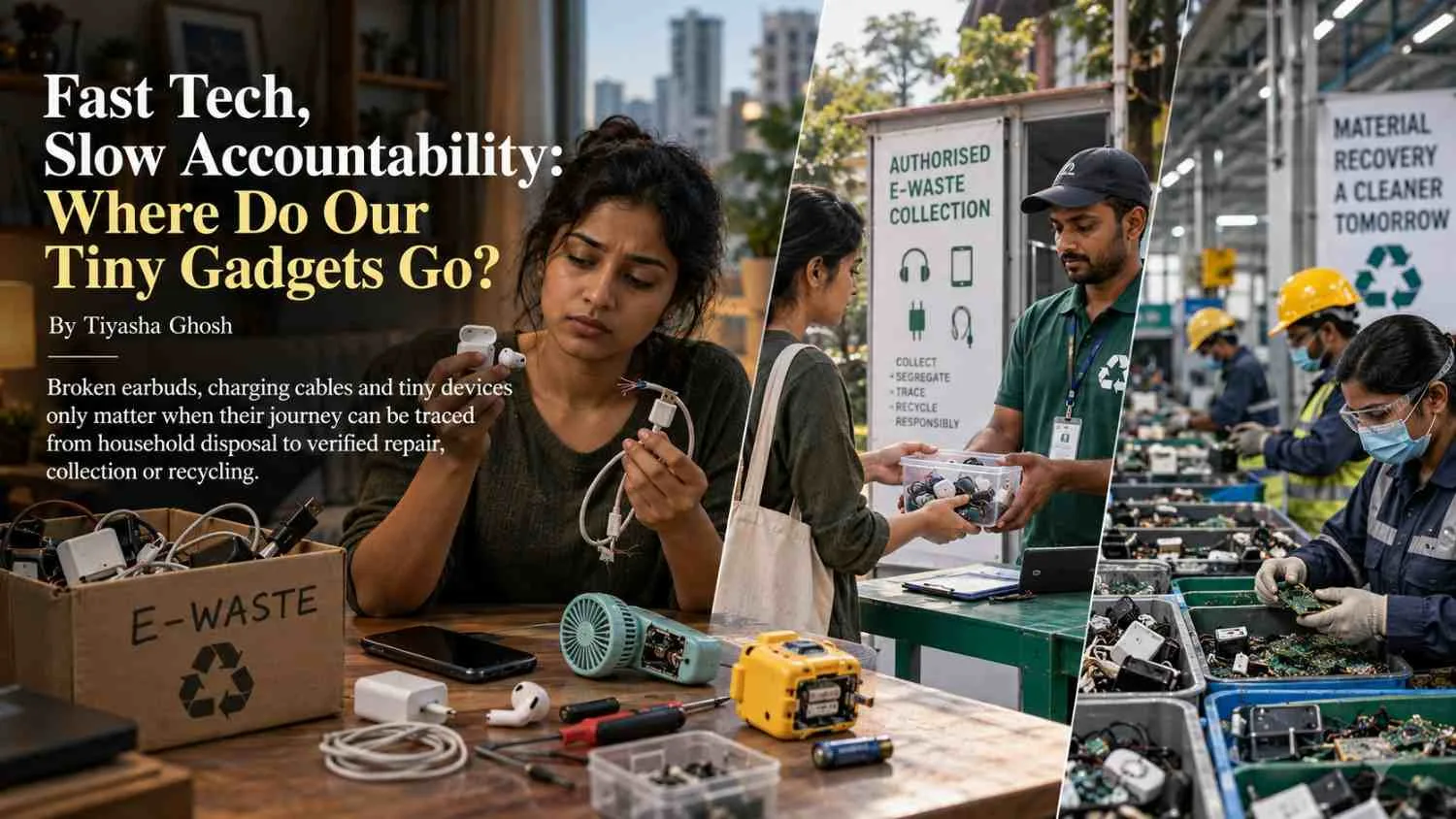
| Earbuds, charging cables and electronic toys are easy to replace. But when they stop working, their journey towards repair, collection or recycling is far less visible. |
| Summary: Small electronic devices are an overlooked part of the e-waste problem. India has a formal e-waste management framework, but responsible disposal depends on accessible collection, accountable recycling and products that can be repaired. The real test is whether a discarded gadget can be traced from a household to its verified destination. |
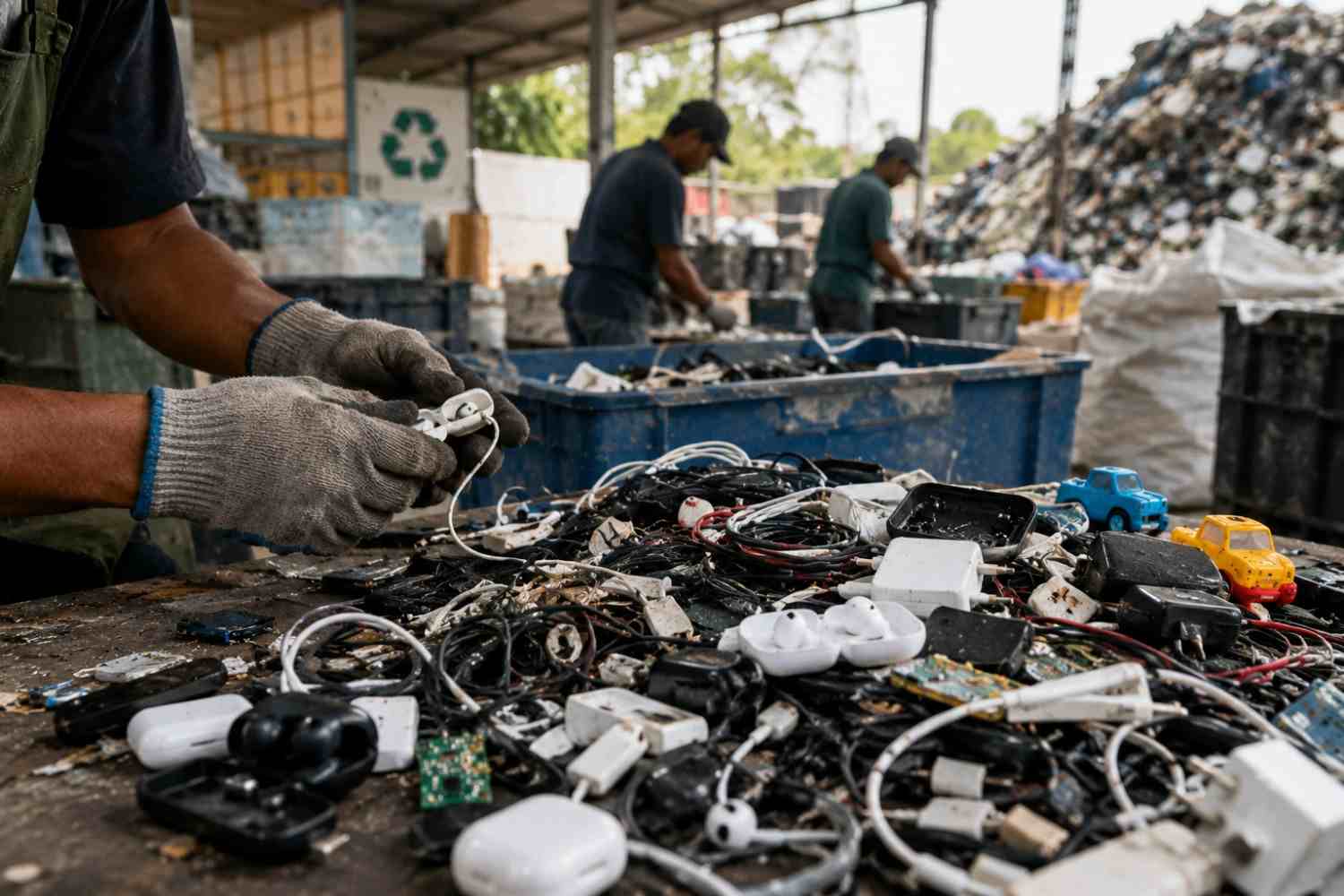
If a Broken Earbud or Charging Cable Leaves Your Home, Can You Trace Where It Goes Next?
A pair of earbuds stops working. A charging cable becomes unreliable. A small electronic toy breaks, or a mini fan is replaced by a newer model. These items are often too small to attract much attention, and their relatively low prices can make replacement seem easier than repair.
Yet their size does not make them insignificant. Devices containing plugs, cables, circuit boards or batteries can become electronic waste when discarded. Some contain valuable materials that can be recovered, while others contain components that require careful handling.
The problem is not simply how much electronic waste is generated. It is whether discarded devices enter a traceable system that can demonstrate what happens to them after they leave a household.
The Global Numbers Reveal a Blind Spot
The Global E-waste Monitor 2024, produced through the International Telecommunication Union and the United Nations Institute for Training and Research, estimated that the world generated 62 million tonnes of e-waste in 2022. Only 22.3% was documented as formally collected and recycled in an environmentally sound manner. Small equipment, including electronic toys and other household devices, accounted for 20.4 million tonnes, of which only 12% was documented as formally collected and recycled.
India generated an estimated 4.137 million tonnes of e-waste in 2022, according to the Global E-waste Statistics Partnership. This is a historical estimate, not a measure of India’s current annual output or of the amount generated by small gadgets alone.
These figures establish the scale of the problem, but they do not tell us how many earbuds or cables are collected in Kolkata, how much is processed locally or how much reaches its final destination. National estimates cannot substitute for evidence from a local collection chain.
What Do India’s E-Waste Rules Require?
India’s E-Waste (Management) Rules, 2022, which came into force on 1 April 2023, establish responsibilities for manufacturers, producers, refurbishers, dismantlers and recyclers handling electrical and electronic equipment covered by the rules.
The framework includes extended producer responsibility (EPR), under which producers have specified obligations linked to e-waste management. The rules cover equipment listed in Schedule I and related components, parts and spares. Waste batteries are governed separately under the Battery Waste Management Rules, 2022.
The Central Pollution Control Board operates an e-waste portal as part of the regulatory framework. Registration and compliance records provide an important starting point for checking whether an operator is authorised and what responsibilities apply to it.
However, a regulatory framework does not prove that every household can conveniently return a small device. Nor does an authorised recycler’s stated annual capacity establish how much e-waste it actually receives or processes. Capacity, collection, processing and verified recovery are different measures.
The key question is whether records connect these stages - and whether the information is accessible enough for consumers to make informed choices.
Repair, Recycling and the Informal Sector
Repair can extend a device’s useful life and delay the need for replacement. However, access to spare parts, repair information, compatible components and affordable services can influence whether a product is repaired or discarded.
India’s Right to Repair portal, maintained by the Department of Consumer Affairs, provides information on warranty terms, spare parts, service details and repair options across several product categories. It is a useful consumer resource, but its existence does not guarantee that every component will be available or that every independent repair will be possible.
There are competing concerns. Manufacturers and authorised service providers may emphasise product safety, quality control and the need for trained handling. Independent repairers and consumer advocates focus on affordability, access to parts and the ability to repair products without unnecessary restrictions. These concerns should be examined through actual repair costs, product policies and spare-part availability rather than assumptions about every company or repair shop.
The collection stage raises another question. Informal collectors and dismantlers can help recover discarded materials and provide convenient collection services. However, where handling practices are unsafe or downstream destinations are unclear, both workers and the environment may face risks.
The solution is not to overlook informal workers, but to improve safe working practices, traceability and access to accountable systems.
From a Broken Gadget to Its Final Destination
Tracing a discarded device means looking beyond the first collection point. A gadget may be repaired, reused, stored, handed to a collector or transferred to a recycling facility. Each route requires different evidence, and collection alone does not establish that materials have been recovered.
The Afterlife of a Small Gadget
What happens after your electronics stop working?
| Stage | What to check |
| Repair | Can the gadget be repaired and used again? |
| Collection | Was it handed over to an appropriate e-waste collection channel? |
| Processing | Which recycler or other facility received it? |
| Final destination | Is there evidence that it was properly processed, recycled or reused? |
The Accountability Gap
A collection claim is not the same as proof of recycling. To trace a gadget’s journey, look for the receiver’s identity, a handover receipt, transfer records and evidence of its final destination.
This is a reporting checklist, not a verified account of Kolkata’s current e-waste routes.
A credible local audit should record the type and weight of items collected, the date and location of handover, the receiving operator’s identity, available receipts or transfer records, and any evidence of subsequent processing.
This information would help distinguish between a collection drive that gathers devices, a facility capable of processing them and a system that can demonstrate actual recovery. A directory of collection points is useful only when locations, accepted items and operator details have been verified.
What Can Consumers Do Now?
The immediate steps are practical. Consider repair where feasible, keep discarded electronics out of ordinary household waste, and check with an appropriate authorised collection or recycling channel before handing them over.
Devices containing lithium-ion batteries, including some wireless earbuds and small gadgets, should not be thrown into general waste. Damaged batteries can create fire risks during collection, transport and processing.
Consumers can also check warranty conditions, ask whether spare parts are available and compare repair costs with replacement costs. These choices will not solve the e-waste problem alone, but they can help extend product life and reduce unnecessary disposal.
The larger responsibility remains shared among producers, regulators, collection systems, repair businesses and recyclers. Each has a role in making repairs accessible, collection convenient and the final destination of discarded devices more transparent.
The challenge is to make responsible disposal as convenient as buying a replacement. Small gadgets may be easy to overlook, but accountability should not disappear with them. A device’s journey should not end at the collection box; it should end with evidence of where it went and how it was handled.
Sources:
1. WEEE Forum — International E-Waste Day 2026: “Fast Tech” Read the campaign brief
2. International Telecommunication Union — Global E-waste Monitor 2024 Read the report and key findings
3. Global E-waste Statistics Partnership — India, 2022 data View country statistics
4. Ministry of Environment, Forest and Climate Change — E-Waste (Management) Rules, 2022 Read the official rules (PDF)
5. Central Pollution Control Board — E-Waste Management System Visit the official portal
6. Department of Consumer Affairs — Right to Repair India Portal FAQs · About the initiative
7. Repair Café — International Repair Day, 17 October 2026 Read the announcement






Add a Comment