

| Christ’s Child: El Nino and Indian Monsoon examines how El Niño and the Indian Ocean Dipole can influence India’s monsoon, rainfall distribution and agricultural conditions, with particular attention to the uneven and delayed 2026 monsoon. |
World Meteorological Organizations (WMO) has assumed on the possibility of an El Nino episode that it may be bad news for the Indian Monsoon. Though experts’ opinion was it would be premature to say anything definitely at the juncture, an El Nino year usually negatively impacts rains during the monsoon.
On 10th March the India Meteorological Department (IMD) predicted that day temperatures are likely to remain above normal by 5 to 7°C over Jammu and Kashmir, Himachal Pradesh, by 4 to 6°C over places of North East India including Delhi NCR, Gujarat and Madhya Pradesh during few days in the month .
El Nino refers to the periodic large-scale warming of the ocean surface temperature in the central and eastern equatorial Pacific Ocean coupled with changes in the tropical atmosphere circulation including wind pressure and rainfall pattern (Vishwa Mohan, The Times of India, March 11, 2026).
The History:
Since 1980, there have been 14 El Nino years, 9 out of 14 have corresponded with deficient monsoon in India with rainfall at least 10% below the average. The year 2018 experienced deficit of rainfall at 9.4 %.
There is an established connection between the El Nino year and poor monsoon, though there have been exceptions. The notable example is 1997, when the monsoon was normal despite a super strong El Nino.
In 1997, a strong positive phase of the Indian Ocean Dipole (IOD), counteracted the El Nino. IOD is a measure of the temperature difference between surfaces in the ocean’s east and west regions. This year it is predicted that the IOD will probably be positive.
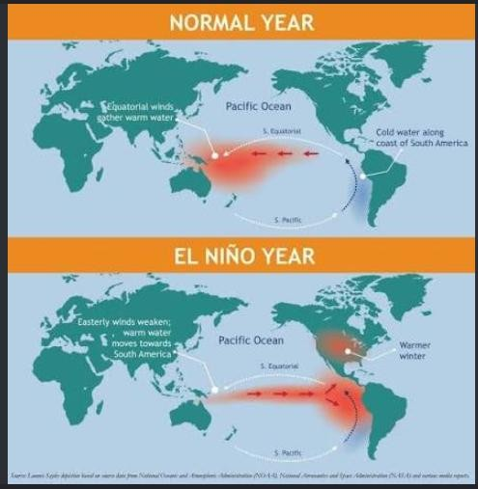
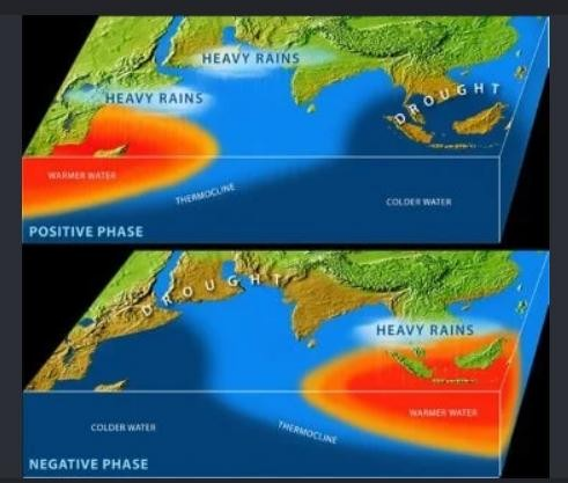
Fig 1: El Nino and Indian Ocean Dipole
IMD prediction:
June - September rains are likely to be below normal in South, Central and North West India.
Monsoon onset over Kerala expected to be delayed.
June is predicted to be hotter than normal.
On 30th June, 2026, IMD confirmed its forecast of below normal rainfall this year.
The 2026 monsoon in India experienced delayed onset and localised deficit, with IMD forecasting overall rainfall at 90% of the long period average.
March -May: pre monsoon showers were 1313mm nationally, close to the normal rainfall of 1306mm.
Rainfall in the month of June experienced a deficit. June 2026 faced a slow start particularly across central and western states like Maharashtra and Gujarat due to delayed monsoon progression.
August, 2026 experienced active spells targeting Kerala, Coastal Karnataka and south interior Karnataka with heavy to extremely heavy rainfall.
Widespread rain is observed across Uttarakhand, Himachal Pradesh, Gangetic West Bengal and Odisha, though average rainfall is still below normal for several interior tract.
Since July localised floods and landslides affected multiple regions in Himalayan region and North East India, mainly Assam caused more than 200 deaths.
Uneven progression impacted Kharif crop sowing schedule. As a result, the cost of irrigation has created a problem. There is regional stress for major summer crops like rice, pulses, and oil seeds.
Initial dry spells delayed paddy, coarse cereals and pulses planting in key rainfed areas, forcing contingency plans across nearly 200 vulnerable districts. There are also recovery signs during late July and August. Revival and localised heavy spells in late July and August have helped improve soil moisture and catch up on delayed sowing in several tracts, though regional anomalies persist. In the first week of August, 2026, heavy rainfall took place over Delhi, Haryana and eastern Rajasthan. But this heavy rainfall didn't reduce the overall country's deficits in rainfall. At least 11% deficit in rainfall will persist according to IMD. Many agrarian states of the country including Bihar, Jharkhand, Uttar Pradesh and Andhra Pradesh will continue to witness deficient rainfall affecting agricultural productivity (The Times of India, Kolkata, August 10, 2026)
West Bengal: Erratic and delayed start across eastern India due to early El Nino impact led to a slow beginning for Kharif crop sowing in west Bengal. But July experienced deep depressions in the Bay of Bengal and subsequent heavy rainfall. This situation eliminated deficits enabling a steady recovery in paddy transplantation.
June rainfall deficits and slow progression put initial stress on agricultural pockets postponing nursery bed preparation. Districts of South and West Bengal experienced weeks of delay in the standard Aman paddy schedule as farmers awaited proper soil saturation. During the early days of monsoon, the dry pockets of the state relied on ground water to protect seed beds. In another negative, it rained in many parts of the country at the time when the sowing of Kharif crops had ended in almost 88% of the country's total sown areas.
Approximately 52% of the country's net sown area is rainfed and relies directly on monsoon rainfall. During 3 July to 31 July at least 34 places of the country experienced 200mm rainfall or more in 24 hours. Umargram of Bhaldas district of Gujarat experienced 1067mm rainfall on 23 July. It is the highest recorded rainfall in a day in 2026.
Umargram, Gujarat ------- 1067mm----2026
Sohora, Meghalaya ------1563.3mm--1995
Amin div, Laksha div----1168.5----------2004
In general, the rainfall scenario of the country is as follows,
Deficit rainfall in the first week of July,2002 amounting to 35%.
On 9 July depression in the Bay of Bengal initiated rainfall throughout the country.
July rainfall became normal after the first week.
After the second week of July the deficit rainfall amounted to 51%.
August,2026 closed out with a sharp 16% nation -wide rainfall deficit.
August 2026 is registered as one of India's warmest August months since 1901.
Isolated heavy to extremely heavy downpours over West Bengal, Jharkhand, and parts of Madhya Pradesh, while Punjab, West Rajasthan, and the southern peninsula remained largely dry.
The first 9 days of September,2002, experienced a deep of 26% deficit affecting cotton, soybean and pulses production.
Over 14 states and Union Territories report severe rainfall deficiencies. Heavily affected states include Andhra Pradesh and Punjab (40%), Goa, Kerala (24%), parts of Maharashtra (Vidarbha and Mararathwada), Karnataka, Rajasthan, and Gujarat (20%) Bihar (27%), Assam, Mizoram, Manipur, Arunachal Pradesh, Meghalaya and parts of East and North East India including some parts of West Bengal. The scenario may change as the withdrawal of monsoon is not complete. In the third and fourth week of September the rainfall pattern may change the scenario of the monsoon rainfall in 2026.
There are areas of India with above normal rainfall during the 2026 monsoon although rainfall distribution is highly uneven. Gujarat and some parts of central India IMD recorded an isolated extremely heavy rainfall in Gujarat region and northern Madhya Pradesh on 13 September.
Delayed or deficient monsoon ----------- low agricultural productivity -------------low rural income --------------- increased food prices ------------- high dependence on ground water --------- ground water depletion.
The solution:
Micro -irrigation: deployment of Drip sprinkler irrigation can reduce water conservation by 30 -50% and enhance crop productivity.
Restoration of wetlands: Wetlands are the source of water during dry spells for preparation of paddy seed beds. Wetlands can reduce the possibility of flooding during heavy rainfall.
Monitoring drainage infrastructure in flood prone urban areas.
Strengthening ground water recharge systems to improve water management during extreme weather.
Crop switching may take place. In rain deficit areas water -heavy paddy farming may be transformed into low -water, drought- resistant alternatives like millet and oilseeds.
Short - duration seeds may be used in some water deficit parts of the country.
Quick yielding seed varieties that mature faster, allowing farmers to save their yield even within a compressed monsoon timeline should be taken into consideration.






Add a Comment