

| As temperatures rise in India, cooling is becoming essential to public health, household satisfaction, and economic productivity. But the growing popularity of air conditioning raises questions about electricity consumption, refrigerant emissions, affordability, and waste. We investigate how the Kigali Amendment and India’s Cooling Action Plan can support a cooling system that looks after people without compromising the environment. |
SummaryWe explore how India’s growing cooling demand relates to climate change, public health, and energy usage. Through the Kigali Amendment and India’s Cooling Action Plan, we look at sustainable cooling technologies, refrigerant management, building design, and worker safety. The article highlights the need for affordable, accessible cooling without increasing environmental stresses. |
Why is cooling becoming a necessity in India?
As temperatures continue to rise, cooling is becoming an important part of everyday life in India. What once was seen as a luxury in many households is increasingly connected to health, productivity, and basic comfort. Heat affects people differently, but the risks can be particularly pronounced for older adults, children, outdoor workers, and people with existing health vulnerabilities. We often think of cooling as switching on an air conditioner or a fan, but the larger cooling system is far more complex. It begins with the design of buildings, the electricity consumed to use equipment, the refrigerants contained within cooling appliances, the workers who install and support them and the way equipment is treated when it is discarded.
This wider perspective is important because cooling can protect people from heat but also contribute to environmental pressures. Air conditioners and refrigeration systems consume electricity and, if refrigerants escape, can contribute to global warming.
As more households, offices, hospitals, shops, and industries require cooling, we must consider how this demand can be met responsibly. We cannot simply focus on selling more appliances – we also must ask whether buildings can be designed to stay cooler, whether equipment will be efficient and whether cooling is affordable to the people who need it most. For us, the central question is not whether India needs cooling – it is how we can provide cooling without creating new environmental and social challenges.
What is the Kigali Amendment, and why does it matter?
The Kigali Amendment to the Montreal Protocol was adopted in 2016 to reduce the production and consumption of hydrofluorocarbons, commonly known as HFCs. These substances are used in many refrigeration and air-conditioning systems. HFCs were introduced as a substitute for ozone-depleting substances, but many HFCs are powerful greenhouse gases. When they escape from air-conditioning equipment, they can contribute to global warming.
The Kigali Amendment, therefore, is concerned with gradually phasing down the production and consumption of HFCs. India ratified the amendment in 2021 and follows a phased schedule for reducing HFC production and consumption. India’s schedule includes a first reduction landmark in 2032, followed by further reductions in 2037, 2042 and 2047. These are the scheduled phase-down landmarks, not evidence that the reductions have already occurred.
The amendment is important because it ties the cooling sector to global climate action – but simply substituting one refrigerant for another is not enough on its own. We also must ensure that new equipment is energy-efficient, safe to run and suitable for India’s climate and cooling needs.
If a refrigerant has a lower climate impact but the appliance consumes too much electricity, the overall environmental benefit may be reduced. This is why refrigerant transition and energy efficiency need to move together. The Kigali Amendment gives us an international framework – the challenge is to translate it into practical action across India’s cooling economy.
How is India’s Cooling Action Plan addressing the challenge?
India launched the India Cooling Action Plan (ICAP) in 2019 to address cooling demand with a broader, longer-term approach. The plan is aware that cooling is connected to several sectors – including buildings, transport, agriculture, healthcare, and industry. It aims to reduce demand for cooling, improve energy efficiency and encourage better technology, as well as supporting the development of skilled workers. The plan set targets for reducing cooling demand, refrigerant demand, and cooling energy requirements by 2037-38. These targets are intended outcomes and should not be described as achieved unless there is updated evidence.
An important aspect of ICAP is its emphasis on reducing cooling needs before relying solely on mechanically produced cooling. If the buildings we occupy can limit the amount of heat we allow in, we may require less air conditioning to keep comfortable. The plan is also aware of the need for trained technicians – cooling equipment requires installation, servicing and maintenance, and refrigerants must be handled with care. Without skilled workers and suitable equipment, even efficient appliances can perform poorly or cause environmental harm. We should view ICAP as a framework that unites elements of the wider cooling system. Its success depends on co-ordination between government agencies, manufacturers, building designers, service providers, workers and consumers.
Why can a cooler room also mean a hotter grid?
Air conditioners make indoor spaces more comfortable, but they require electricity to work. When many people start using cooling equipment, electricity demand can surge. This creates a challenge for power systems, especially during periods of extreme heat. If electricity supply relies on fossil fuels, increasing demand can also increase greenhouse gas emissions.
This is why the phrase “a cooler room can mean a hotter grid” is important – cooling may protect us indoors, but the electricity we consume can have environmental consequences elsewhere. It would be wrong to interpret this as a reason to discourage people from using cooling when they need it – but it does highlight how we have to improve the overall system.
Energy-efficient appliances can provide the same service but consume less electricity. Better building design can reduce the demand for energy-intensive air conditioning. Smart control systems and proper maintenance can help equipment function more effectively. We also have to consider electricity access and affordability. A household may have an air conditioner but avoid using it because of the cost of running it – in this case, appliance ownership does not mean the household has reliable access to cooling. A sustainable cooling system, therefore, has to reduce electricity consumption while ensuring that people can stay safe during extreme heat.
How can passive cooling reduce our dependence on air conditioning?
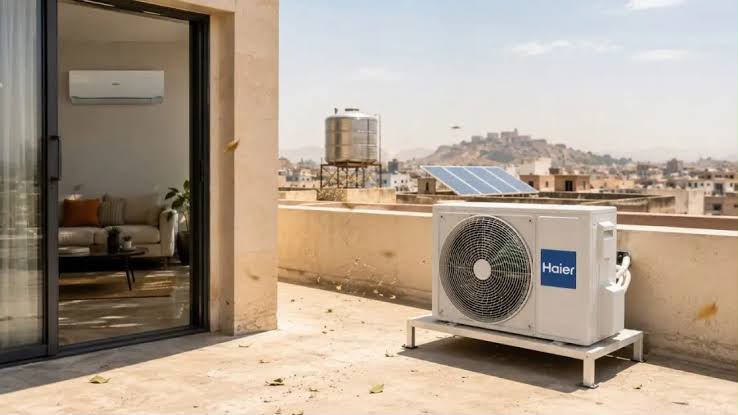
Passive cooling refers to building design and other methods that seek to reduce heat indoors without relying solely on mechanically produced cooling. We can begin by looking at a few simple aspects: shading, ventilation, reflective surfaces and suitable building materials. The way a building is placed, its window size, the materials of its roof and walls – these can influence the amount of heat indoors.
For example, external shading can reduce direct sunlight entering a room, and roof treatments may reflect sunlight to reduce the heat they absorb. Ventilation can also be used to create a flow of air when the outdoor conditions permit. These methods have proven to be helpful in many residential, educational, office and community buildings. They can also help reduce electricity costs by reducing the amount of time air conditioners have to work. However, passive cooling is not a universal solution, and its effectiveness varies depending on the climate, building design, humidity, air quality and use. While natural ventilation is ideal in some conditions, it may not be desirable in others.
Natural ventilation, for instance, may not be desirable during periods of poor outdoor air quality or extreme humidity. Some hospitals and specialist workplaces also require controlled conditions – which cannot be achieved solely through passive measures. We should view passive cooling as one component of a broader system. Coupled with efficient appliances and thoughtful building design, it can help reduce cooling demand and contribute to indoor comfort.
What makes energy-efficient cooling important?
Energy efficiency plays a crucial role in sustainable cooling, as it allows us to get the cooling we want while consuming less electricity. When comparing air conditioners or other equipment for personal use, we should pay attention to their energy-performance information rather than focusing on price, aesthetics or marketing claims. In India, the Bureau of Energy Efficiency offers energy labelling programmes for relevant appliances.
These labelling guidelines can help us compare the energy performance of products, provided we look at the label for the product and its requirements. Of course, energy efficiency is not just about the appliance – it depends on several factors, such as the building’s design, the room’s size in which equipment will be used, its insulation and ventilation, as well as its maintenance. An air conditioner that is poorly installed or supported may not deliver the service we expect – in fact, dirty filters or blocked airflow can significantly affect its performance.
We should also resist the assumption that the latest appliance will automatically be the right one for every space. Consumers need to understand the cooling requirements of their space, as well as the impact on operating costs, servicing requirements, and energy-performance characteristics. For hospitals, businesses and large buildings, the same principles apply – but on a larger scale, and with energy audits and maintenance playing a prominent role. The aim is not simply to reduce the amount of electricity we consume – but to provide the cooling service we want without consuming more than we must.
Which refrigerants are used, and what happens when they leak?
Refrigerants are substances that are contained within cooling systems to help the transfer of heat. Different appliances use different refrigerants, and these substances vary in their environmental impact. Some have high global warming potential – others have a lower impact, but they also have safety, flammability, and operational considerations. These differences mean that refrigerant selection is a balance: it is not simply a matter of choosing whichever has the lowest climate impact.
Equipment has to be compatible with a refrigerant, and technicians have to be trained to handle them. Leaks are a major concern because they can occur during equipment operation or servicing, transport or disposal. A refrigeration system may continue to function after a leak, but the system will be less effective and the refrigerant may escape.
We need proper servicing records, leak detection and repair practices to reduce these risks. Technicians should have suitable tools and follow safety procedures for the specific refrigerant and equipment. We should also distinguish between refrigerant recovery and reclamation. Recovery refers to removing refrigerant from equipment, as opposed to simply releasing it into the atmosphere. Reclamation involves processing the recovered refrigerant to specific requirements for reuse. Both can be part of responsible refrigerant management, but they are distinct processes.
What happens to cooling equipment at the end of its life?
The environmental impact of cooling equipment does not stop when it stops working. Discarded air conditioners, refrigerators and other appliances have materials that can be recycled or reused. They also have refrigerants and oils that may pose environmental and safety risks. Improper dismantling can expose workers to unsafe conditions and valuable materials will be lost when appliances are simply discarded without recovery. We, therefore, must consider the entire lifecycle of cooling equipment – from design and manufacturing to installation, maintenance, repair, collection, and end-of-life treatment.
A responsible system would make it easier for us to return old appliances to proper collection points. Service providers and waste handlers must follow suitable procedures for recovering refrigerants and separating materials. Manufacturers can support this by considering product design, repair guidelines, spare parts availability, and take-back options were proper. We should not assume that an appliance has been responsibly recycled simply because it has been collected – we must look at the evidence about where it went, how the refrigerants were treated and which materials have been recovered.
How can district cooling support sustainable cities?
District cooling refers to systems in which cooling is produced in a central location and distributed to several buildings through a network. Instead of each building having its own equipment for mechanically produced cooling, a shared system can be used for connected buildings. This can bring out opportunities for improved efficiency, maintenance and energy management depending on local conditions.
District cooling can be a relevant model for large developments, commercial districts, hospitals, campuses, and other areas with intensive demand for cooling. However, it is not necessarily the best option for every city or neighbourhood – its performance will depend on factors such as building density, network design, local climate, electricity supply, investment costs, and the reliability of the system.
We, therefore, must evaluate district cooling on a case-by-case basis. We need to look at how much energy it will use, what refrigerant it will rely on, how cooling is distributed, and whether the service will be affordable for the buildings and people it serves. District cooling is likely to be one component of sustainable urban infrastructure, but it has to complement other measures such as passive cooling and efficient appliances.
Why are hospitals an important part of the cooling conversation?
Hospitals not only rely on cooling but also have significant cooling needs. Some spaces require controlled temperatures to support patient care, protect medicines, or operate equipment. This means reliable cooling is particularly important during extreme heat – but a cooling failure can impact patients, staff and hospital operations.
At the same time, hospitals may have substantial cooling demands due to the long hours they run and the range of temperature-sensitive spaces. We should assess hospitals from both a public-health and an energy-efficiency point of view – the goal is not to reduce cooling indiscriminately, but to ensure that necessary conditions are kept while reducing unnecessary energy use. Hospitals must review their maintenance schedules, cooling arrangements, and energy performance. They must look at whether different areas require different cooling settings and whether building improvements can reduce heat gain.
To understand the situation, we would have to speak to hospital administrators, maintenance staff, and healthcare professionals. Useful evidence would include indoor temperatures, equipment types, energy costs, maintenance schedules, and what resources exist for power interruptions. A specific hospital case should be based on verified reporting rather than assumptions – this would help prove how cooling decisions impact patients, workers, and costs in actual practice.
Who are the workers behind India’s cooling economy?
Behind every functioning air conditioner or refrigeration system is a network of workers who install, repair, and keep equipment. Refrigeration and air-conditioning technicians are essential in the cooling transition – they handle refrigerants, inspect systems, identify leaks and perform repairs. As India moves towards new refrigerants and more efficient technologies, technicians will require updated training.
We should not treat training as a one-off activity – workers have to have access to updated technical knowledge, appropriate tools and practical instruction. They also need safe working conditions and procedures related to refrigerant handling. Informal workers may face additional barriers such as the costs associated with training, limited access to equipment and uncertain employment conditions. A policy transition that ignores these may not be effective.
We should include technicians in discussions on sustainable cooling, as their experience can help highlight practical problems such as recurring equipment failures, the availability of spares and difficulties in recovering refrigerants. A technician-focused field report could look at the refrigerants technicians typically handle, the tools they use, their training and the challenges they encounter during servicing. These details can help connect national climate targets with day-to-day working conditions.
How can we make cooling accessible without increasing inequality?
As we develop our appreciation for new cooling technologies, we need to remember that access is not simply about availability.
A cooling system may exist in a city, but it may not be affordable to nearby households. A hospital may have modern equipment, but maintenance costs may be too high. Technicians may receive training, but they may struggle to obtain recovery tools. We, therefore, must link cooling policy to affordability, infrastructure, and working conditions.
For households, this can begin with better information on energy-efficient appliances, practical building improvements, and affordable servicing. For hospitals, it means protecting critical cooling while reducing unnecessary energy use. For businesses it means reviewing their equipment, refrigerant management, and the full cost of operating cooling systems.
For policymakers, the challenge is to co-ordinate the various aspects of the system. We need building policies that reduce unnecessary heat gain, appliance standards that promote energy efficiency, refrigerant regulations that enable safe transitions and training programmes that reach the technicians who install and keep equipment. We also need reliable information – without data on electricity consumption, refrigerant leakage, equipment performance, indoor temperatures, and waste, it will be hard to measure whether systems are delivering the intended benefits.
This is where independent research organisations, public-health experts, worker associations, and civil-society groups can contribute – their work can help us see the practical barriers that may not be clear in policy documents or industry announcements. Sustainable cooling must be measured not only through the technology being installed but also through the quality of services people are receiving, the environmental impact and the conditions in which workers are performing their roles.
What can we do at home and at work?
Beyond national policy and industrial transformation, there are practical actions we can take to improve the way we use cooling. At home, we can reduce the amount of direct sunlight entering our premises by using right curtains, blinds, or shading. We can keep fans and air conditioners, keeping filters clean per manufacturers’ guidance and avoiding unnecessary use.
We should use air conditioners following the needs of the room – rather than assuming lower temperatures will always be preferred. These settings can reduce electricity consumption while keeping our comfort. At work, we can review our use of fans or air conditioners, avoiding unnecessary energy use. If our workplace is air conditioned, we can check whether the temperature and airflow are proper and raise concerns if not. We can also consider the use of building materials and designs that help keep spaces cool without consuming vast amounts of electricity.
As citizens, we should engage with building or appliance standards and energy labelling, encouraging our communities to embrace opportunities for passive and active cooling. We can support cleaner energy generation and promote responsible electricity use. We can ask questions about how our electricity is generated – is it cleaner? Is it cheaper? – and encourage our households and workplaces to reduce consumption where they can.
We can request more information on waste management and refrigerant recovery – rather than assuming recycling happens automatically, we must demand accountability. This can help us assess whether our cooling systems are genuinely helping the environment. Finally, we can take care of our air conditioners and make sure they are supported, serviced, and repaired responsibly. This will ensure they are performing the most efficient service possible.
What should we check when evaluating a cooling system?
To understand whether a cooling system is sustainable, we need evidence that covers its full lifecycle.
Cool-home and cool-workplace checklist
Refrigerant: What type is used, and what are its climate and safety characteristics?
Energy performance: What energy label or performance information is available?
Installation: Was the equipment correctly sized and installed?
Service record: Is there a record of maintenance, repairs and leak checks?
Recovery and reclamation: Is refrigerant collected during servicing or decommissioning, and where does it go?
Disposal route: Is the appliance sent to a proper collection or treatment facility?
Indoor temperature: Are indoor conditions suitable for the people using the space?
Electricity cost: Is cooling affordable to use?
Worker certification and training: Are technicians trained and equipped to handle the refrigerant safely?
Cooling lifecycle
Design and manufacture → Installation → Operation → Servicing and leak repair → Refrigerant recovery → Reclamation or proper treatment → Appliance collection and end-of-life processing
This lifecycle approach helps us look beyond the appliance itself. It also gives consumers, businesses, and policymakers a clearer set of questions to ask when assessing cooling claims.
Conclusion: Cooling people without overheating the planet
As we look towards India's cooling future, we need to recognise that cooling is no longer simply a question of comfort. It is connected to public health, energy security, employment, infrastructure, and climate action.
The Kigali Amendment provides an international framework for reducing HFC production and consumption. India's Cooling Action Plan offers a broader approach that connects cooling demand, energy efficiency, refrigerant management, technology, and skills development. Together, they give us a starting point for rethinking how cooling is provided across the country.
But the real test of this transition lies beyond policy documents and technology announcements.
We need to understand whether households can afford to stay cool during extreme heat. We need to know whether hospitals can support reliable cooling when patients need it most. We need to examine whether technicians have the skills, tools, and working conditions necessary to manage refrigerants safely. And we need to set up whether cooling equipment is repaired, recovered, and disposed of responsibly.
We also need to move away from the idea that one technology can solve every problem. Passive cooling can reduce heat entering buildings, efficient appliances can reduce electricity use, and district cooling may offer shared solutions in suitable locations. But each approach needs to be evaluated according to local conditions, costs, access, and environmental performance.
Most importantly, we need to understand that sustainable cooling is not only about reducing harm. It is also about expanding access to an essential service. A household that cannot afford to use its air conditioner, a hospital struggling to support critical temperatures or a technician working without proper recovery equipment stands for a gap in the cooling system.
We should therefore measure progress through more than the number of appliances sold or the refrigerants replaced. We need to consider whether cooling is reliable, affordable, energy-efficient, and accessible, while ensuring that workers and waste-management systems are included in the transition.
The next time we enter a cool room, we should look beyond the temperature on the thermostat. We should ask how that cooling was produced, how much energy it needed, what refrigerant it uses and what happens when the equipment reaches the end of its lif
Because the future of cooling is not simply about making our rooms colder. It is about building a system that protects people from heat without adding unnecessary pressure to the planet.
References and sources
Ministry of Environment, Forest, and Climate Change — India Cooling Action Plan (ICAP)
https://www.pib.gov.in/PressReleaseIframePage.aspx?PRID=1805795®=48&lang=2
Official framework for cooling demand reduction, refrigerant transition, energy efficiency, and cooling technology development.
Press Information Bureau — India Cooling Action Plan
https://www.pib.gov.in/indexm.aspx?reg=48&lang=2
Government information on implementation, passive cooling in buildings and technician training.
Press Information Bureau — Kigali Amendment to the Montreal Protocol
https://www.pib.gov.in/PressReleasePage.aspx?PRID=1746946®=48&lang=2
Details on India's ratification, HFC phase-down schedule and expected climate benefits.



Add a Comment