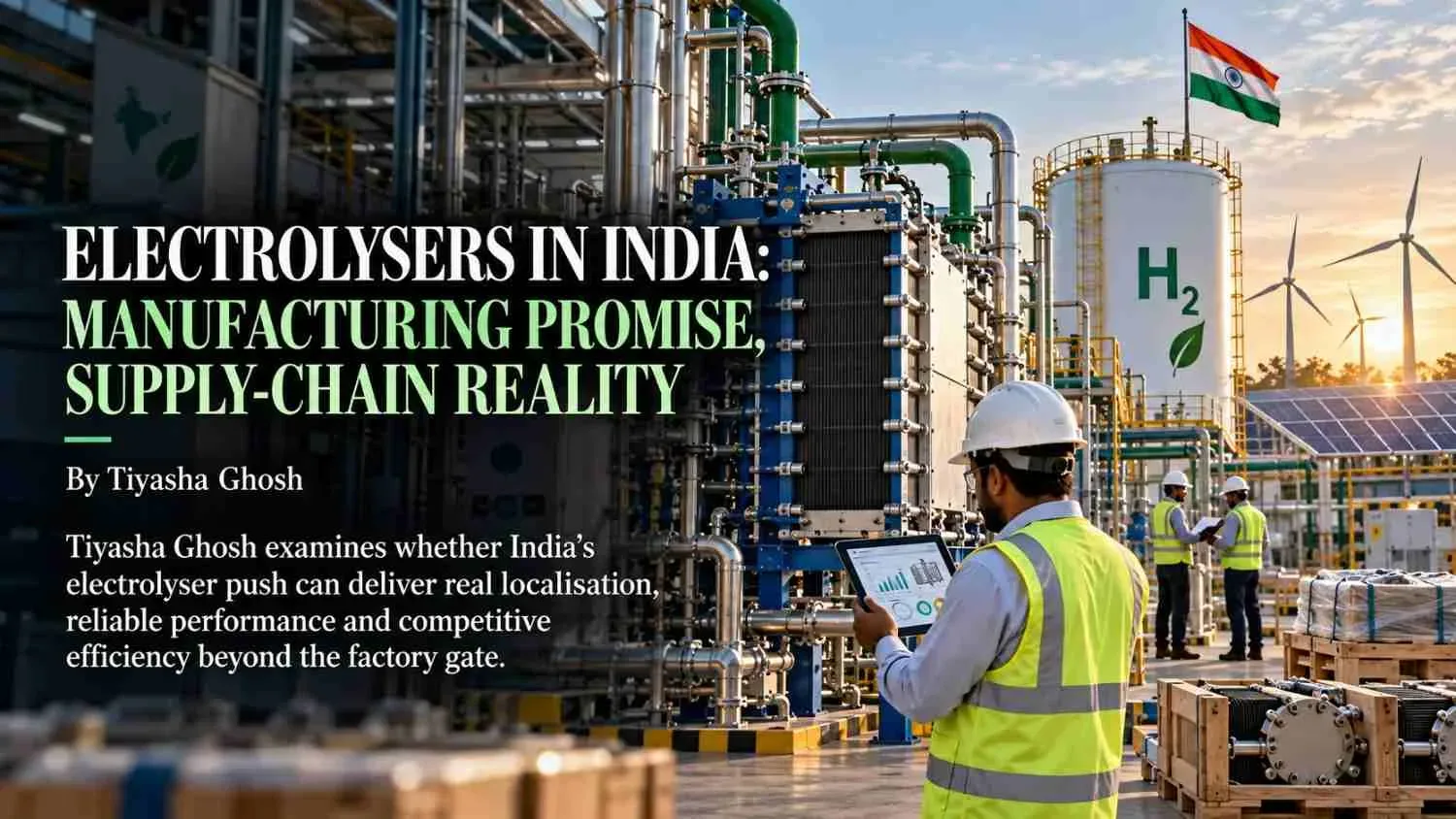
| India is building the machines that could power its green-hydrogen ambitions. But the harder test is whether those machines can deliver competitive efficiency, genuine localisation and dependable performance long after the factory gates open. |
Summary India is rapidly building a domestic electrolyser manufacturing base to support its green-hydrogen ambitions, backed by the National Green Hydrogen Mission and ₹4,440 crore in manufacturing incentives. But approved factory capacity is only the starting point. The real test lies in how much equipment is actually produced, how much of its supply chain is truly local, how efficiently it operates, and whether it can remain reliable and commercially competitive over time. This feature examines the gap between manufacturing promises and operating reality - through localisation, critical minerals, system costs, efficiency, degradation, renewable-power requirements and the evidence buyers should demand before calling an electrolyser truly “Made in India.” |
THE BIG QUESTION
Can India turn electrolyser manufacturing capacity into a genuinely competitive industrial supply chain?
India’s green-hydrogen story is gradually becoming a manufacturing story.
The country is no longer viewing electrolysers simply as imported equipment required for future hydrogen projects. Through the National Green Hydrogen Mission and its Strategic Interventions for Green Hydrogen Transition (SIGHT) programme, India is seeking to establish a domestic manufacturing base for the equipment that splits water into hydrogen and oxygen.
The scale is significant.
The National Green Hydrogen Mission aims to position India as a global hub for green hydrogen and targets production of 5 million tonnes per annum by 2030. Under the SIGHT programme, the government has allocated ₹4,440 crore for domestic electrolyser manufacturing.
The official MNRE SIGHT portal lists 3,000 MW per year of approved electrolyser manufacturing capacity across two manufacturing tranches: 1,500 MW under Tranche-I and another 1,500 MW under Tranche-II.
The headline, therefore, is no longer whether India intends to manufacture electrolysers.
It does.
The more important question is what exactly “manufacturing” means when the system is examined component by component.
INDIA’S ELECTROLYSER MANUFACTURING PUSH
Infographic:
National Green Hydrogen Mission → SIGHT → Tranche-I: 1,500 MW/year → Tranche-II: 1,500 MW/year → 3,000 MW/year approved capacity
Callout:
How much of that capacity will translate into actual production?
Note: Clearly label 3,000 MW as approved/awarded manufacturing capacity, not equipment produced.
FROM HYDROGEN TARGET TO FACTORY FLOOR
An electrolyser is deceptively simple in principle.
Electricity is passed through water, triggering an electrochemical reaction that separates hydrogen from oxygen.
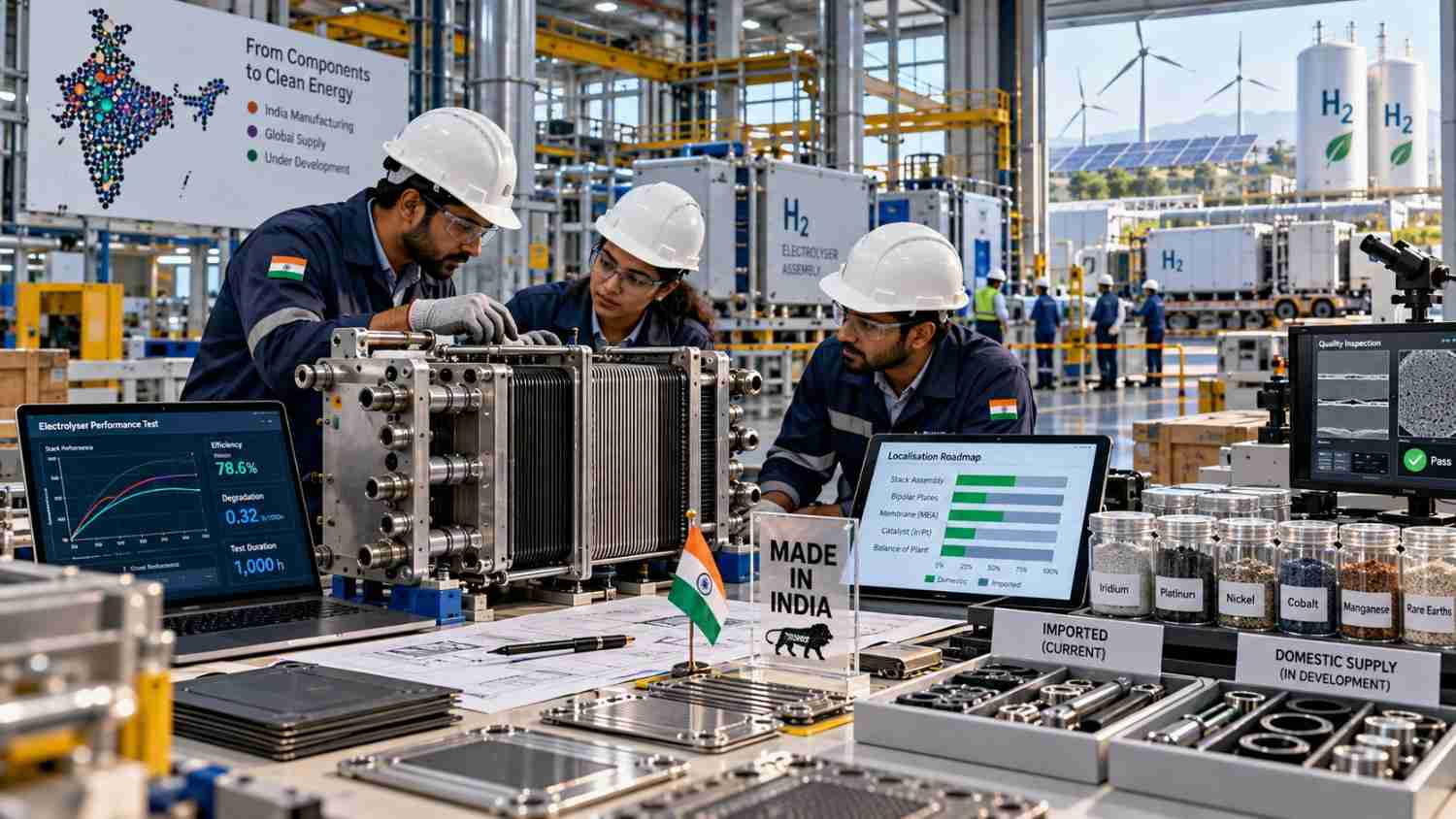
But the machine performing that reaction is a sophisticated industrial system involving a stack, electrodes, catalysts, membranes or diaphragms, bipolar plates, power electronics, pumps, heat-management systems, controls and other balance-of-plant equipment.
And not every electrolyser is the same.
Alkaline, PEM, solid-oxide and emerging AEM technologies use different materials, designs and operating characteristics. Their supply chains can therefore look very different.
This matters because a factory producing an electrolyser system is not necessarily producing every critical component within it.
A system can be assembled domestically while some of its most specialised inputs remain imported.
That distinction lies at the centre of India’s manufacturing challenge.
The policy objective, therefore, is not simply to increase the number of machines carrying a “Made in India” label.
It is to build an industrial ecosystem capable of producing reliable equipment at competitive cost while reducing vulnerable import dependencies.
The editorial brief for this feature identifies precisely these tests: quality, localisation, minerals, efficiency and after-sales performance—not factory ribbon-cutting.
CAPACITY IS NOT THE SAME AS OUTPUT
The first number any manufacturing story tends to celebrate is capacity.
But capacity is only the beginning.
A manufacturer may announce a plant with a particular annual nameplate capacity. A government tender may award manufacturing capacity. A facility may be constructed. Equipment may be installed. Production may begin.
These are different stages.
For this story, the useful ladder is:
ANNOUNCED → AWARDED → BUILT → COMMISSIONED → PRODUCING → SOLD → INSTALLED → OPERATING → MAINTAINED → MEASURED
The MNRE portal lists eight Tranche-I projects with scheduled commissioning dates in August 2026, while the listed Tranche-II projects have a scheduled commissioning date of 26 March 2027. As of October 2026, however, a scheduled commissioning date should not automatically be interpreted as evidence of actual commercial output.
The evidence threshold must be higher.
India’s electrolyser manufacturing progress should increasingly be measured through harder indicators:
- How much capacity has been physically commissioned?
- How much equipment has actually been produced?
- What is the plant’s utilisation rate?
- How many stacks or systems have been sold?
- Where are they operating?
- What is their measured efficiency?
- How quickly does performance degrade?
- What does the warranty cover?
- Which components are domestically sourced?
- Which remain imported?
- How quickly can replacement parts be supplied?
- This is where the story moves from industrial policy to industrial reality.
CAPACITY ≠ OUTPUT
Status ladder:
Announced → Awarded → Built → Commissioned → Producing → Sold → Operating → Measured
Centre callout:
3,000 MW/year = approved manufacturing capacity, not 3,000 MW produced.
WHAT DOES “MADE IN INDIA” REALLY MEAN?
The phrase sounds straightforward.
The supply chain is not.
A complete electrolyser system can contain dozens of components and materials, and the domestic share can differ substantially between technologies.
A 2024 CEEW assessment examined PEM, alkaline and solid-oxide electrolysers and found substantial potential for localisation across all three. It estimated overall indigenisation potential at 82% for PEM, 88% for alkaline and 85% for solid-oxide electrolysers. The report also identified specialised materials and critical minerals as continuing supply-chain challenges.
The distinction is crucial:
Potential indigenisation is not the same as current indigenisation.
The CEEW assessment estimated manufacturing costs of roughly USD 350–400 per kW across the technologies it studied and identified opportunities to reduce stack costs through higher current density, lower catalyst loading, thinner coatings and alternative materials.
For PEM systems, the report found that around 72% of manufacturing cost could be readily indigenised in its assessment, while components such as Nafion membranes and minerals including platinum and iridium remained areas of import dependence.
For alkaline systems, the picture is different but still not completely domestic. The CEEW analysis identified opportunities to manufacture or process several components in India while pointing to continuing dependence on imported materials and commodities.
So the question should move from:
“How much of the electrolyser is Indian?”
to:
“Which parts are Indian, which are imported, and which supply chains could become bottlenecks as production scales?”
That is a much more useful manufacturing question.
WHAT ACTUALLY SITS INSIDE AN ELECTROLYSER?
Technical cutaway:
Stack, electrodes, catalyst, membrane/diaphragm, bipolar plates, power electronics, water treatment, cooling, gas handling and controls.
Show two labels:
Domestic manufacturing potential | Import / critical-material exposure
Callout:
“Made in India” is a supply-chain question, not just an assembly question.
THE CRITICAL-MINERAL QUESTION
The localisation debate cannot stop at factories.
It has to reach the materials inside those factories.
Electrolyser technologies use different combinations of materials, and some specialised components rely on minerals for which India does not have sufficient domestic resources or established supply chains.
This creates a strategic dilemma.
Trying to manufacture everything domestically may not always be technically or economically sensible.
But relying heavily on a narrow group of foreign suppliers can create another vulnerability.
The better objective is therefore supply-chain resilience.
That can mean:
- developing domestic component manufacturing;
- processing imported raw materials within India where economically viable;
- reducing the quantity of critical minerals required per unit of hydrogen;
- developing alternative materials;
- diversifying international suppliers;
- building domestic testing and certification capabilities;
- investing in research into next-generation electrolyser technologies.
- The CEEW study specifically identifies reduced catalyst loading, alternative materials and technology development as potential routes to lower costs and increase localisation.
The strategic question is not whether India can eliminate every import.
It is whether India can prevent one imported component, mineral or technology from becoming a single point of failure.
THE HIDDEN COST: THE SYSTEM AROUND THE STACK
Another reason headline manufacturing capacity can be misleading is that the stack is only one part of the overall economics.
CEEW’s assessment found that balance of plant can account for 50–60% of the total electrolyser system cost.
That changes the procurement conversation.
A buyer should not compare two electrolysers simply by comparing the quoted price of their stacks.
The relevant comparison is the complete system.
That includes:
STACK + POWER ELECTRONICS + WATER TREATMENT + COOLING + GAS PROCESSING + CONTROLS + INSTALLATION + MAINTENANCE + REPLACEMENT + FINANCING
A cheaper machine that consumes more electricity, degrades faster or requires expensive imported replacement parts may not remain cheaper over its operating life.
The real metric is therefore not simply:
₹ per kW of electrolyser
but increasingly:
₹ per kilogram of hydrogen over the operating life of the system.
That is where manufacturing competitiveness becomes commercial competitiveness.
THE STACK IS ONLY PART OF THE BILL
Infographic:
Stack + power conversion + water treatment + cooling + gas handling + controls + installation + maintenance.
Highlight:
Balance of plant = 50–60% of total system cost
Bottom line:
Purchase price ≠ lifetime cost
EFFICIENCY: THE NUMBER THAT NEEDS A COMMON RULE
Efficiency sounds like a simple number.
In practice, it requires a common measurement framework.
Two manufacturers can describe system performance differently depending on what is included in the calculation, how electricity consumption is measured and under what operating conditions the test is performed.
That makes standardisation critical.
A June 2025 BIS draft standard on efficiency assessment of AEM, PEM and alkaline water electrolysers note that different electrolyser technologies have different configurations, materials, operating conditions and performance characteristics. It also states that meaningful comparison requires a standardised procedure for evaluating system performance.
The document highlights another important complication: some performance characteristics can be assessed during initial testing, while aspects related to equipment life become clearer only through operation and accelerated testing.
For buyers, therefore, the important question is not merely:
“What efficiency does the manufacturer claim?”
It is:
“Under what test protocol was that efficiency measured, at what load, and which parts of the system were included?”
Without comparable testing, headline efficiency numbers can be difficult to use in procurement decisions.
WHEN TWO EFFICIENCY NUMBERS ARE NOT COMPARABLE
Comparison graphic:
Two illustrative electrolyser test cards showing:
Efficiency → Operating load → Temperature → Pressure → System boundary
Centre:
STANDARDISED TESTING
Note: Do not use invented manufacturer numbers.
THE PERFORMANCE TEST DOES NOT END WHEN THE MACHINE STARTS
An electrolyser can perform well when new and still become a different economic proposition several years later.
That makes degradation one of the most important—and least headline-friendly—questions in the sector.
A serious buyer needs to know:
- How quickly does stack performance decline?
- What operating conditions accelerate degradation?
- How frequently does the stack need replacement?
- What is covered under warranty?
- What happens when efficiency falls below the guaranteed level?
- Who supplies replacement components?
- How long will critical spare parts remain available?
- Who carries the performance risk?
- These questions matter because hydrogen projects are not buying a machine for a photograph.
They are buying an operating asset.
If an electrolyser is expected to function for years, uptime, degradation and service availability can ultimately matter as much as its initial purchase price.
The editorial brief therefore calls specifically for degradation data, warranty claims and signed customer orders, rather than relying only on factory-capacity claims.
THE RENEWABLE POWER QUESTION
There is another part of the electrolyser equation that sits outside the factory.
Electricity.
Green hydrogen is only as credible and economically viable as the renewable electricity system supporting its production.
An electrolyser may be technically excellent, but its economics can deteriorate if the electricity feeding it is expensive, unreliable or poorly matched to its operating profile.
This creates a second test for Indian manufacturing.
Can domestically manufactured electrolysers operate efficiently under the actual renewable-power conditions that Indian projects will face?
Solar-heavy systems, for example, can experience changing electricity availability throughout the day. That makes dynamic operation, power-electronics performance and degradation behaviour important procurement considerations.
The machine therefore cannot be assessed in isolation.
The chain is:
RENEWABLE ELECTRICITY → WATER → ELECTROLYSER → HYDROGEN → STORAGE / TRANSPORT → INDUSTRIAL CUSTOMER
A weakness anywhere along that chain can affect the economics of the final kilogram of hydrogen.
THE HYDROGEN MOLECULE’S FULL ITINERARY
Systems map:
Renewable electricity → Water → Electrolyser → Hydrogen conditioning → Storage → Transport → Industrial buyer
Under each stage, ask one short question:
Power: Affordable?
Water: Available?
Electrolyser: Who made it?
Performance: How efficient?
Storage: What infrastructure?
Transport: What cost?
Buyer: Who pays?
Callout:
A green-hydrogen project is a chain, not a machine.
INDIA’S ADVANTAGE — AND ITS COMPETITIVE PROBLEM
India has a major reason to pursue domestic electrolyser manufacturing.
It wants the economic benefits of the green-hydrogen transition to extend beyond hydrogen production itself into manufacturing, engineering, components, services and jobs.
But the global market is already competitive.
The International Energy Agency’s Global Hydrogen Review 2026 reports that installed global electrolysis capacity doubled in 2025 to more than 4 GW, with China accounting for nearly three-quarters of new installations. The IEA also says electrolyser manufacturing is entering a consolidation phase as market development remains slow.
That creates a difficult environment for India.
The country is attempting to build manufacturing capacity while the global industry itself is still searching for stable demand and sustainable economics.
The challenge is therefore not simply to make electrolysers.
It is to make them:
CHEAP ENOUGH. EFFICIENT ENOUGH. RELIABLE ENOUGH. SERVICEABLE ENOUGH.
to win real orders.
That is a much higher bar.
THE GLOBAL ELECTROLYSER RACE
Global map:
Highlight India and China.
Show the comparison around:
Scale | Cost | Technology | Project experience | Domestic demand | Export potential
Bottom line:
The competition is for cost, scale, reliability and customers—not just technology.
THE GLOBAL LESSON: CHEAP EQUIPMENT IS NOT THE WHOLE STORY
China’s position provides an important comparison.
The IEA reports that China has become the leading centre for electrolyser deployment and manufacturing, benefiting from lower technology costs and experience with large projects. But the same analysis points to excess capacity and market consolidation.
The lesson for India is not that domestic manufacturers must simply imitate China.
It is that manufacturing scale alone does not guarantee sustainable industrial competitiveness.
A country can have factories and still struggle with:
- weak demand;
- underutilised capacity;
- thin margins;
- imported critical components;
- insufficient testing infrastructure;
- limited after-sales networks;
- technology dependence;
- financing constraints;
- inadequate customer confidence.
The strongest industrial ecosystem is therefore not necessarily the one with the largest announced factory capacity.
It is the one whose manufacturers can continue delivering after subsidies, incentives and policy headlines become less central to the business case.
THE REAL PROCUREMENT TEST
For developers and industrial buyers, the questions should become more demanding.
Before purchasing an electrolyser, a buyer should be able to request a documentary record covering at least:
1. FACTORY CAPACITY
What is the annual nameplate capacity, and what is the actual production?
2. BILL OF MATERIALS
What are the major components, and where does each come from?
3. TECHNOLOGY
Is the system alkaline, PEM, SOEC, AEM or another configuration?
4. EFFICIENCY
What test protocol produced the quoted efficiency figure?
5. DEGRADATION
What performance decline is expected over time?
6. WARRANTY
What exactly is guaranteed, for how long and under what operating conditions?
7. WATER
What water quality does the system require, and what treatment infrastructure is necessary?
8. OPERATING EVIDENCE
How many systems are actually operating, and for how long?
9. CUSTOMER EVIDENCE
Are there signed customer orders rather than only memoranda or announcements?
10. LIFETIME ECONOMICS
What is the expected total cost of producing hydrogen over the equipment’s operating life?
This is the point where “Made in India” becomes a measurable industrial proposition rather than a branding exercise.
BEFORE BUYING AN ELECTROLYSER, ASK FOR THE FILE
☐ Factory capacity vs. actual output
☐ Bill of materials
☐ Supplier origin
☐ Technology / chemistry
☐ Efficiency test protocol
☐ Degradation data
☐ Warranty terms
☐ Water requirement
☐ Operating customer evidence
☐ Lifetime hydrogen cost
Callout:
If the number matters to the business case, ask for the document behind the number.
WHAT SHOULD INDIA MEASURE NEXT?
India’s next manufacturing phase should be judged through a different dashboard.
Not just:
MW OF ANNOUNCED CAPACITY
but:
MW COMMISSIONED
MW ACTUALLY PRODUCING
UTILISATION RATE
PERCENTAGE OF COMPONENTS LOCALLY SOURCED
CRITICAL-MATERIAL EXPOSURE
MEASURED SYSTEM EFFICIENCY
ANNUAL DEGRADATION
STACK REPLACEMENT INTERVAL
WARRANTY PERFORMANCE
NUMBER OF OPERATING CUSTOMER SYSTEMS
SYSTEM AVAILABILITY
COST PER KILOGRAM OF HYDROGEN
These indicators would reveal whether the domestic electrolyser industry is moving from policy-supported capacity creation towards commercially durable manufacturing.
The government intervention has already created a strong market signal: according to MNRE, 15 companies have been awarded 3,000 MW/year of electrolyser manufacturing capacity with ₹4,440 crore in total incentives.
The next phase is about proving what those numbers produce in practice.
FROM ANNOUNCEMENTS TO OPERATING DATA
| OLD MEASURE | BETTER MEASURE |
|---|---|
| Announced MW | Commissioned MW |
| Factory capacity | Actual output |
| Local assembly | Local component share |
| Claimed efficiency | Standardised tested efficiency |
| New equipment | Operating equipment |
| Purchase price | Lifetime cost |
| Warranty promise | Warranty performance |
| Customer announcement | Signed order + operating evidence |
THE BUSINESS CASE BEHIND THE CLIMATE CASE
There is a tendency to frame green hydrogen as a climate technology first and an industrial technology second.
For electrolysers, the order increasingly needs to be reversed.
The climate ambition depends on industrial performance.
If electrolysers are expensive, inefficient or unreliable, green hydrogen becomes more expensive.
If green hydrogen remains expensive, demand can remain weak.
If demand remains weak, manufacturing plants can operate below capacity.
If factories operate below capacity, domestic suppliers struggle to build economies of scale.
And if component suppliers cannot scale, import dependence can persist.
That creates a cycle:
HIGH EQUIPMENT COST
↓
EXPENSIVE HYDROGEN
↓
WEAK DEMAND
↓
LOW FACTORY UTILISATION
↓
LIMITED SCALE
↓
WEAK SUPPLY CHAIN
India needs to build the opposite cycle:
RELIABLE EQUIPMENT
↓
COMPETITIVE HYDROGEN
↓
STRONGER DEMAND
↓
HIGHER UTILISATION
↓
SUPPLIER SCALE
↓
LOWER COST
↓
STRONGER DOMESTIC INDUSTRY
That is the real industrial prize.
THE BUSINESS-CASE CYCLE
Risk cycle:
High cost → Expensive hydrogen → Weak demand → Underused factories → Weak supply chain
Industrial cycle:
Reliable equipment → Competitive hydrogen → Demand → Scale → Lower cost → Stronger industry
Centre question:
Which cycle will India’s electrolyser industry enter?
WHAT THE EVIDENCE SHOULD LOOK LIKE
The strongest version of this story is not built around the number of factories announced.
It is built around documents.
For each major manufacturing claim, the evidence hierarchy should move from:
Policy announcement
→ Letter of award
→ Factory commissioning evidence
→ Production data
→ Customer order
→ Operating data
→ Performance data
→ Independent verification, where available
This distinction matters because announcements are not equivalent to operational outcomes.
For this reason, the article should not claim that every SIGHT-listed factory is already producing at its awarded capacity unless documentary evidence establishes that.
The absence of such evidence is itself important.
It tells the reader where India’s manufacturing story currently has a measurement gap.
THE EVIDENCE LADDER
Announced → Awarded → Commissioned → Producing → Operating → Measured → Independently verified
Callout:
The higher the evidence, the stronger the claim.
THE BOTTOM LINE
India has moved beyond the stage where electrolyser manufacturing is merely an aspiration.
Policy support exists.
Manufacturing capacity has been awarded.
Companies are developing production capabilities.
The potential for substantial localisation is real.
But:
CAPACITY IS NOT YET COMPETITIVENESS.
A factory can have a nameplate capacity without producing at that level.
A machine can be assembled domestically while relying on imported critical components.
A low purchase price can conceal higher lifetime electricity, maintenance or replacement costs.
And a promising technology can still struggle if customers cannot secure affordable renewable electricity or dependable long-term service.
The next chapter of India’s electrolyser story therefore needs fewer ribbon-cutting numbers and more operating numbers.
The decisive evidence will come from:
production records, component origins, standardised efficiency tests, degradation data, warranties, customer orders, operating experience and lifetime cost.
India does not simply need electrolyser factories.
It needs an electrolyser industry that can:
SURVIVE AFTER INCENTIVES.
COMPETE AFTER HEADLINES.
PERFORM LONG AFTER THE RIBBON IS CUT.
Because a factory can make a stack.
The real question is whether the stack can make a business case.
SOURCES & DOCUMENTATION:
- Ministry of New and Renewable Energy — National Green Hydrogen Mission / SIGHT approved projects MNRE National Green Hydrogen Mission — SIGHT
- Ministry of New and Renewable Energy — SIGHT Supply Incentives MNRE — SIGHT Supply Incentives
- Press Information Bureau / MNRE — National Green Hydrogen Mission progress PIB — National Green Hydrogen Mission progress
- Press Information Bureau / MNRE — Green Hydrogen expansion and electrolyser manufacturing PIB — Green Hydrogen expansion and electrolyser manufacturing
- MNRE — India's Green Hydrogen Revolution MNRE — India's Green Hydrogen Revolution
- Council on Energy, Environment and Water — How can Hydrogen Electrolysers be Made in India? CEEW — Hydrogen Electrolyser Manufacturing in India
- International Energy Agency — Global Hydrogen Review 2026 IEA — Global Hydrogen Review 2026
- International Energy Agency — Global Hydrogen Review 2026: Production IEA — Global Hydrogen Review 2026: Production
- Bureau of Indian Standards — Draft efficiency assessment standard for electrolysers BIS — Draft efficiency assessment standard

Add a Comment