
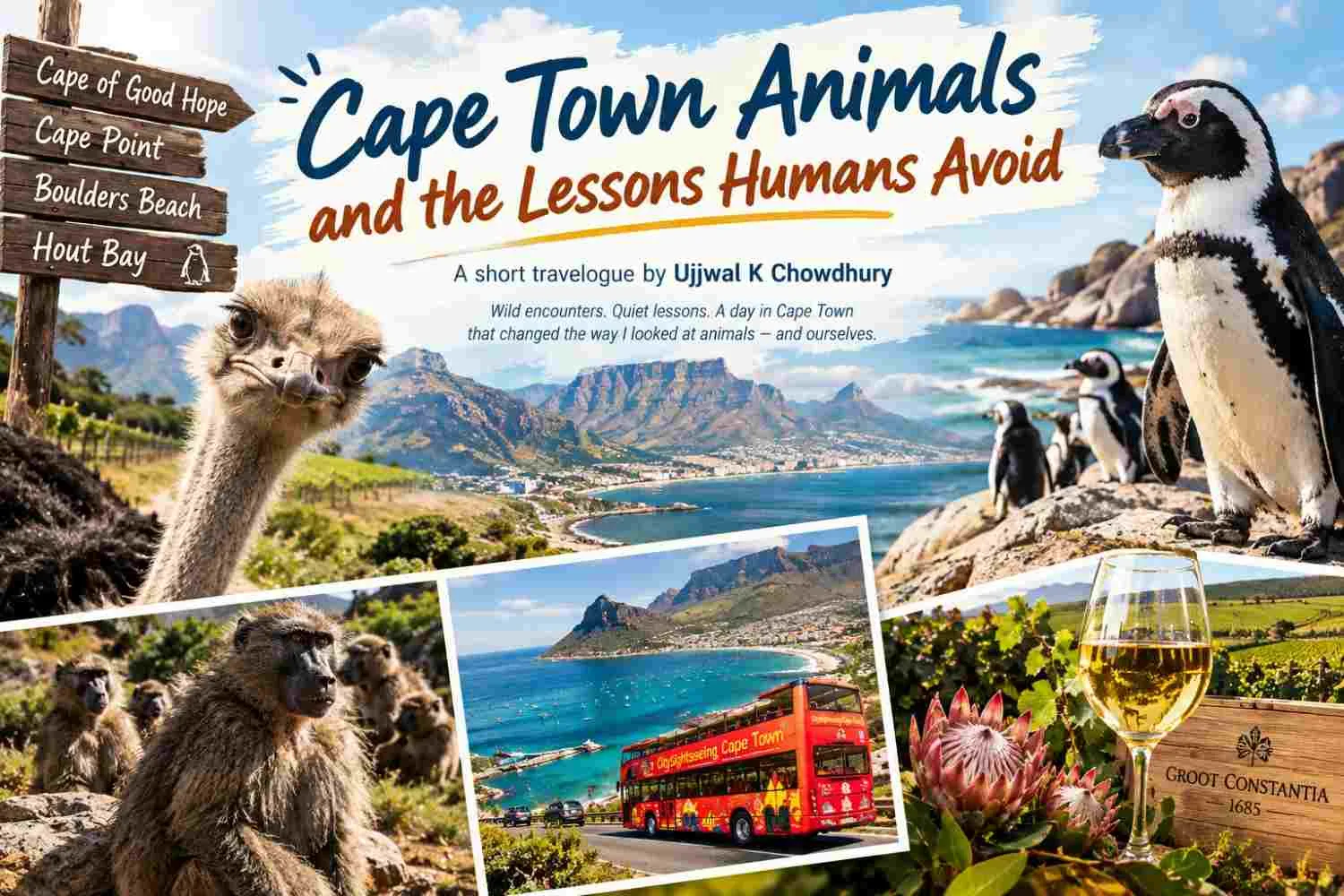
| From ostriches and baboons to seals and endangered African penguins, a day around Cape Town's wildlife becomes an unexpected lesson in humility, conservation and the limits of human entitlement. |
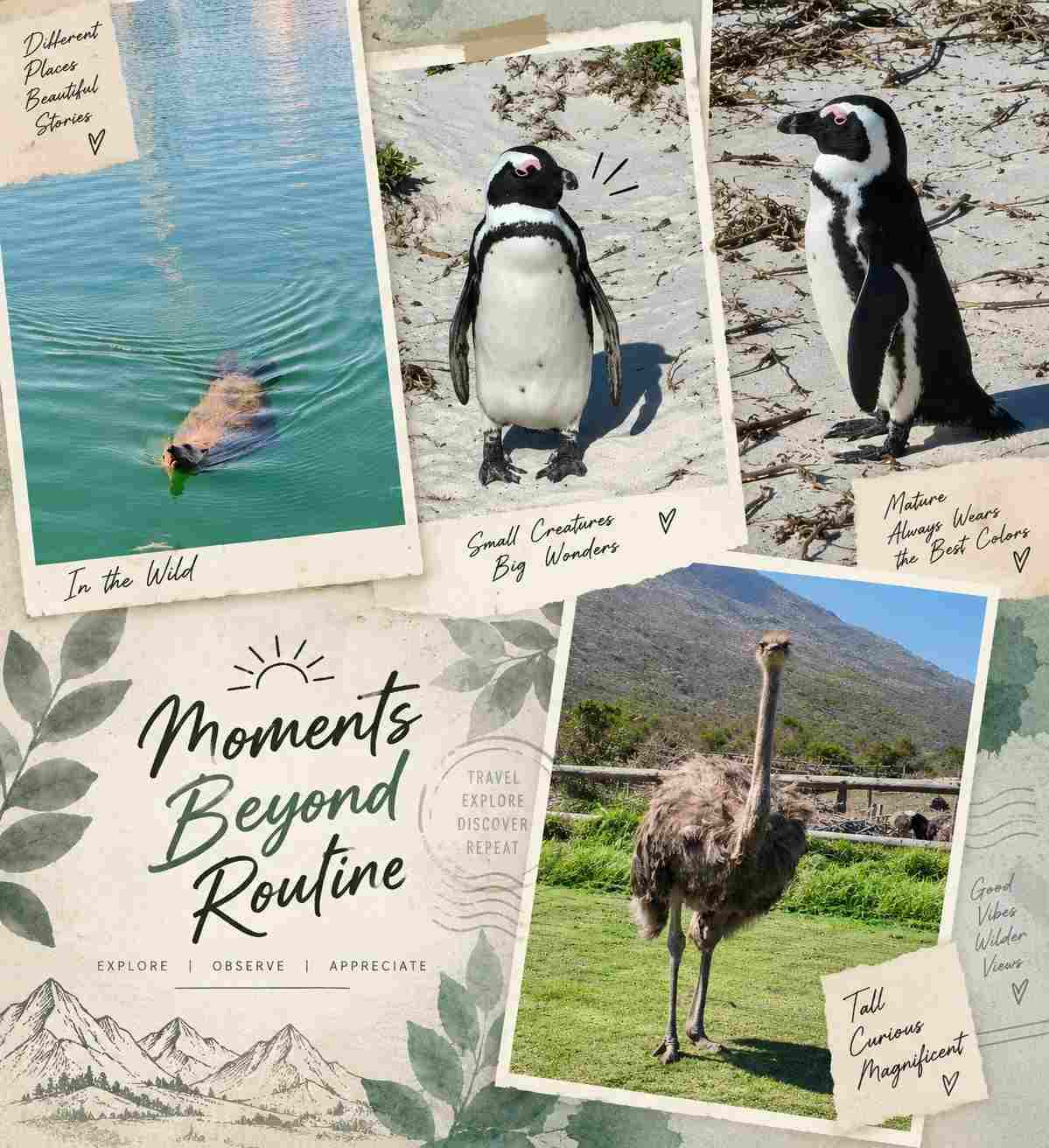
People travel thousands of miles to meet people, admire architecture and photograph nature. On my last full day in Cape Town, nature reversed the arrangement: it gave me appointments with animals, and I arrived with a camera and the usual confidence that the world was arranged for our inspection. A short date with animals that Ujjwal K Chowdhury will remember for a long time.
The Peninsula at the Edge
We set out for the Cape Peninsula, toward the Cape of Good Hope and Cape Point. The names sound interchangeable, but they are not. The Cape of Good Hope is the celebrated southwestern promontory; Cape Point is the nearby headland with two lighthouses. The real southernmost point is Cape Agulhas, a fact geography supplies whenever tourism gets too poetic. Bartolomeu Dias called this coast the Cape of Storms in 1488; Portugal's King John II later gave it the hopeful name that survived.
All of it lies within Table Mountain National Park, stretching roughly 70 kilometres from Signal Hill to Cape Point. This is not merely a mountain reserve but part of the Cape Floral Kingdom, a UNESCO World Heritage landscape where fynbos - fine, tough, fire-adapted vegetation - produces abundance from stingy soil. Proteas, ericas and restios fill the slopes, while the King Protea, South Africa's national flower, announces that elegance need not be delicate.
The road also offered a lesson in Cape Town's social geography. Hout Bay and Chapman's Peak carry the glamour of sea-facing homes and high property values. In the same wider valley stands Imizamo Yethu, an informal settlement whose isiXhosa name means "our common effort." Beauty and inequality share the same view. The mountain does not hide who lives beside it and who crosses it for work.
The Ostrich with the Night Shift
At an ostrich farm, a few birds came close to the wire, not quite tame and not interested in our passports. The males wore black with white wing feathers; the females a quieter grey. The largest living bird cannot fly, but it can run at extraordinary speed, pivot on two toes and look at a tourist with the authority of a creature that knows the tourist cannot keep up.
Ostriches eat mostly plants, along with insects and other small items, and can go for long periods without drinking. During breeding, a male may court several females and scrape a communal nest. The female incubates by day, blending into the earth; the male takes the night shift, disappearing into darkness. Even the ostrich has a practical division of labour. Humans, with our committees and relationship podcasts, still negotiate who will answer the message.
The guide asked whether Indians eat ostrich meat. Ostrich farming is an established Western Cape economy, linked to meat, leather, feathers and tourism, especially around Oudtshoorn. I understand that livelihoods are complicated. Still, after a bird tilted its head at me with comic dignity, I could not imagine lunching on it. I claim no saintliness - human food systems are full of contradictions - but that bird had become a person in my travel story, and people are difficult to order medium rare.
A Landscape that Refused to Be One Country
We drove through long stretches of the reserve, where fynbos lay low beneath the wide sky. The hills, sea and sharp light made the landscape feel like a meeting between the Andes and the Himalayas, with a South African accent. In the distance, eland and other antelope moved across the ground. The park includes bontebok, red hartebeest and zebra, but I was denied the cinematic herd I wanted.
Instead, a large snake crossed the road. It was dark, marked with gold, and unimpressed by our vehicle. I could not identify it, so I will not pretend to be a field biologist after one glance through a windscreen. It slid away with the confidence of a citizen who had not requested a road. Humans name everything and behave as if naming grants ownership. The snake needed neither label nor applause.
The Bay that Was Named by Mistake
At Mariner's Wharf in Hout Bay, we took a boat toward Duiker Island, a rocky haul-out for Cape fur seals. This was the Atlantic side; False Bay lies beyond the peninsula, toward Simon's Town and warmer waters. Its name is an old navigational joke: sailors returning from the East mistook Cape Hangklip for Cape Point and confused False Bay with Table Bay. A human error became a permanent label - proof that our mistakes receive official signage.
The seals were the stars. Some lay in heaps on the rocks, some rolled into the water, and others surfaced with whiskers twitching as if mildly interested. They were Cape fur seals, not plush toys: social, vocal divers that rest on land and hunt fish and squid at sea. Their eyes looked gentle, but gentleness is not consent and wildness is not an invitation to touch.
Tourists were offered fish to throw to the seals for a fee. The transaction was entertaining and revealing: humans had travelled to an animal's home, charged one another for access, then bought a snack to make the animal perform near the boat. I watched without feeding them. They were capable of being magnificent without our hospitality package.
The Abundant Baboons with a Streak of a Memory
The baboons seemed to be everywhere in the Nature Reserve Park—along the roadside, on the rocky slopes and near the bends where our vehicle slowed to watch them. At first glance, they reminded me of the Indian monkeys familiar from towns, temples and childhood stories, though these animals were a little larger, heavier and more powerfully built. Still, resemblance is not identity: these were baboons, not the Indian monkeys, with their own families, calls, hierarchies and unruly intelligence. Their presence also brought back my childhood name, “Babun,” a name my mother and her side of the family used with affection. My maternal elder cousin mischievously turned it into “Baboon” and would explain that I resembled the real animals because of my restlessness and occasional flashes of anger. Looking at them now, I could not dismiss his diagnosis entirely. The baboons at least seemed honest about their moods; when annoyed, they showed it openly. Humans, by contrast, often hide their irritation behind polite smiles, official emails and the remarkable claim that they are “fine.”
Penguins at the Edge
The day's final encounter came at Boulders in Simon's Town. First there was one African penguin, then two, then a procession from the rocks, sand and sea. They were small, upright and determined, with the comic seriousness of officials arriving late to a meeting. Their braying calls explain the old nickname "jackass penguin," though the birds have done nothing to deserve it.
African penguins are the only penguin species breeding on the African continent, along the coasts of South Africa and Namibia. The Boulders colony began in 1983 and is one of the few land-based colonies visitors can see from boardwalks. The boards keep fingers, shoes and selfie sticks away from birds already under pressure. The signs say do not touch or feed them; for once, a tourist instruction is also a moral philosophy.
Their bodies are marvels of adaptation. They eat sardines and anchovies, dive through cold water, then return to rest. Salt glands above their eyes remove excess salt. Once a year they moult completely, staying ashore for roughly three weeks while replacing feathers on stored fat. They sleep in short spells between feeding, guarding and colony negotiations. It is a demanding life, made harder by food scarcity, overfishing, pollution, habitat loss and climate change.
The African penguin is globally Critically Endangered, with fewer than 10,000 breeding pairs remaining. That statistic sat uneasily beside the tourists' delight. The colony supports conservation work, guides, restaurants and guesthouses, but the penguins are not a tourism product first. They are trying to survive the consequences of human appetite.
People often say that penguins choose one partner for life and die soon after a partner dies. The truth is less sentimental: many pairs remain together across breeding seasons and share incubation and chick-rearing, but a survivor can re-pair. Nature does not need romantic exaggerations. The real lesson is harder. Penguins keep returning, feeding, moulting and raising young while the sea changes. Humans, who write poems about loyalty, are often less reliable with the planet that feeds us.
By evening, I had not automatically become a better human. I had been reminded that animals do not exist to decorate our itineraries. We travel thousands of miles to see them while they remain busy living, feeding, resting and surviving. Their patience is not permission. Their beauty is not property. Cape Town gave me a day with animals; they returned the gift as embarrassment. They were trying to stay alive. We were making captions and clicking photographs.


Add a Comment