
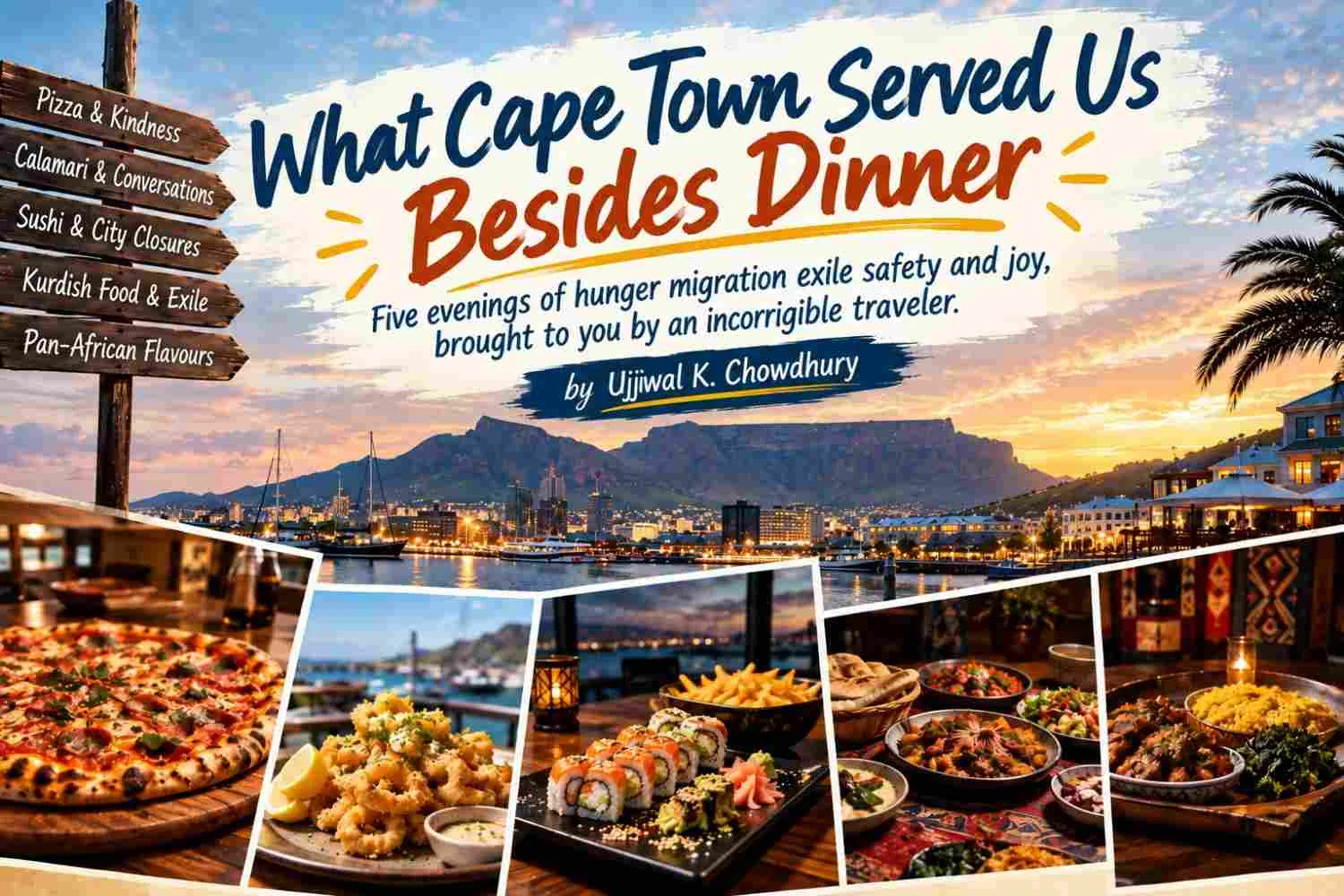
| Five dinners across Cape Town become five unexpected windows into hunger, migration, safety, exile and joy—proving that sometimes a city reveals itself most honestly around the dinner table. |
Summary A five-night dinner trail across Cape Town becomes an unexpected way of understanding the city beyond its food. The first evening, two slices of pizza offered to a hungry man turn dinner into a reflection on hunger, housing and inequality. A conversation with Rashid, a Bengali-speaking migrant from Barisal, reveals how migration can be shaped by skill, family networks, risk and hope. A rushed meal of sushi and chips highlights how business hours, transport and safety influence who can experience the city after dark. Kurdish food opens a conversation about exile, cultural identity and the experience of a people without a sovereign state. The final evening at Mama Africa brings music, food and celebration, leaving the larger lesson that Cape Town's dinner tables can reveal stories of struggle, movement, memory and joy. |
Five evenings of hunger migration exile safety and joy, brought to you by an incorrigible traveler, Ujjwal K Chowdhury
I came to Cape Town for an official programme. After a day of listening and speaking, the body keeps its own score. For five nights, Mathew and I ate in five different rooms. The food changed, but so did the city around it. By the end, dinner had become a way of reading Cape Town through hunger, migration, safety, exile and joy.
Night One: Pizza and the Two Pieces That Changed the Table
The first dinner was near Cape Town Station, in a modest single-storey pizza shop. We sat beside the glass wall and ordered a double-meat pizza that arrived with the confidence of a dish that had never met a small appetite. It was huge. Halfway through, a man over sixty came to the other side of the glass. Visibly hungry, he asked to be fed. He did not ask for money. He asked for food.
Mathew went outside and gave him two slices. The man did not eat them. He ran to a younger man waiting nearby and handed over the pieces. Hunger had made him a messenger before it made him a diner. I have seen hunger in India all my life, so it is never abstract. Yet the scene unsettled us. Cape Town is praised for beauty and administration, but recent reporting based on city data describes a housing divide: 18.8 percent live in informal housing and more than 400,000 were on the social-housing waiting list in 2024. No urban success story is complete when a meal must pass through glass.
Night Two: Calamari and a Bengali Voice
After the first day of the Global Entrepreneurship Network Congress at the Cape Town International Convention Centre, we wanted a simple dinner. We found a smaller restaurant and ordered chips, calamari and a drink. Halfway through, I heard the man at the cash counter speaking in a Bengali dialect close to Bangladesh.
His name was Rashid, from Barisal. He had arrived in Cape Town four years earlier after eight years in Dubai. In his early twenties he had gone there with his elder brother-in-law and started as a waiter in an Indian restaurant. He learnt English and Arabic, understood the business from kitchen to counter, and grew into management.
A childhood neighbour from Bangladesh had taken this restaurant on lease from an African owner and brought Rashid in on profit share. He said he earned more than twice what he had in Dubai. His family remained in Bangladesh, and he returned around Ramadan and Eid. The calamari was pleasant, but Rashid was the real meal. His journey showed me that migration travels through language, kinship, skill, risk and hope.
Night Three: Sushi and Chips Before the City Shut
The third evening was less dramatic, which is also a travel lesson. At seven, we went to a food mall expecting dinner and found shutters coming down. We hurriedly bought sushi, chips and whatever else could be packed, then carried it to the Holiday Inn Express. Sushi and chips made an accidental marriage, but hunger is a generous matchmaker.
Cape Town does have late bars and restaurants around Long and Bree streets, but its evening life is not one continuous festival. It is shaped by location, transport, business hours and safety. Homeless people were gathering outside as shops closed, and we felt uneasy about petty theft. But I also had to correct my first impression: a person without a home is not automatically a criminal. Homelessness and crime may share an urban geography, yet they are not the same thing.
We learnt that nightlife is also a map of who feels safe enough to stay outside. Cape Town can have a mountain for a backdrop while inequality and violent crime remain awake after the shutters come down.
Night Four: Kurdish Food and a People Without a State
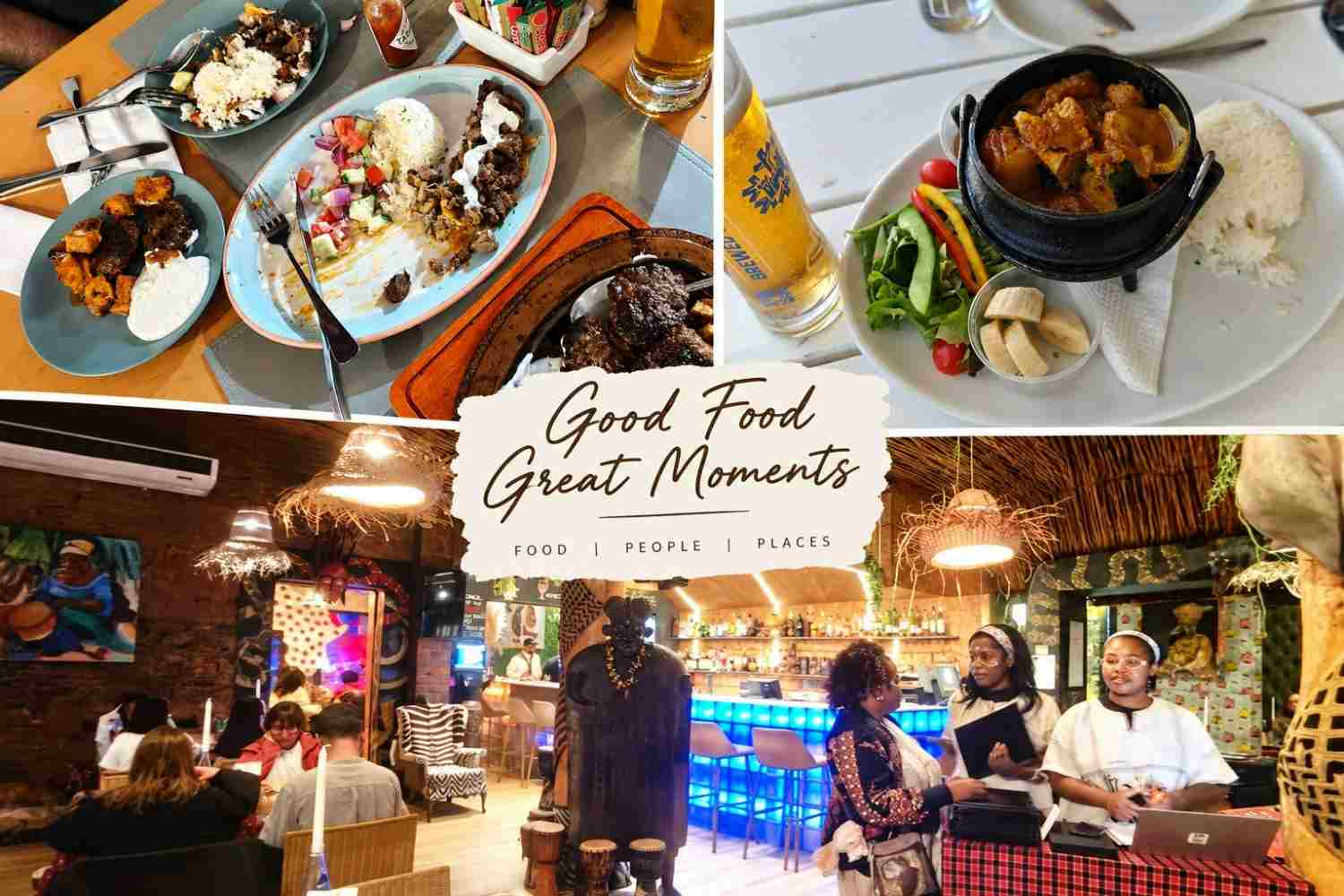
By the fourth night, dinner became a question. We went to a large Mesopotamian Kurdish restaurant, described as the only Kurdish restaurant in town. It was run by Baran Kalay, a Kurdish man living in exile. I asked to meet him. He joined us, and the plates became a map.
My background in International Relations education made me curious about Kurdish life and the Yazidis. Baran spoke of Kurdish communities across Turkey, Iraq, Iran and Syria, and of a diaspora beyond the region. The numbers vary, but the broad reality is clear: Kurds are one of the world's largest peoples without a sovereign state. Their language and cultural rights have been caught between nationalism, war and stronger powers.
Yazidis are a distinct ethno-religious minority, many of Kurdish heritage. The 2014 ISIS assault in northern Iraq was recognised by a United Nations inquiry as genocide. Hundreds of thousands were displaced, and thousands of women and children were abducted or enslaved. The facts are unbearable; Baran's quiet way of carrying them made them heavier.
He felt that attention to Palestine had been justified, while Kurdish claims for self-determination and cultural-linguistic autonomy received less sustained notice. That was his judgement. We had entered for Kurdish food and found an exile's small embassy. Every restaurant run by a displaced people serves memory without a passport.
Night Five: Mama Africa and the Evening That Refused to Sit Still
The last dinner was the most colourful, theatrical and expensive of the five. Mama Africa on Long Street has served Pan-African food since 1995, with live marimba, drumming and dance. Its menu crosses the continent, from Cape Malay flavours to Moroccan and Mozambican influences, with game meats such as springbok, kudu, ostrich and crocodile. I chose a fish fillet, one of the best I had eaten in a very long time.
The restaurant was managed largely by African women. One young woman, younger than my daughter, came to paint my face. A marine-sciences graduate working evenings, she created a design that reminded me of birthday face painting in Bengali families. For a few minutes, she turned my face into a small festival, drawing a bright shore across my forehead.
Then the marimba began, dancers entered and performers pulled the audience into the room. We ate, laughed and danced among mostly foreign patrons. The evening did package Africa as dinner, music and movement, but the warmth was genuine. People were working, creating and hosting, not performing a museum piece. The bill made us wince, but some evenings charge for memory as much as fish.
Five dinners, five recognitions
The pizza taught me that food can become a moral choice before it becomes culinary. Rashid showed me that a restaurant may be an immigration story with a cash counter. The closed food mall revealed how safety shapes a city's hours. Baran reminded me that cuisine can carry a people through exile. Mama Africa restored the right to end a serious journey with music and colour. I left with conference notes, but remember the people who appeared when the plates arrived. A city is often more honest at dinner than

Add a Comment