Total Articles 231+

Core Review Streams

Covers key sustainability themes, analyzing practices, challenges, and innovations shaping environmental and corporate responsibility.

Showing 12/65

12 Aug 2026

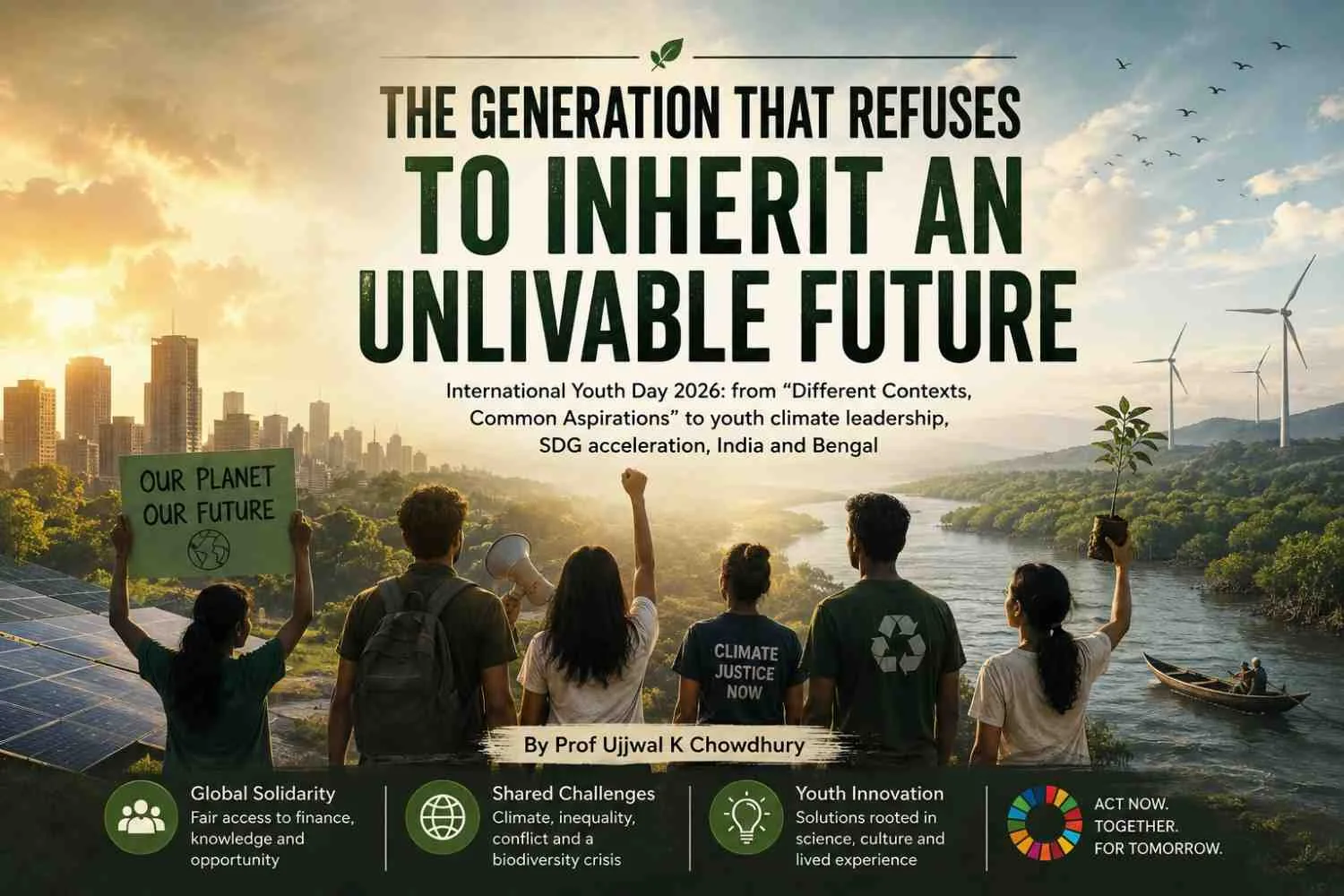
International Youth Day 2026: from “Different Contexts, Common Aspirations” to youth climate leadership, SDG acceleration, India and Bengal By Prof Ujjwal K Chowdhury International Youth Day 2026 is not officially a “climate day.” Its theme is broader: “Different Contexts, Common Aspirations.” Yet few issues reveal that idea more sharply than climate change. From Samoa to Sudan, Kampala to Stockholm, Tamil Nadu to the Sundarbans, young people are moving from beneficiaries of development to organizers, innovators, litigants, negotiators, translators, journalists and implementers of the SDGs. The challenge now is not to praise their courage from a distance, but to give them the skills, finance, protection and institutional power to shape the future they will live in. SUCCINCT SUMMARYThe UN observes 12 August as International Youth Day following a 1998 ministerial recommendation endorsed by General Assembly Resolution 54/120 in 1999. The 2026 theme, “Different Contexts, Common Aspirations,” is built around Global Solidarity, Shared Challenges and Youth Innovation. This feature uses climate leadership as an SDG lens: climate action intersects with food, health, education, water, clean energy, jobs, inequality, cities, ecosystems, governance and partnerships. It profiles twelve global youth voices, examines practical models of youth-led action, and places India—especially West Bengal—at the centre. Bengal’s opportunity is to graduate from episodic green activities to youth climate governance through a Sundarbans Youth Climate Corps, Kolkata climate labs, Bangla knowledge systems, green-skills pathways, micro-grants and youth seats in decision-making. HASHTAGS  #InternationalYouthDay #YouthDay2026 #DifferentContextsCommonAspirations #YouthClimateLeadership #SDGs #ClimateAction #ClimateJustice #GreenSkills #YouthInnovation #India #Bengal #Sundarbans #Kolkata #ActNow   12 AUGUST: NOT A GREETING CARD, A GOVERNANCE QUESTION On 12 August, the United Nations does more than “celebrate youth.” International Youth Day is a reminder that the generation expected to live longest with today’s decisions must have power in making them. The date itself carries a policy lineage. Young people at the first World Youth Forum of the United Nations System in Vienna proposed an international youth day in 1991. The World Conference of Ministers Responsible for Youth, meeting in Lisbon from 8–12 August 1998, recommended 12 August as the observance. The UN General Assembly endorsed that recommendation on 17 December 1999 through Resolution 54/120, and the first International Youth Day was observed in 2000. The purpose was deliberately larger than ceremony: to draw public attention to youth issues and strengthen awareness of the World Programme of Action for Youth. In other words, 12 August is a day of visibility, participation and accountability. It asks governments, universities, businesses, civil society and the UN system to stop treating young people as a future constituency and start treating them as present-tense partners. That is especially urgent in a decade defined by climate disruption and a race to rescue the Sustainable Development Goals. Young people are not simply inheriting climate change. They are already living through heat stress, floods, wildfire smoke, polluted air, water insecurity, displacement, disrupted education, precarious work and climate anxiety. UNICEF’s 2026 Children’s Climate Risk Report says more than a billion children face at least three overlapping climate hazards. Youth climate leadership therefore is not a fashionable add-on to sustainable development. It is increasingly one of the places where the SDGs become real.   2026: DIFFERENT CONTEXTS, COMMON ASPIRATIONS GLOBAL SOLIDARITYSHARED CHALLENGESYOUTH INNOVATIONFair access to finance, technology, education and opportunity.Jobs, education, climate, digital inclusion and mental well-being cross borders.Youth-led social enterprise, climate tools, community action and civic innovation.   The official UN theme for International Youth Day 2026 is “Different Contexts, Common Aspirations.” That distinction matters. “Youth Climate Leadership and the SDGs” is a powerful lens through which to interpret the day, but it is not the formal UN theme. The 2026 framing begins with a simple truth: a young entrepreneur in a Small Island Developing State, a student in a landlocked country, a climate organizer in a Least Developed Country and a graduate in Kolkata may inhabit radically different economies and ecologies, yet share remarkably similar aspirations—quality education, decent work, health and mental well-being, a voice in decisions, dignity and the chance to build a viable future. UN DESA organizes the 2026 observance around three connected ideas. First, Global Solidarity: opportunities for youth depend on cooperation, fair access to finance, technology, education and resources. Second, Shared Challenges: employment, education gaps, climate change, digital exclusion and mental stress cross borders even when their intensity differs. Third, Youth Innovation: young people are not simply describing problems; they are building social enterprises, climate tools, community networks and new forms of civic action. Climate change runs through all three. It exposes inequality between countries and communities; it multiplies shared risks in food, water, health, cities and jobs; and it is generating some of the most inventive youth-led responses. For young people in SIDS, climate risk can mean the physical survival of homelands. For youth in the Sundarbans, it can mean salinity, embankment failure and migration. For city youth, it can mean lethal heat, air pollution or flooded streets. Different contexts; unmistakably common aspirations.   CLIMATE IS NOT JUST SDG 13 The mistake is to place youth climate action in a box marked SDG 13. Climate leadership is an SDG multiplier. A young farmer using climate-resilient methods touches SDG 2 on hunger, SDG 8 on livelihoods and SDG 13. A student campaign for clean air intersects with SDG 3 on health and SDG 11 on sustainable cities. Mangrove restoration links climate action with SDGs 14 and 15 on oceans and terrestrial ecosystems while protecting incomes and settlements. Climate education connects SDG 4 with future green skills. Clean-energy innovation links SDG 7 with decent work. Youth participation in municipal planning and litigation activates SDG 16 on accountable institutions. Partnerships for finance, technology and scale invoke SDG 17. Young people add a distinctive political force to this web. They translate complex science into peer language. They organize through networks faster than many institutions. They expose the gap between promises and implementation. They experiment with technology and behaviour. Above all, they introduce intergenerational justice into public reasoning: what does a development decision look like when the people who will bear its longest consequences are in the room? KEY IDEA  |  Climate leadership is an SDG multiplier: one youth-led intervention can move health, education, water, energy, jobs, cities, ecosystems, justice and partnerships at the same time.  WHY YOUTH LEADERSHIP WORKS DIFFERENTLY Youth leadership also changes the method of development. Traditional programmes often begin with institutions, budgets and sectoral silos; young organizers frequently begin with lived friction—a flooded lane, an unsafe water source, plastic in a lake, a missing tree canopy, a school without cooling, a community that cannot access climate information. They then connect the problem to networks, media, science and public authority. This “problem-first” approach can make the SDGs legible at neighbourhood scale. A UN example from Mathare in Kenya illustrates the pattern. Youth-led community work around clean-ups, tree planting and water initiatives can simultaneously advance sustainable cities, climate action and clean water while mobilizing residents and local authorities. The point is not that volunteering substitutes for public infrastructure. It is that young people can act as connectors between community evidence and systems that otherwise operate at a distance. Young leaders also insist on intersectionality because their lives do not arrive in ministerial departments. A cyclone is simultaneously an education event if schools close, a health event if water is contaminated, a gender event if care burdens rise, an employment event if livelihoods disappear, and a migration event if families move. Climate anxiety similarly cannot be dismissed as a soft issue when insecurity about heat, jobs, disasters and the future affects mental well-being. The 2026 UN theme recognizes exactly this interconnectedness. Finally, youth networks are unusually capable of combining local identity with global solidarity. A student in Kolkata can learn from Pacific advocacy on sea-level rise; a Sundarbans youth group can exchange tools with mangrove communities elsewhere; an Indigenous Indian activist can connect land rights to global biodiversity debates. Digital platforms make those bridges possible, although unequal access means digital inclusion itself remains part of the agenda.   TWELVE VOICES THAT CHANGED THE CLIMATE CONVERSATION Twelve youth voices show how wide this repertoire has become. Greta Thunberg of Sweden turned a solitary school strike in 2018 into the global Fridays for Future movement. At the 2019 UN Climate Action Summit, her accusation that leaders were “failing us” made the credibility gap between climate science and political action impossible to discuss as a technical matter alone. Her enduring contribution is intergenerational accountability: targets mean little without delivery. Vanessa Nakate of Uganda brought African climate justice into a conversation too often dominated by wealthier countries. Through the Rise Up Climate Movement and work around renewable energy, schools and the Congo Basin, she has insisted that climate change is about people, livelihoods and survival. She helped normalize demands that adaptation, loss and damage and climate finance must reflect those already on the frontlines. Xiye Bastida, an Indigenous Otomi-Toltec activist from Mexico based in the United States, co-founded the Re-Earth Initiative and has pushed climate movements to center Indigenous knowledge and frontline communities. Her public argument is that Indigenous peoples are not decorative “stakeholders” in climate policy; their rights, land stewardship and knowledge must shape decisions. Elizabeth Wathuti of Kenya founded the Green Generation Initiative. Its model joins environmental education with greening schools, fruit-tree planting, food forests and an adopt-a-tree culture. Her example shows why restoration works best when biodiversity, nutrition, education and community ownership reinforce one another. Autumn Peltier, an Anishinaabe water protector from Canada, brought clean water and Indigenous rights to global forums while still very young. Her leadership reframed water security as a moral, treaty and human-rights issue—not merely an infrastructure problem. In a warming world, that is also climate adaptation. Brianna Fruean of Samoa has carried Pacific youth perspectives into global climate spaces, including COP26. Her presence makes an essential point: Small Island Developing States are not marginal to the climate debate. Their experience turns abstract arguments about sea-level rise, adaptation and finance into questions of culture, sovereignty and survival. Nisreen Elsaim of Sudan moved from activism into climate negotiation and served in the UN Secretary-General’s first Youth Advisory Group on Climate Change. Her work connects climate vulnerability with renewable energy, development, governance and security. She embodies the transition from youth being invited to side events to youth participating in policy architecture. Sophia Kianni of the United States founded Climate Cardinals, which has worked to translate climate information into more than 100 languages. That is climate justice through knowledge. If science, warnings and policy options remain linguistically inaccessible, millions are excluded from meaningful participation before a meeting even begins. Archana Soreng of India, from the Kharia Indigenous community, served on the Secretary-General’s Youth Advisory Group and advocates documenting and protecting traditional knowledge. Her core message is radical in its clarity: Indigenous people and young people should be leaders of climate action, not victims of climate policy. She places land rights, identity and ecological knowledge inside contemporary governance. Ridhima Pandey of India showed that the courtroom can also be a youth climate arena. She petitioned the Indian government on climate inaction when she was nine and later joined an international child-rights climate complaint. Her contribution is to frame climate failure as a question of children’s rights and duties owed across generations. Licypriya Kangujam of India began campaigning as a child and has pushed climate education, stronger environmental laws and public attention to pollution and disasters. Her persistence shows the importance of making climate literacy part of basic civic education rather than leaving it to specialist environmental courses. Vinisha Umashankar of Tamil Nadu represents another route: invention. Her solar-powered ironing cart was designed as an alternative to charcoal-fired street irons, linking cleaner air and renewable energy with the livelihoods of ironing vendors. As an Earthshot Prize finalist and a COP26 speaker, she turned a locally observed problem into a globally legible clean-tech idea. Together these leaders break the stereotype of the youth climate activist as only a protester. The contemporary repertoire includes protest, litigation, negotiation, translation, engineering, ecological restoration, Indigenous knowledge, entrepreneurship, journalism and policy design.   FROM PROTEST TO PRACTICE: THREE MODELS THAT SCALE Three case studies reveal why this breadth matters. First, Wathuti’s “school as ecological laboratory” model. When students plant and tend fruit trees or food forests, climate learning leaves the textbook. Children observe soil, water, shade, biodiversity, nutrition and the long time-scale of living systems. The lesson for education systems is profound: sustainability becomes a practice, not a chapter. Second, Kianni’s multilingual climate knowledge. Climate information is still heavily concentrated in English and technical language. Translation expands who can act. In India, this principle should move climate information through Bangla, Hindi, Odia, Tamil and Indigenous languages so that a cyclone warning, heat-risk protocol, farming adaptation guide or waste handbook is genuinely public knowledge. Third, Vinisha’s solar ironing cart. Climate innovation is strongest when it solves several problems together. The cart tackles charcoal smoke and deforestation pressures while preserving a familiar livelihood and adding the possibility of phone charging and mobility. That is the SDG mindset at its best: clean energy without forgetting jobs.   INDIA: FROM BENEFICIARIES TO CLIMATE PARTNERS India is one of the world’s most consequential arenas for youth climate leadership because its scale is immense and its vulnerabilities are diverse. UNICEF describes young Indians organizing in courtrooms, classrooms, neighbourhoods and online spaces; national youth statements have demanded that children and young people be placed at the centre of resilience and climate policy. The UN in India’s #WeTheChange campaign has likewise showcased young people working across renewable energy, forestry, climate finance, sustainable agriculture, disaster-risk reduction, ecosystem restoration, water and waste. There is also an institutional turn. The UNDP-TERI Mission LiFE Youth Ambassadors Programme, launched in 2026, aims to put young leaders and higher-education institutions at the forefront of sustainability through behaviour change and zero-waste campus systems. This is significant because the next phase of youth action cannot depend only on heroic individuals. It needs repeatable pathways: climate education, green skills, grants, procurement opportunities, internships, representation in public bodies and access to data. India’s youth climate agenda should therefore move from “awareness” to co-governance. A climate club is useful; a youth seat on a city climate committee is more consequential. A hackathon is exciting; seed finance and public procurement for its best solution are better. A plantation drive is valuable; youth participation in biodiversity budgeting and survival audits is deeper.   BENGAL: A LIVING CLIMATE CLASSROOM West Bengal may be one of India’s most complete classrooms for climate leadership because the state compresses multiple climate realities into one geography. In the Sundarbans, sea-level rise, cyclones, salinity, embankment stress, erosion, livelihoods, migration and mangrove ecology meet each other every day. In Kolkata, the agenda shifts to urban heat, air quality, mobility, solid waste, ponds, wetlands and development pressure. In the western plateau and northern districts, water, forests, agriculture and Indigenous ecological practices form another set of realities. “Different Contexts, Common Aspirations” could almost have been written for Bengal. The most telling youth stories are often local. In Murshidabad, UNICEF’s Community Youth Reporter Programme, designed with IMAGIN Community Media and the Press Club Kolkata, enabled 17-year-olds Rimjhim Mandal, Soumiki Chakraborty and Shraddha Sarkar to document a pond near their school that had deteriorated into a garbage dump. They did not stop at reporting. They proposed cleaning and deepening the pond, helping trigger conversations among residents and local authorities. In one modest story, SDG 6 on water, SDG 11 on communities, SDG 13 on resilience and SDG 16 on civic accountability meet. In Kolkata in March 2026, NGO SHER, Scottish Church College and TERI School of Advanced Studies brought representatives from 28 schools into a “Knowing Climate Change” workshop and launched a Climate Ambassador Programme. Students encountered climate science, urban resilience, policy, analytical tools and applications of AI in environmental monitoring. The significance lies in the progression: from climate literacy to a role identity—ambassador—and then to local projects. At Subhas Sarobar, a 2026 plogging and wetland-conservation activity organized by the West Bengal Pollution Control Board, WWF West Bengal and KMDA involved 32 students from Classes VI to VIII. A clean-up alone will not solve urban waste systems, but it makes pollution visible, turns a waterbody into a learning site and can recruit long-term citizen stewardship. These examples echo the attached source document’s larger insight: Bengal must move from scattered “green activities” to youth climate governance. SEVEN MOVES BENGAL SHOULD MAKE NOW A serious Bengal strategy could be built around seven moves. One: create a Sundarbans Youth Climate Corps. Train local young people in mangrove ecology, salinity and water monitoring, cyclone preparedness, citizen science, sustainable aquaculture, solar systems, climate communication and resilient livelihoods. Pay them where the work provides public value. Two: establish Kolkata Youth Climate Labs. School, college and university teams could audit ward-level heat, trees, ponds, wetlands, waste, mobility and energy, with standardized data feeding municipal planning rather than ending as exhibition posters. Three: launch a Bangla Climate Knowledge Mission. Translate rigorous climate science, disaster guidance and green-skills material into accessible Bangla and local dialects. Make climate knowledge usable by schools, panchayats, fishers, farmers, self-help groups and local media. Four: reserve meaningful youth participation in climate-relevant governance—municipal consultations, biodiversity committees, wetland dialogues, disaster planning and panchayat-level resilience work. Representation must include girls, rural youth, Indigenous and marginalized communities, not only metropolitan student leaders. Five: create green innovation micro-grants. Small sums, quickly disbursed, could finance prototypes in water, cooling, waste, clean energy, mangroves, sustainable agriculture and climate-tech. Pair grants with mentors and routes to procurement. Six: build a Bengal Green Skills Pathway across schools, ITIs, polytechnics and universities for solar, EV systems, batteries, green buildings, sustainable tourism, biodiversity, environmental data, ESG and climate-resilient agriculture. Climate leadership must also lead to dignified work. Seven: create district youth climate-journalism networks. The Murshidabad model shows why. Environmental damage often remains politically invisible until it is documented. Train young reporters in evidence, mobile storytelling, data, verification and solutions journalism. The principle behind all seven is the same: do not romanticize youth action while withholding power and resources.   DON’T OUTSOURCE THE CRISIS TO THE YOUNG There is a danger in celebrating young climate heroes. Governments, companies and older generations can applaud a teenager planting mangroves while continuing the policies that destroy coasts; praise students carrying steel bottles while failing to regulate industrial pollution; celebrate clean-ups while underfunding waste systems. That reverses responsibility. Youth leadership must supplement, not absolve, state responsibility, corporate accountability and adult political leadership. The right response to youth courage is not to outsource the crisis to them. It is to give them knowledge, finance, safety, institutional authority and access to decisions, while those with larger legal and economic power meet their own obligations.   LEADERS OF TODAY—BECAUSE TOMORROW IS TOO LATE Perhaps the most outdated compliment we still offer young people is: “You are the leaders of tomorrow.” For the climate generation, tomorrow is not an adequate timetable. Greta Thunberg changed political language before she could vote. Autumn Peltier addressed global leaders as a child. Ridhima Pandey used legal institutions before adulthood. Archana Soreng carried Indigenous knowledge into a UN advisory structure. Vinisha Umashankar turned a street-side observation into a clean-energy prototype. Three schoolgirls in Murshidabad used reporting to make a polluted pond a civic question. These are not rehearsals for citizenship. They are citizenship in practice. That is the deeper meaning of International Youth Day 2026. Different contexts: a Samoan island, an African school, an Indigenous forest, a Tamil Nadu street vendor, a Kolkata wetland, a Murshidabad pond, a cyclone-threatened Sundarbans village. Common aspirations: clean water, breathable air, meaningful work, education, dignity, participation, justice and a planet on which adulthood remains worth looking forward to. Young people have already answered the question of whether they care. The harder question is directed at institutions: will we give them the seat, the skills, the finance and the authority to convert concern into measurable change? On 12 August, celebration should become a contract. Listen to youth. Fund youth. Protect youth civic space. Teach climate literacy. Build green skills. Put youth into decision-making. And then judge success not by the number of speeches made on International Youth Day, but by whether a generation with everything at stake is finally allowed to help shape the future it will inherit.   SOURCES & VERIFICATION NOTES This feature integrates the uploaded YouthDay.docx as its editorial base, then independently checks the 2026 theme, UN history and key current/local claims. Current-event facts were verified on 12 August 2026 (IST). The article does not rely on unverified assertions from the source document. 1. United Nations — International Youth Day: Background 2. UN DESA Voice (July 2026) — What unites young people across borders? 3. United Nations — Closing Remarks at the 2026 ECOSOC Youth Forum 4. UNICEF — The Children’s Climate Risk Report 2026 5. UNICEF India — India’s Youth and Climate Change 6. United Nations in India — #WeTheChange youth climate leaders 7. United Nations — Youth Advisory Group on Climate Change 8. United Nations — Archana Soreng: Our voice matters 9. United Nations — Vanessa Nakate: Climate change is about the people 10. UNEP — Elizabeth Wathuti, Young Champions of the Earth 11. The Earthshot Prize — Vinisha Umashankar 12. UNICEF India — West Bengal’s Community Youth Reporters Drive Social Change 13. TERI — Mission LiFE Youth Ambassador Programme (2026) 14. Scottish Church College — “Knowing Climate Change” workshop listing, 30 March 2026 15. Times of India — 2026 Kolkata climate-literacy / Climate Ambassador workshop 16. Times of India — Students help make Subhas Sarobar plastic-free Verification caveat: As this document was prepared at the start of 12 August 2026 in India, it relies on UN DESA’s official July 2026 IYD framing and the April 2026 ECOSOC Youth Forum remarks for the 2026 theme and pillars. No unverified 2026 Secretary-General IYD message is quoted. ...Read more
10 Aug 2026

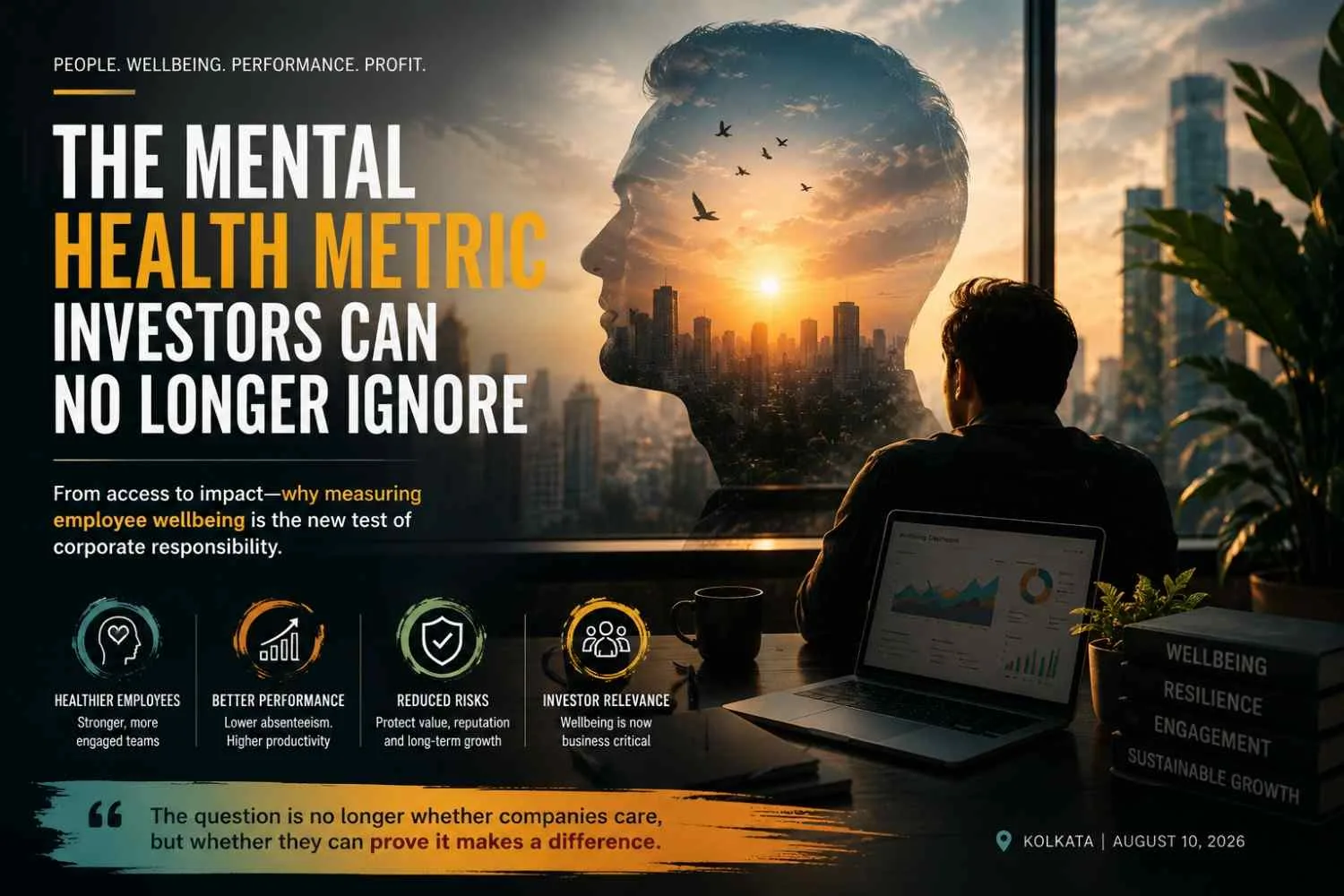
Kolkata | August 10, 2026 Employee mental health is moving beyond the HR department as companies, regulators and investors look at wellbeing as part of the “S” in ESG. The real test, however, is whether such programmes create measurable improvements in workers’ well-being- not merely whether an activity was organised. Quick SummaryWorkplace mental health is becoming harder for companies to treat it as a private HR matter. Employee-assistance programmes, counselling access and wellbeing initiatives are gradually appearing alongside broader workforce and social disclosures, while burnout, absenteeism and attrition are gaining attention as potential business risks. But measuring workplace wellbeing remains difficult. A company can report how many employees had access to a programme without showing how many actually used it, completed it or benefited from it. The gap becomes even wider for blue-collar, contract and gig workers, who may have fewer avenues to access mental-health support. As investors pay greater attention to the social side of ESG, the question is shifting from whether a company has a wellness programme to whether it can demonstrate a meaningful outcome from it. Can Employee Wellbeing Become an ESG Metric Investors Can Trust? For years, workplace mental health was largely treated as an HR responsibility. Companies organised counselling sessions, wellness workshops and employee-assistance programmes, often presenting them as workplace benefits aimed at improving employee morale. That approach is now changing. Mental health is gradually being linked to wider business concerns such as employee retention, absenteeism, productivity, workplace safety and governance risks. For investors examining the “S” in ESG, employee wellbeing can offer valuable insight into how responsibly a company manages one of its most important assets- its people. This shift comes at a time when corporate sustainability reporting is also becoming more structured. Under India's Business Responsibility and Sustainability Reporting (BRSR) framework, workforce-related information has become part of the broader discussion on responsible business practices. This creates an opportunity for employee wellbeing to move beyond general promises and become an area that can be assessed through clear evidence. But an important question remains: What should companies actually measure? Reporting that an employee-assistance programme exists only shows that support is available. It does not reveal how many employees used the service, whether they received continued support or whether the programme led to meaningful improvements. The gap between providing access and demonstrating results could become one of the biggest tests of credibility in workplace wellbeing reporting. The same applies to spending. A large budget for wellness programmes may look impressive in a sustainability report, but the amount spent alone cannot show whether the investment reached employees who needed support or whether it produced meaningful results. The challenge becomes even greater when looking beyond corporate offices. A wellbeing programme designed for salaried employees with access to private healthcare may not work in the same way for blue-collar, contract or gig workers, who may face different working conditions, financial pressures and barriers to accessing support. The real question, therefore, is no longer simply whether Indian companies are paying greater attention to workplace mental health. But whether their ESG reporting can provide credible evidence that these efforts are actually improving employees' wellbeing and working lives. Are Companies Measuring Wellbeing or Just Counting Participation? One of the biggest challenges in bringing workplace mental health into ESG reporting is measurement.  Companies can easily count the number of wellness programmes conducted, workshops organised or employees covered by an assistance programme. But these figures do not necessarily show whether employees are actually benefiting from them or not. This distinction is important because a programme can reach thousands of employees on paper while having very little real impact. A counselling service may be available across an organisation, for example, but only a small number of employees may use it. Others may hesitate because of stigma, concerns about confidentiality or simply a lack of awareness about the support available. This makes utilisation, completion and outcomes more meaningful indicators than programme availability alone. For investors, the difference can provide a much clearer picture of a company's social performance. Saying that 90% of employees have access to mental-health support shows the scale of the programme. Reporting how many employees actually used the service, completed the intervention and continued receiving support provides a better indication of whether that investment is making a difference. The same caution applies to employee burnout and turnover. High attrition may signal problems within the workplace, but it cannot automatically be linked to mental health. Factors such as salary, workload, management practices, career growth and job security can also influence an employee's decision to leave. This is where stronger ESG reporting can provide greater insight. Companies should also establish a clear baseline before measuring change, otherwise improvements in employee wellbeing cannot be meaningfully compared over time. Rather than relying on a single indicator, companies can look at employee turnover, absenteeism, engagement, workplace safety and access to wellbeing support together. Examining these factors side by side can help identify whether workforce wellbeing is becoming a broader business risk. Another important issue is who is actually covered by the data. A company may report strong wellbeing support for its permanent employees while excluding contract workers, outsourced staff or gig workers from the same programmes and disclosures. For businesses that rely heavily on such workers, this can create a significant gap between reported performance and the reality of the workforce. The expectation, therefore, is shifting from simply counting programmes to measuring the people they actually reach and the difference they make. A credible wellbeing metric should provide a clearer picture of who received support, who used it, what outcomes followed and whether support continued when required or not. Without such evidence, workplace mental-health reporting risks becomes another list of ESG activities rather than a meaningful measure of how a company is supporting its people. Wellbeing Beyond the PayrollThe corporate conversation around mental health often focuses on employees who are easiest to reach: permanent, office-based staff with access to HR teams, digital platforms and private healthcare. But India's workforce is much more diverse, and workers facing the toughest conditions may have the least access to mental-health support. For blue-collar workers, long hours, physically demanding jobs, safety concerns and limited flexibility can add to everyday pressures. Yet counselling and employee-assistance programmes may not be as accessible to them as they are to office employees. Shift workers may struggle to attend sessions during regular hours, while language barriers, limited awareness and concerns about confidentiality can discourage them from seeking support. The challenge can be even greater for contract and gig workers. Their relationship with a company often runs through contractors, vendors or digital platforms, creating uncertainty about who is responsible for providing mental-health support. As a result, a company may report strong employee-wellbeing figures while a significant part of its workforce remains outside formal support systems. This raises an important ESG question: Who is included when companies measure employee wellbeing? A narrow reporting boundary can make a company's social performance appear stronger than the experience of its wider workforce. For businesses that depend heavily on contract or outsourced labour, credible reporting should clearly state whether these workers are included, excluded or covered through separate arrangements. There is also a barrier that participation figures cannot fully capture: stigma. Employees may avoid counselling because they fear being judged, labelled as unable to cope or treated differently by managers and colleagues. Simply providing a helpline or counselling service, therefore, does not guarantee that employees will feel comfortable using it. Closing this gap requires more than an annual wellness campaign. Support must be accessible, confidential and trusted, and it needs to reach workers across different locations, shifts and employment arrangements. This is where the difference between wellness programming and a genuine wellbeing strategy becomes important. A wellness week may create awareness for a few days, but a meaningful ESG approach asks a deeper question: can workers access support when they actually need it, and is the company also addressing the workplace conditions that contributes to stress in the first place? Absolutely. I’d make this one tighter, more analytical and mass-friendly, while keeping the ESG and impact-measurement angle clear. I’d also avoid making it sound like a conclusion. When Wellness Becomes a Box-Ticking Exercise As workplace wellbeing gains importance in corporate ESG discussions, a new concern is emerging: are companies improving employee wellbeing, or simply adding mental-health initiatives to their ESG checklist?  A wellness week, meditation session or counselling app may show that a company is taking action, but it does not necessarily prove that employees are benefiting. This is where the difference between activity and outcome becomes important. An activity-based approach records what a company has done, while an outcome-based approach looks at what has changed as a result. For investors and other stakeholders, the second measure offers a much clearer picture of social performance. A more meaningful assessment could therefore consider indicators such as participation, programme completion, repeat use of support services, absenteeism trends, employee feedback and continuity of care. None of these measures can establish a direct cause-and-effect relationship on their own, but together they can show whether wellbeing initiatives are reaching the people they are intended to support. Investment also needs closer attention. If a company spends significantly on employee wellbeing, stakeholders should be able to understand how spending relates to the number of workers covered and the support provided. Budget allocation does not necessarily mean the money was spent, and spending alone does not demonstrate impact. Stronger reporting would connect financial investment with measurable reach and longer-term outcomes. Privacy is another critical concern. Mental-health information is highly sensitive, and employees may avoid seeking help if they fear that their participation could become known to managers or affect their careers. Companies therefore need clear rules on confidentiality, data collection, storage and access to employee information. This makes governance an important part of the “S” in ESG. A wellbeing programme cannot be considered effective simply because it exists. Employees must also feel safe, respected and confident enough to use the support available to them. The wider ecosystem is also expanding beyond corporate HR teams. NIMHANS-affiliated workplace-health initiatives, mental-health organisations such as the Live Love Laugh Foundation and worker-health institutions such as ESIC are part of a broader push towards improving access to mental-health support. Their relevance to ESG, however, should be assessed through measurable reach, outcomes and continuity rather than the visibility of individual programmes. Large employers such as Infosys, TCS, Wipro, ITC, Tata Steel and JSW Steel, along with major banks and other listed companies, offer useful examples of how workplace wellbeing is being incorporated into employee policies and sustainability reporting.  However, the real comparison should not be based on who has the most visible wellness programme. It should focus on who provides wider access, protects employee privacy, measures outcomes and maintains support over time. From Wellness Activity to ESG Outcome What companies reportWhat investors should askEAP availableHow many employees actually used it?Wellness sessions conductedWhat changed afterwards?Employees coveredWho is excluded from the denominator?Counselling accessIs it confidential and accessible?Programme spendingWhat was the cost per beneficiary/outcome?Annual campaignDid support continue beyond the campaign? The credibility of workplace wellbeing reporting depends on moving beyond programme availability to measurable and sustained outcomes. What Would Make Workplace Wellbeing Credible to Investors?If mental health is becoming an important part of the “S” in ESG, companies will need to show more than the existence of a counselling service or employee-assistance programme. Investors want to know who is covered, whether employees can actually access and use the support, and what evidence shows that it is making a difference. The first requirement is clear coverage. Companies should state how many workers are included in their wellbeing programmes and whether this covers only permanent employees or also contract, outsourced and gig workers. Reporting both total figures and workforce-adjusted measures can provide a clearer picture of the programme’s actual reach. Without a defined reporting boundary, percentages can create a misleading impression of scale. The second is accessibility. A programme may be officially available but difficult to use because of working hours, location, language, limited awareness or concerns about confidentiality. For blue-collar, shift and contract workers, removing these barriers can be just as important as offering the programme itself. Then comes evidence of outcomes. Companies do not need to reduce mental health to a single score, but they can track indicators such as programme use, completion, employee feedback, absenteeism and retention trends. These measures can help show whether support is reaching employees and whether workforce wellbeing is changing over time, without claiming that one programme alone caused a particular business outcome. Continuity is another important test. Mental-health support should not disappear once a wellness campaign ends or an annual budget cycle close. Credible wellbeing strategies require sustained access, regular evaluation and safe channels through which employees can share feedback. Investors and ESG-data providers can also influence this shift. Rather than rewarding companies simply for reporting that a wellbeing programme exists, they can place greater emphasis on coverage, accessibility, outcomes and transparency. The Wellbeing Measurement ChainAccess → Participation → Completion → Outcome → Continuity Credible workplace wellbeing reporting requires companies to move from simply offering support to demonstrating sustained outcomes. For companies, the message is straightforward: strong wellbeing performance is not about having the most visible wellness programme. It is about creating a workplace where employees can seek support without stigma, access it without unnecessary barriers and trust that their personal information will remain protected. The conversation is therefore moving from “We have a wellness programme” to “Here is the evidence that our workforce is better supported.” That distinction could determine whether workplace wellbeing remains another activity listed in an ESG report or becomes a meaningful indicator of how responsibly a company manages its people. Ultimately, the wellbeing section of an ESG report should measure more than the number of workshops or campaigns conducted. It should show who is covered, who receives support, what changes and whether that support lasts or not!   Evidence Check: What Should Investors Look For?  Coverage: What percentage of the total workforce is included? Utilisation: How many employees actually used the support? Outcome: What changed after the intervention? Worker mix: Are contract, blue-collar and gig workers included? Cost: How much was actually spent per beneficiary/outcome? Continuity: Did support continue beyond the campaign or funding period? Baseline: Is there a starting point against which improvement is measured? Reporting boundary: Does the data cover the whole workforce or only selected employees?      Primary sources  SEBI — BRSR Core & ESG disclosure frameworkThis is your most important source. SEBI’s BRSR Core specifically includes employee/worker wellbeing spending and says mental-health access can be part of the reported wellbeing measures. SEBI — BRSR Core framework SEBI — Updated BRSR formatUseful for your coverage/denominator argument because the framework asks companies to report employee wellbeing benefits separately for permanent and non-permanent employees. SEBI — Updated BRSR format SEBI — BRSR Core industry reporting standardsUse this when discussing how ESG disclosures are becoming more standardised and comparable. SEBI — Industry Standards on Reporting of BRSR Core Live Love Laugh Foundation — Corporate Mental Health & Well-being ProgrammeVery useful for your wellness vs measurable outcome argument. Its programme uses employee assessments, stigma-reduction measures and utilisation of existing EAPs rather than relying only on awareness events. Live Love Laugh — Corporate Mental Health & Well-being Programme Live Love Laugh Foundation — Corporate India roadmapUse its Transforming Mental Health in Corporate India: A Roadmap for Action as a sector-specific source for burnout, workplace stress and the argument that mental health should move beyond one-off initiatives. Live Love Laugh — Corporate India Roadmap NIMHANS — Centre for Well BeingGood primary institutional source for the availability of professional mental-health support and NIMHANS' broader role in mental-health services. NIMHANS Centre for Well Being NIMHANS — Institutional informationUseful for establishing NIMHANS' role in mental-health research, care, policy and national programmes. NIMHANS ...Read more

10 Aug 2026

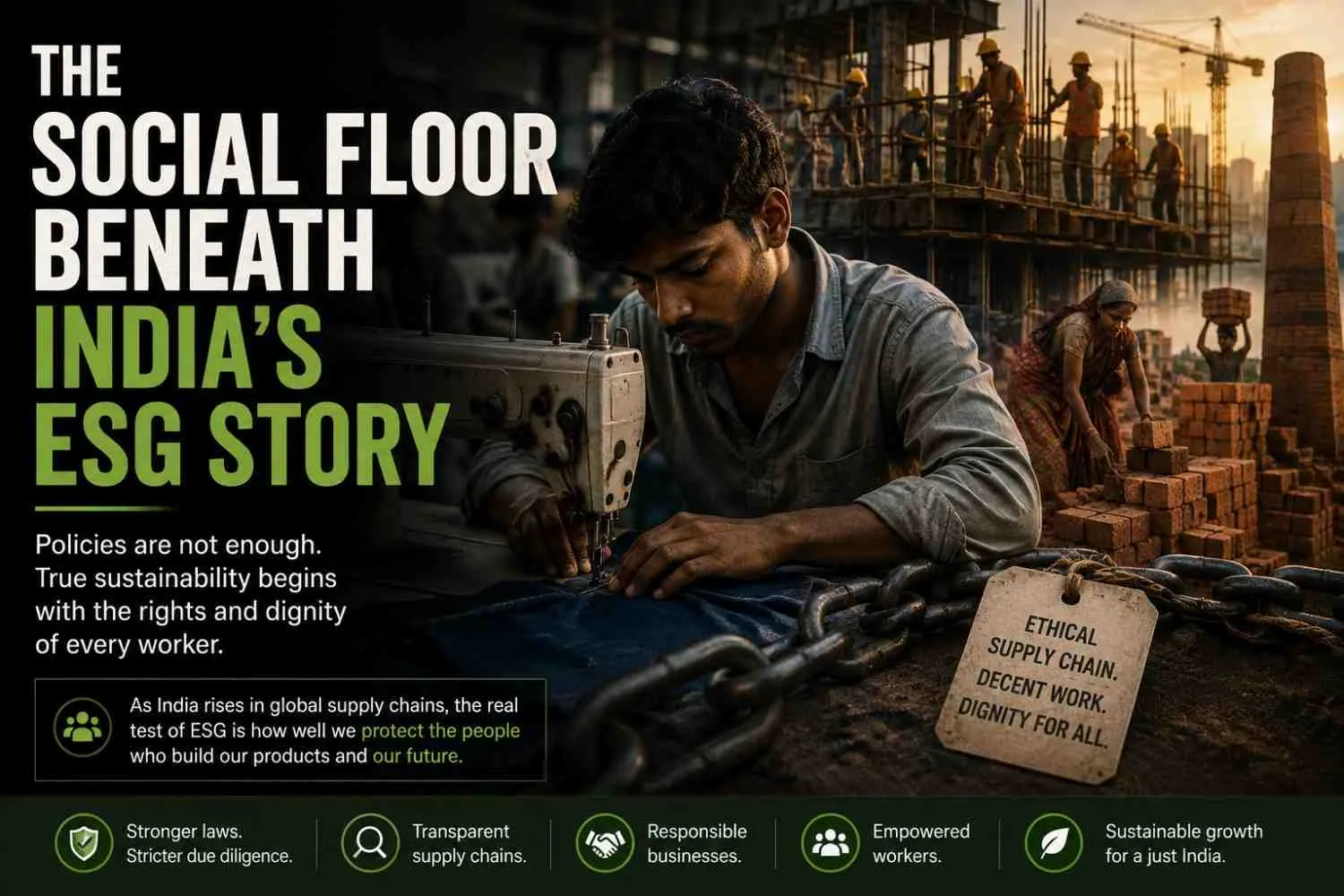
Kolkata | August 7, 2026 As India strengthens its position in global supply chains, responsible sourcing has become just as important as sustainable production. While companies increasingly promote ESG commitments and ethical procurement, concerns over bonded labour, migrant-worker exploitation and weak rehabilitation continue to challenge the credibility of these claims. The real question is no longer whether businesses have policies- but whether those policies protect workers on the ground. Quick SummaryIndia's ambition to become a global manufacturing and sourcing hub is placing greater attention on labour rights across supply chains. International buyers, particularly in Europe, now expect companies to prove that products are made without forced or bonded labour, making human-rights due diligence a critical part of ESG reporting. While governments have intensified anti-bonded labour campaigns and many large companies have strengthened supplier monitoring, challenges remain in sectors such as brick kilns, quarrying, textiles and construction, where migrant workers often face debt, poor working conditions and limited access to legal protections. Experts argue that rescue operations alone are insufficient unless rehabilitation, fair wages and long-term livelihood support are ensured. As global regulations become stricter, India's competitiveness will increasingly depend not only on environmental sustainability but also on how effectively it safeguards the rights and dignity of workers throughout its supply chains. Can India Build Global Supply Chains Without Leaving Workers Behind? India's ESG journey is no longer judged only by carbon emissions, renewable energy targets or environmental commitments. Gradually, investors, regulators and consumers around the world are asking a more fundamental question: Who made the product, and under what conditions? As global supply chains become more transparent, labour rights have emerged as one of the strongest indicators of corporate sustainability. This shift comes at a critical moment for India. As the country strengthens its position as a global manufacturing hub through initiatives such as Make in India and the Production-Linked Incentive (PLI) schemes, it is attracting companies looking to diversify their supply chains. But with this opportunity comes greater scrutiny. International buyers now expect more than quality products and competitive prices- they also want assurance that goods are produced without forced labour, child labour or exploitative working conditions. At the heart of this challenge is bonded labour, one of India's oldest and most persistent labour-rights issues. Although the practice was abolished under the Bonded Labour System (Abolition) Act, 1976, cases continue to emerge across several industries. Workers caught in cycles of debt, informal employment and labour contracting arrangements often remain trapped in exploitative conditions despite legal protections. The issue goes far beyond legal compliance. Labour rights have become a key part of ESG performance. A company may reduce emissions, invest in clean energy and publish detailed sustainability reports, but if exploitation exists anywhere within its supply chain, those achievements are seen as incomplete. For global investors and responsible businesses, environmental responsibility and human rights are now inseparable. This changing landscape is also reshaping corporate practices. Large listed companies, exporters and multinational buyers are strengthening supplier checks, conducting labour audits and integrating human-rights due diligence into their procurement processes. These measures are aimed not only at meeting international expectations but also at reducing the legal, financial and reputational risks associated with unethical supply chains. However, experts caution that stronger corporate policies alone will not eliminate the problem. A large share of India's workforce remains employed in the informal sector, where monitoring is limited and many workers have little awareness of their rights or access to effective grievance mechanisms. As India seeks to expand its role in global manufacturing and trade, ensuring that economic growth is matched by stronger labour protections has become one of the country's most pressing sustainability priorities.The Hidden Reality of Bonded Labour Despite stronger laws and growing corporate commitments, bonded labour continues to exist across parts of India. Rather than disappearing, it has become less visible, often hidden within informal employment, labour contracting systems and migrant-worker networks that receive limited oversight.Some of the highest risks of bonded labour continue to be reported in sectors such as brick kilns, stone quarries, textiles, construction and small manufacturing units. In many cases, workers are recruited through middlemen who offer advance payments or small loans. What begins as financial support can soon turn into a cycle of debt, leaving workers unable to leave their jobs until the amount is repaid- a practice widely recognised as debt bondage. Migrant workers are particularly at risk. Many travel long distances in search of work without formal contracts, proper documentation or access to social security. Language barriers, dependence on labour contractors and limited awareness of their legal rights often make it difficult for them to report exploitation or seek help. According to labour experts, these conditions can lead to unpaid wages, excessive working hours and restrictions on workers' freedom, especially in labour-intensive sectors. In response, government agencies have stepped up efforts to identify and rescue bonded labourers through district administrations and Bonded Labour Vigilance Committees. States such as Telangana have expanded inspections and rescue operations, while the National Human Rights Commission (NHRC) and organisations such as International Justice Mission India (IJM India) continue to support rescue, legal action and rehabilitation. However, experts stress that rescue is only the beginning of the process. The bigger challenge is helping survivors rebuild their lives. Under the Central Sector Scheme for Rehabilitation of Bonded Labourers, rescued workers are entitled to financial assistance, skill development and livelihood support. However, implementation remains uneven across states. Delays in issuing Release Certificates, slow disbursal of rehabilitation funds and limited follow-up support often leave survivors vulnerable to returning to the same exploitative conditions. Organisations such as Aajeevika Bureau and SEWA Bharat have repeatedly pointed out that financial insecurity remains one of the biggest reasons many rescued workers return to informal employment. Without stable livelihoods, social protection and long-term support, breaking the cycle of bonded labour becomes extremely difficult. Businesses, too, are facing growing pressure to strengthen labour oversight throughout their supply chains. Companies are now expected to look beyond their immediate suppliers by scrutinising labour contractors, monitoring subcontractors and ensuring that temporary and migrant workers receive the same protections and rights as permanent employees.For many organisations, protecting labour rights is no longer just about regulatory compliance, it has become a key part of responsible business practices and long-term ESG performance. Where Labour-Risk Vulnerabilities Are Highest  Brick kilns Quarrying Textiles Construction Small Manufacturing When Human Rights Become a Trade Requirement The discussion around bonded labour is no longer confined to human rights- it has become a business priority. As global markets place greater emphasis on responsible sourcing, Indian companies are finding that labour practices now influence market access, investor confidence and brand reputation as much as product quality or pricing.A major reason for this shift is the European Union's Corporate Sustainability Due Diligence Directive (CSDDD) and other emerging international regulations. These require companies to identify, prevent and address human-rights risks across their supply chains. Global buyers are no longer satisfied with just supplier declarations. They expect evidence that workers are recruited fairly, paid properly and employed under safe and ethical conditions, particularly in sectors that have historically been linked to labour exploitation. In response, many Indian exporters and large listed companies are strengthening their human-rights due diligence processes. Supplier agreements are gradually incorporating labour-rights clauses, mandatory compliance requirements and independent audits. Businesses are also looking beyond their direct suppliers to examine labour contractors and subcontractors, where informal employment practices are often more difficult to monitor. Many companies in sectors such as manufacturing, construction, logistics and platform-based services are investing in digital worker registration, attendance systems and grievance mechanisms to improve transparency. Others are working with independent auditors and civil society organisations to assess labour conditions instead of relying solely on internal reports. These efforts are aimed not only at meeting international regulations but also at reducing legal, operational and reputational risks in an ESG-focused business environment. However, experts caution that due diligence should go beyond paperwork. Audits conducted in the presence of management, pre-announced inspections or supplier self-declarations often fail to reflect the actual conditions faced by workers. Labour-rights organisations argue that meaningful due diligence requires confidential worker interviews, regular field visits and independent grievance mechanisms that allow workers to raise concerns without fear of retaliation. The situation is particularly challenging for migrant workers employed through third-party contractors. While many companies have adopted strong ESG policies, they often have limited visibility into the working conditions of people employed beyond their direct workforce. Bridging this gap between corporate commitments and on-ground realities remains one of the biggest challenges in building truly responsible supply chains. As India strengthens its position as a global manufacturing hub, businesses are realising that long-term competitiveness will depend not only on production capacity and product quality but also on their ability to uphold human rights throughout the supply chain. For global buyers, a sustainable product begins with fair treatment of the worker long before it reaches the consumer. Progress Is Visible, But Challenges Persist Government agencies say India has made significant progress in tackling bonded labour over the past decade. Several states have stepped up rescue operations; labour inspections have become more focused and rehabilitation programmes continue to receive policy support. Authorities also point to stronger coordination between government departments, district-level vigilance committees and awareness campaigns as important steps towards identifying and protecting vulnerable workers. Businesses also highlight improvements in their labour practices. Many large listed companies now require suppliers to follow human-rights standards, conduct regular labour audits and provide grievance mechanisms for workers. ESG reporting has also broadened the focus from workplace safety to issues such as ethical recruitment, fair wages and responsible sourcing.For companies serving international markets, these measures have become essential for maintaining investor confidence and meeting global buyer expectations. However, organisations working closely with affected communities present a more cautious assessment. Groups such as Aajeevika Bureau, SEWA Bharat and International Justice Mission India (IJM India) argue that while rescue operations have improved, long-term rehabilitation remains a major challenge. Many rescued workers continue to face financial hardship, while delays in rehabilitation support, limited livelihood opportunities and difficulties in accessing government benefits often leave them vulnerable to exploitation again. Labour-rights organisations also point out that migrant workers frequently remain outside formal monitoring systems, making it difficult to identify abuse until it becomes severe. Experts also caution that corporate compliance reports do not always reflect the realities of the entire supply chain. Most audits focus on direct suppliers, while smaller subcontractors and labour contractors- where the risk of exploitation is often highest receive much less attention. Without independent worker interviews, confidential grievance mechanisms and regular field verification, important labour issues can remain hidden despite positive ESG disclosures. For this reason, many experts believe that the next stage of India's ESG journey should focus less on expanding policies and more on measuring real outcomes. The true test of progress is not the number of audits conducted or policies announced, but whether workers receive fair wages, safe working conditions, access to benefits and effective protection when their rights are violated.   Closing this gap between policy and implementation will be crucial if India has to build supply chains that meet both national labour standards and rising global expectations. From Compliance to Competitiveness Worker Rights → Responsible Supply Chains → Stronger ESG → Investor Confidence → Export Competitiveness   Why Protecting Workers Is Good for Business Labour rights are no longer seen as just a legal requirement. They have become an important measure of how companies are judged by investors, regulators and global buyers. Today, a strong ESG profile is not defined only by lower emissions or renewable energy investments- it is also shaped by how businesses treat the people working across their supply chains. This shift is changing the way companies operate. Investors are paying greater attention to labour-related risks, while international buyers expect businesses to prove that their products are made under fair and ethical working conditions. Companies that cannot demonstrate responsible recruitment, safe workplaces and effective grievance mechanisms risk damaging their reputation, losing investor confidence and facing challenges in global markets. At the same time, organisations that invest in better labour practices are discovering clear business benefits. Fair wages, transparent supply chains and safe working conditions can improve employee morale, reduce operational disruptions and build stronger relationships with customers and investors. Protecting workers is no longer just about meeting regulations- but becoming a competitive advantage. For India, this shift carries particular significance. As the country strengthen its position as a global manufacturing hub, the credibility of its supply chains will depend not only on production capacity but also on the confidence that goods are produced under fair and lawful conditions. Sustainable economic growth cannot be achieved without protecting the people who drives it. Ultimately, India's ESG journey will be judged not only by how successfully it cuts emissions or expands clean industries, but also by how effectively it safeguards the rights and dignity of its workforce. Ending bonded labour requires much more than rescue operations or compliance reports.   It demands fair wages, timely rehabilitation, secure livelihoods and supply chains where every worker is visible, protected and treated with dignity. As global markets continue to demand greater transparency, businesses that place human rights at the centre of their ESG strategies will be better positioned to earn trust, attract investment and compete internationally. In the end, India's success as a global manufacturing and sourcing destination will depend not only on what it produces, but on how well it protects the people who produce it.    Sources:  Ministry of Labour & Employment, Government of India – Bonded Labour System (Abolition) Act, labour welfare schemes and rehabilitation policies.https://labour.gov.in/ National Human Rights Commission (NHRC) – Reports and advisories on bonded labour, migrant workers and human-rights protection.https://nhrc.nic.in/ International Justice Mission (IJM) India – Bonded labour rescue, rehabilitation and survivor case studies.https://www.ijm.org/india Aajeevika Bureau – Research and policy work on migrant labour, safe migration and labour rights.https://www.aajeevika.org/ SEWA Bharat – Informal workers, women's livelihoods and labour rights.https://www.sewabharat.org/ J-PAL South Asia – Evidence-based research on labour markets, migration and public policy.https://www.povertyactionlab.org/south-asia Telangana Labour Department – State-level bonded labour rescue initiatives, inspections and rehabilitation measures.https://labour.telangana.gov.in/ Central Consumer Protection Authority (CCPA) (for broader ethical business and consumer accountability where relevant)https://consumeraffairs.nic.in/ ESIC (Employees' State Insurance Corporation) – Worker welfare, social security and benefit access.https://www.esic.gov.in/  International Labour Organization (ILO) – Global standards on forced labour, decent work and supply-chain due diligence.https://www.ilo.org/                   ...Read more

10 Aug 2026

Kolkata | August 6, 2026 Climate-tech companies are beginning to deliver the kind of investor returns once reserved for mainstream technology start-ups. High-value private equity exits, founder wealth creation and employee stock payouts suggest India's green economy is entering a more mature phase. Yet behind the headline deals lies a more complex reality, although sustainability attracts unprecedented investment globally, many early-stage climate innovators still struggle to secure the capital they need. Quick SummaryIndia's climate-tech ecosystem is reaching an important milestone as sustainability-focused start-ups begin generating meaningful financial returns for investors, founders and employees. Successful private equity exits, strategic acquisitions and expanding ESOP wealth creation indicate that green businesses are gradually moving from experimental ventures to commercially viable enterprises capable of attracting institutional capital. These developments could strengthen investor confidence and encourage greater participation from banks, infrastructure funds, venture capital firms and green-bond issuers. However, beneath these success stories, early-stage climate-tech companies continue to face tightening funding conditions, higher investor expectations and longer fundraising cycles. As India's clean economy expands, the real challenge is ensuring that capital supports not only established winners but also the next generation of innovators developing technologies needed for the country's long-term climate transition. Are Climate-Tech Exits Creating a Stronger Green Investment Cycle? For years, climate-tech entrepreneurs faced a familiar question: Can sustainability generate attractive financial returns? Although investors recognised the long-term potential of sectors such as clean energy, battery recycling, carbon capture, green materials and circular manufacturing, many remained cautious about investing. Climate-tech businesses often require years of research, large upfront investments and supportive government policies before they become profitable, making them a riskier bet than many conventional technology start-ups.That perception is gradually changing.Across India, a growing number of climate-tech companies are moving beyond the experimental stage and proving that environmental innovation can also be commercially successful. High-value acquisitions, private equity exits and strategic investments are giving investors the returns they have been waiting for while rewarding founders who have spent years building businesses around the low-carbon economy. For venture capital and private equity firms, these deals represent far more than isolated success stories. Every successful exit strengthens confidence that climate-tech can become a profitable business. It shows that companies in the sector can grow, attract institutional buyers and generate competitive returns, encouraging more investors to back climate-focused innovation.The benefits are also reaching employees.Many professionals who joined climate-tech start-ups in their early years are now benefiting through Employee Stock Ownership Plans (ESOPs), turning years of equity ownership into real financial gains. In a sector long driven by purpose as much as profit, wealth creation is becoming an important sign of maturity. These success stories are also helping attract experienced professionals who may once have viewed climate-tech as a risky career choice. However, the headlines tell only part of the story. While a handful of established climate-tech companies are securing impressive valuations and rewarding investors, many younger start-ups continue to struggle to raise funding. Investors have become far more selective, preferring businesses that already have clear revenue streams, strong financial performance and a realistic path to profitability. As a result, many promising early-stage innovators are finding it difficult to secure the capital needed to grow. This reflects one of the biggest challenges facing India's green economy. If the wealth created through successful exits is reinvested across the broader climate-tech ecosystem, it could encourage new ideas, support emerging businesses and accelerate India's transition to a low-carbon economy. But if investment remains concentrated in a small number of mature companies, many promising innovators may never receive the support needed to develop the technologies that will drive India's future in clean energy, resource efficiency and net-zero development. The debate is therefore no longer about whether climate-tech can create economic value. The real question is whether today's success stories will generate enough fresh investment to support tomorrow's innovators and strengthen the ecosystem that made those achievements possible. From Climate Ambition to Commercial Returns India's climate-tech sector has changed dramatically over the past decade. What was once a niche investment space focused mainly on renewable energy has grown into a broad ecosystem of businesses working on electric mobility, battery technologies, sustainable materials, carbon management, resource efficiency and circular economy solutions. This growth has been fuelled by a combination of government support, rising investor confidence and increasing demand from businesses for low-carbon technologies. Policies promoting clean energy, electric vehicles and green manufacturing, together with India's net-zero commitment and growing ESG expectations, have encouraged companies to develop solutions that not only reduce environmental impact but also create long-term commercial value. As the sector has matured, the pattern of investment also evolved.In the early years, most climate-tech start-ups depended on angel investors, incubators and venture capital firms willing to back high-risk ideas. Today, many successful companies are attracting larger investors, including private equity firms, infrastructure funds, strategic corporate buyers and institutional investors. This shift reflects growing confidence that climate-tech can deliver strong and sustainable financial returns.For investors, a successful exit represents far more than the success of a single company. When a company is acquired or investors sell their stake, they recover their investment, demonstrate returns to their backers and free up capital to invest in the next generation of start-ups.  This recycling of capital is essential for keeping the innovation ecosystem healthy. Without successful exits, investors become more cautious, fundraising slows and fewer new businesses receive the support they need to grow.India is beginning to see the benefits of this cycle.Large infrastructure investors, climate-focused funds and financial institutions are treating green businesses as long-term investment opportunities rather than experimental ventures. Organisations such as IREDA continue to expand financing for renewable energy and clean technology projects, while SIDBI Venture Capital is strengthening support for innovation-driven enterprises. Alongside them, specialised climate funds and impact investors are broadening the range of financing available for businesses working on decarbonisation, sustainable manufacturing and resource efficiency.The country's expanding green finance market is also playing an important role. Green bonds, sustainability-linked loans and ESG-focused investment products are opening new funding channels and attracting larger pools of institutional capital. Banks, non-banking financial companies (NBFCs) and infrastructure funds are gradually evaluating climate-tech businesses not only for their environmental benefits but also for their commercial potential and long-term resilience. While the sector has made significant progress, important hurdles remain.  While established climate-tech companies are attracting larger investments and delivering successful exits, many younger start-ups continue to struggle to raise funding. Investors have become more selective, favouring businesses with proven revenues, efficient operations and a clear path to profitability. As a result, many promising start-ups are finding it difficult to secure the funding needed to develop and expand their technologies. This growing gap raises an important question. If successful exits are creating wealth and attracting new investors, how can India ensure that enough of this capital reaches the next generation of climate innovators who will drive the country's future green economy?   The Climate-Tech Capital Cycle Innovation → Seed Funding → Series A/B Growth Capital → Scale-Up → Private Equity / Strategic Investment → Exit → Capital Reinvested into New Climate Start-ups Key takeaway: Successful exits do more than reward investors- they recycle capital back into the innovation ecosystem. The Exit Economy: When Green Innovation Starts Delivering Returns For venture capital and private equity investors, a successful exit is more than a profitable deal- it is a sign that an industry has reached a new level of maturity. Climate-tech companies have traditionally taken longer to grow than conventional technology start-ups. Many require significant investment, years of research and supportive regulations before becoming commercially successful. Because of this, investors often had to wait much longer to see returns. Today, however, successful acquisitions, private equity exits and secondary sales are changing that picture, showing that businesses built around sustainability can generate strong financial returns alongside environmental impact. These success stories are boosting investor confidence. Institutional investors are viewing climate-tech as a promising long-term investment rather than a niche sustainability sector. Large transactions in renewable energy, electric mobility, battery technology, climate software and sustainable materials are encouraging infrastructure funds, pension-backed investors and growth capital firms to increase their exposure to India's green economy. The gains are not limited to investors and founders. Employees who joined climate-tech companies in their early years are also beginning to benefit through Employee Stock Ownership Plans (ESOPs), turning years of equity ownership into significant financial rewards. These outcomes are helping attract experienced engineers, scientists, sustainability professionals and business leaders who may once have considered climate-tech too risky as a long-term career choice. For entrepreneurs, successful exits carry equal importance. They validate years of innovation, business development and investor confidence, proving that sustainability-focused businesses can scale successfully while delivering meaningful environmental solutions.  Many founders who achieve successful exits also go on to become angel investors or mentors, using their experience and capital to support the next generation of climate-tech start-ups. However, these encouraging developments reveal only one side of the story. While established climate-tech companies are attracting larger investments and delivering strong investor returns, many younger start-ups continue to face a difficult fundraising environment. Investors are becoming selective, favouring businesses with stronger revenues, clear business models and a faster path to profitability. As a result, many early-stage companies developing new technologies are finding it harder to secure the funding needed to grow. This has created an uneven investment landscape. A small number of mature companies are generating impressive returns, while many promising start-ups continue to struggle for early-stage funding. Industry experts warn that if investment remains concentrated only in established businesses, India could slow the development of the next generation of technologies needed to support its long-term decarbonisation and sustainability goals. Successful exits, therefore, are only part of the story. They prove that climate-tech can create both environmental impact and financial value. But the long-term strength of the sector will depend on whether today's returns are reinvested in the innovators building tomorrow's clean technologies. Where the Returns Go Successful Climate-Tech Exit ⬇ ✔ Investors recover capital ✔ Employees benefit through ESOPs ✔ Founders gain liquidity ✔ Confidence in climate-tech grows ✔ Fresh capital flows into future ventures Key takeaway: Every successful exit has the potential to finance the next generation of climate innovation- but only if capital continues moving downstream.  Beyond the Headlines: Are Green Returns Reaching the Next Generation of Innovators? The recent wave of climate-tech exits has strengthened confidence in India's green economy. However, experts caution that headline valuations and high-profile deals alone do not reflect the true health of the sector.Every successful acquisition or investor exit marks the end of one investment journey. The bigger question is whether the money generated from these deals is being reinvested in the next generation of climate-tech start-ups or remaining concentrated in a small number of established companies. Research organisations such as the Council on Energy, Environment and Water (CEEW), Climate Policy Initiative India (CPI India) and WRI India have consistently pointed out that achieving India's climate and net-zero goals will require steady investment at every stage of innovation. This includes everything from early research and product development to large-scale commercial deployment. In other words, a strong climate-tech ecosystem depends not only on successful exits but also on a continuous flow of funding for new ideas and emerging businesses. This is where the funding gap becomes more visible. While investors continue to announce ambitious climate commitments, much of the available capital is flowing towards companies with proven business models and stable revenues. Early-stage start-ups working on technologies such as green materials, carbon removal, industrial decarbonisation and advanced battery solutions often face longer fundraising periods and greater difficulty attracting investment, despite their long-term importance. For policymakers, the challenge is not simply attracting more investment but ensuring that it reaches the right parts of the ecosystem. Institutions such as the Reserve Bank of India (RBI), SEBI, IREDA, SIDBI and the Ministry of Finance are gradually strengthening India's sustainable finance ecosystem through green bonds, climate-focused lending and improved disclosure frameworks. However, experts argue that financing must support innovation as much as infrastructure if India hopes to remain a leader in climate technology. Looking beyond headline numbers is therefore essential. A large investor exit may signal growing confidence in the sector, but it does not tell the complete story. Analysts believe that market performance should also be assessed through transparent reporting, realistic valuations and clear distinctions between announced investments and capital that has actually been deployed. Such disclosures provide a more accurate picture of the sector's long-term growth. Transparency is equally important. Large funding announcements often make headlines, but less attention is given to how that capital is used, how projects perform over time or whether they deliver meaningful environmental outcomes. Experts believe that stronger disclosure around investment deployment, technology adoption and measurable impact would help investors identify businesses creating lasting value rather than short-term optimism. Ultimately, the future of India's climate-tech sector will not be defined by the size of a few high-profile exits alone. Its long-term success will depend on whether today's financial gains help fund tomorrow's innovators, ensuring that investment continues to support not only companies already delivering returns but also those developing the technologies that will power India's low-carbon future.   Evidence Check Evidence TestWhat Investors Should AskMethodologyHow was the valuation calculated?Peer BenchmarkHow does the company compare with similar climate-tech firms?Implementation GapWas announced investment fully deployed?BaselineWhat was the company's starting scale before investment?Reporting BoundaryAre only financial returns measured, or environmental impact too?Capital DeploymentHow much funding actually reached projects?Long-Term ValueDoes the exit strengthen future climate innovation? Key takeaway: A successful exit proves commercial viability-but a healthy climate-tech ecosystem is measured by how effectively capital is reinvested into future innovation. The Road AheadClimate-tech has reached an important turning point.Not long ago, many green start-ups depended on bold ideas, supportive policies and investors willing to wait years for returns. Today, that picture is changing. A growing number of successful exits show that businesses built around sustainability can create real financial value while helping address environmental challenges. They also reflect a more mature ecosystem where climate-focused companies are attracting institutional investors, rewarding founders and creating wealth for employees through ESOPs. But a few high-profile success stories alone cannot define the future of the sector. For India's climate-tech ecosystem to remain strong, investment must continue across the entire innovation journey- from research labs and early-stage start-ups to companies ready for large-scale commercial growth. If funding keeps flowing only to businesses that have already proven themselves, many promising ideas may never reach the market. The real success of climate-tech will not be measured only by billion-dollar exits or investor returns. It will depend on whether today's gains help build tomorrow's innovators. If the capital generated through successful exits is reinvested into the next wave of entrepreneurs, India will not only strengthen its green economy but also accelerate the development of technologies needed for a cleaner and, a more sustainable future. Evidence Check Evidence TestStatusMethodology disclosedVaries across transactionsExit completed or announcedMust be independently verifiedPeer benchmark availableEssential for valuation comparisonCapital actually deployedMore important than commitments announcedESOP wealth disclosedLimited public reportingLong-term reinvestmentKey indicator of ecosystem maturity Key Takeaways:Climate-tech exits are validating India's green innovation ecosystem.  Private equity returns can attract the next wave of sustainable investment.  ESOP payouts are creating wealth and attracting talent to climate ventures.  Early-stage funding remains significantly tighter than growth-stage capital.  Long-term ecosystem strength depends on reinvesting today's returns into tomorrow's climate innovators.  Expert SnapshotCEEW: Climate innovation requires sustained investment across the entire technology lifecycle.  Climate Policy Initiative India: Long-term climate finance must support both infrastructure and innovation.  IEEFA South Asia: Strong capital flows are essential, but funding must remain diversified across emerging technologies.   Sources: Securities and Exchange Board of India (SEBI) – ESG disclosures, sustainable finance and capital marketshttps://www.sebi.gov.in/ Reserve Bank of India (RBI) – Climate risk, sustainable finance and financial stability reportshttps://www.rbi.org.in/ Ministry of Finance, Government of India – Green finance and economic policy updateshttps://finmin.gov.in/ Indian Renewable Energy Development Agency (IREDA) – Annual Reports, project financing and renewable energy lendinghttps://www.ireda.in/ Small Industries Development Bank of India (SIDBI) – Venture Capital and MSME innovation financinghttps://www.sidbi.in/ Council on Energy, Environment and Water (CEEW) – Climate-tech investment, energy transition and clean economy researchhttps://www.ceew.in/ Climate Policy Initiative (CPI) India – Climate finance reports and investment analysishttps://www.climatepolicyinitiative.org/ WRI India – Climate innovation, sustainable finance and energy transition researchhttps://wri-india.org/ IEEFA South Asia (Institute for Energy Economics and Financial Analysis) – Clean energy investment and financial market analysishttps://ieefa.org/ Rainmatter Foundation – Climate innovation grants and ecosystem supporthttps://rainmatter.org/ Climate Collective Foundation – Indian climate-tech ecosystem and start-up support initiativeshttps://climatecollective.net/ Baring Private Equity Partners India (now part of EQT) – Private equity investment insights and portfolio informationhttps://eqtgroup.com/     ...Read more

07 Aug 2026

From Swadeshi to Sustainability, Why India Must Wear Its Handlooms Into the Future Prof Ujjwal K Chowdhury A century ago, Indian cloth became an instrument of freedom. Today, the handloom faces a different battle—against invisibility, imitation, industrial speed, uncertain incomes and disposable fashion. Yet the same loom offers India something remarkably contemporary: millions of livelihoods, women-led grassroots enterprise, cultural identity, low-energy production and the possibility of a more conscious wardrobe. On National Handloom Day, the question is no longer whether handloom deserves preservation. It is whether India can turn its extraordinary textile inheritance into an aspirational economy of the future. Summary:India celebrates its 12th National Handloom Day on 7 August 2026, linking the occasion to the Swadeshi Movement formally proclaimed on this date in 1905. The sector continues to support more than 35 lakh weavers and allied workers, with women accounting for over 72% of the workforce. But handloom faces formidable pressures: mechanised production, misleading imitations, price competition, unstable artisan earnings, raw-material challenges and changing consumer behaviour. At the same time, new research is strengthening handloom’s environmental case, while design, digital commerce, traceability, branding and technology are opening new markets. The next handloom movement must therefore go beyond nostalgia. India needs to make authentic handloom desirable, verifiable, contemporary and economically rewarding to those who create it. Hashtags: #NationalHandloomDay #HandloomDay2026 #IndianHandloom #ChooseHandloom #WearIndia #WeaveTheFuture #SustainableFashion #SlowFashion #IndianWeavers #BengalHandloom #SupportArtisans #VocalForLocal #MadeInIndia #ConsciousFashion #SustainableIndia A Freedom Movement You Could Wear There are moments in history when an ordinary object stops being ordinary. For India, cloth became one such object. On 7 August 1905, amid the growing resistance to the partition of Bengal, the Swadeshi Movement was formally proclaimed at a massive meeting in Calcutta Town Hall. Indians were urged to reject imported goods and revive indigenous production. Textiles were central to that political imagination. What one wore could become a declaration of economic independence. More than a century later, India commemorates that moment every 7 August as National Handloom Day. The first observance was inaugurated in Chennai in 2015. This year marks the 12th National Handloom Day.  That history makes handloom different from almost every other consumer product. Handloom is cloth. But it is also memory. Work. Geography. Culture. Enterprise. And, once again, choice. The great question of 2026 is whether India will merely admire that inheritance—or build an economy around it. 35 Lakh People Behind the Fabric The handloom conversation often starts with beautiful saris. It should start with people. India's Fourth All India Handloom Census done in 2019-20 recorded 35.22 lakh handloom weavers and allied workers—about 26.74 lakh weavers and another 8.48 lakh allied workers. Of the total workforce, roughly 25.46 lakh are women, more than 72%. The country had approximately 28.20 lakh handlooms when the census was conducted.  That makes handloom one of India's most important decentralised livelihood systems. Behind a finished piece can stand an entire economic chain: cotton and silk producers, yarn suppliers, reelers, spinners, dyers, warp makers, designers, weavers, finishers, traders and sellers. Unlike a giant garment factory, much of this economy is dispersed through homes and small workshops. A loom may stand beside a kitchen. A grandmother may understand a motif without ever having studied design. A daughter may prepare yarn while another member of the family works the loom. Knowledge passes not through manuals, but through observation, rhythm and repetition. That is why when a weaving household abandons its loom, India does not merely lose a unit of production. It can lose a library that was never written down. India Is Not One Handloom Story. It Is Hundreds Try reducing Indian handloom to one aesthetic and the idea collapses immediately. Banarasi brocades carry one vocabulary. Kanchipuram another. Sambalpuri and Pochampally Ikat make mathematics out of resist-dyed yarn. Chanderi finds elegance in translucence. Paithani speaks through colour and peacocks. Kani weaving turns shawls into painstaking compositions. Assam's textiles carry extraordinary traditions of their own. And then there is Bengal. Tant. Jamdani. Baluchari. Garad. Dhaniakhali. Begampuri. Each belongs not merely to a product category but to a landscape and social history. The scale of India's diversity was visible again in the Ministry of Textiles' Weaves of India Festival, which ran up to National Handloom Day this year and brought together 116 heritage weaves.  One nation has somehow accumulated hundreds of ways of crossing warp and weft. That is cultural capital few countries can replicate. Bengal: Where the Loom Carries Memory The Bengal story deserves particular attention because the Swadeshi story itself is inseparable from Bengal. The latest national census data listed more than 6.3 lakh handloom workers in West Bengal, making the state one of India's largest handloom livelihood centres.  Travel through weaving belts such as Nadia and other traditional clusters and the paradox becomes visible. On one side is extraordinary skill. On the other is economic vulnerability. A Jamdani motif can require extraordinary patience. A Baluchari can carry narrative complexity that turns fabric almost into illustration. A fine Tant derives beauty precisely from an apparent simplicity that machinery can imitate visually without replicating the making. And therein lies the problem. The shopper sees two saris. The weaver knows that they represent two completely different economic systems. If the customer cannot tell the difference, the cheaper system usually wins. When Price Wins, Craft Can Lose Handloom should not wage war on machinery. India needs powerlooms. It needs efficient textile factories. It needs an internationally competitive garment industry employing millions. The problem begins when mass-produced cloth and authentic handloom are placed in the marketplace as though they were identical products—or when machine-made imitations are sold using the cultural prestige of handwoven traditions. A handloom artisan simply cannot compete with the speed of mechanised production on price per metre. Nor should that be the competition. The value of handloom lies precisely in human labour, small-batch production, variations, complex craft, provenance and cultural character. India has long recognised this structural vulnerability. The Handlooms (Reservation of Articles for Production) Act, 1985 protects specified products from being manufactured on powerlooms, and enforcement inspections continue. Parliamentary data released in 2026 showed lakhs of powerloom inspections under the Act in recent years.  Authenticity is therefore not merely a marketing issue. It is an economic justice issue. The China Question Needs More Precision There is understandable concern about cheap synthetic fibres, polyester, imported yarn and low-cost textiles entering Indian markets. An anti-dumping investigation is currently underway into Polyester Textured Yarn imported from China, demonstrating that synthetic-yarn competition is a live issue in India's wider textile economy.  But the handloom debate should resist simplistic slogans. Government data presented to Parliament this year says imports classified specifically as handloom products have remained nominal, averaging around ₹14.1 crore annually over the preceding three years.  So the greater threat to the Indian weaver is not simply "foreign handloom". It is a much wider ecosystem of cheap synthetic substitutes, industrial scale, imitation, weak differentiation and a consumer culture trained to compare everything primarily by price. A patriotic case for Indian handloom therefore does not require hostility towards another country. It requires something more constructive: make Indian craftsmanship economically competitive on value rather than impossibly competitive on speed.     The Poverty Hidden Behind the Beautiful Sari This is where the romance of craft must confront economics. Customers may admire a ₹10,000, ₹20,000 or ₹50,000 handwoven sari without knowing how much of that value finally reaches the people who produced it. The artisan often occupies one of the weakest negotiating positions in the value chain. Production takes time. Cash flow does not wait. Yarn must be purchased. Families must be fed. Unsold inventory ties up scarce working capital. The Government acknowledged in a 2025 parliamentary reply that it had not conducted a specific study assessing the income levels and working conditions of women in the handloom sector, although third-party evaluations of schemes indicated improvements in earnings, working days and working conditions among beneficiaries.  This itself points to the next reform requirement. India needs better real-time livelihood data. How much does the primary weaver receive? How much time does a product require? Who captures the retail margin? Are younger family members staying in the profession? Preserving a craft without ensuring a respectable income for the craftsperson is not preservation. It is museumisation. Sustainability: Move From Poetry to Proof Handloom is frequently called sustainable. That claim needs to be both celebrated and qualified. At the weaving stage, a manually operated loom requires little of the industrial energy demanded by mechanised weaving. That is an enormous inherent advantage. And the environmental argument is becoming measurable. In 2025, the Ministry of Textiles and IIT Delhi released Carbon Footprint Assessment in the Indian Handloom Sector: Methods and Case Studies, examining products including cotton bedsheets, floor mats, Ikat and Banarasi saris.  Subsequent research presented by the IIT Delhi team reported that a studied handloom cotton bedsheet had a carbon footprint of about 1.30 kg CO₂-equivalent—nearly four times lower than the comparable powerloom product assessed. The work also showed why one cannot lazily label every handloom item "green": energy and fuel used elsewhere in production, chemicals, dyeing and other processes still matter.  That distinction is crucial. A handwoven polyester product dyed through a highly polluting process and transported repeatedly across continents does not become environmentally perfect simply because the final weaving was manual. True sustainability must examine: fibre → farming → yarn → dye → water → energy → weaving → transport → durability → reuse → end-of-life. Handloom begins with an enormous advantage. Now India needs to improve the rest of the chain. Slow Fashion Before We Invented the Term The global fashion industry is searching for ideas such as slow fashion, traceability, artisanal production, durability, circularity, local supply chains and storytelling. India has practised many of these ideas for generations. The grandmother's sari becoming the granddaughter's sari is circular fashion. Repairing a border rather than discarding an entire garment is circular fashion. A locally woven textile produced in small quantities is slow fashion. A motif carrying the identity of a particular weaving community is traceability through culture. Handloom therefore should not be positioned merely as something ancient that environmentally conscious consumers must rescue out of sympathy. That is terrible branding. Handloom should be sold as premium intelligence: beautiful, tactile, breathable, distinctive, culturally rich and—when responsibly produced—environmentally compelling. Heritage Must Enter the Wardrobe of the 25-Year-Old If handloom remains associated only with ceremonial saris, government emporia and nostalgia, its market will remain unnecessarily narrow. Handloom belongs in shirts. Jackets. Dresses. Trousers. Sneakers and accessories. Curtains. Cushions. Throws. Bed linen. Tableware. Boutique hospitality. Corporate gifting. Contemporary interiors. The government's own recent outreach acknowledges the need for reinvention. In April 2026, Vishwa Sutra – Weaves of India for the World paired 30 Indian handloom traditions with design inspirations from 30 countries, explicitly placing traditional textiles within a contemporary global design narrative.  The ecosystem has also expanded beyond traditional Khadi institutions, cooperatives and state emporia. Retailers, designer labels and platforms such as Fabindia, Taneira, Jaypore, GoCoop, Raw Mango and Anavila have, in different ways, helped introduce craft-based textiles to contemporary consumers. The lesson is simple. Do not ask the young to dress like the past. Give them the past with which to design the future. The Weaver Needs Technology—Just Not a Replacement Technology need not be the enemy of handloom. Technology can make weaving less physically punishing. It can improve jacquards. Map designs. Predict demand. Verify provenance. Translate an artisan's story. Photograph products professionally. Connect rural clusters directly to urban and international customers. Digitise inventories. Improve payments. Reduce middlemen. The Government's current architecture includes the National Handloom Development Programme and Raw Material Supply Scheme, along with support for upgraded looms, design, skills, marketing, branding, e-commerce, credit and social security.  The government-backed Indiahandmade digital marketplace is another attempt to connect artisans and weavers more directly to online consumers.  The question is not whether technology will enter handloom. It already has. The question is whether technology will replace the artisan—or increase the artisan's power. Choose the second. Ask One Question: Who Wove My Cloth? Consumers finally constitute the last—and perhaps most powerful—policy instrument. You do not need to become a textile historian. Just become slightly more curious. Look for credible authentication such as the Handloom Mark and, where applicable, the India Handloom Brand, which was introduced to combine handloom identity with quality and compliance parameters.  Ask the retailer what the weave is. Ask where it came from. Ask whether it is genuinely handwoven. Ask what fibre was used. Ask how to care for it so that it lasts. And then do something even more important: Use it. Do not turn handloom into precious fabric permanently imprisoned in cupboards. Wear the sari. Wear the shirt. Use the runner. Put the handwoven cushion on the sofa. Gift the stole. Take handloom into offices, campuses, hotels, homes, festivals and international conferences. Traditions survive through use, not reverence alone. A New Swadeshi for a New Century The original Swadeshi asked Indians to understand that consumption had political consequences. The same insight is relevant today, but the vocabulary can evolve. Buying handloom can be pro-jobs without being anti-machine. Pro-India without being anti-world. Pro-artisan without romanticising poverty. Pro-sustainability without greenwashing. Pro-tradition without resisting modern design. And pro-market—provided the market learns to recognise genuine value. India's handloom exports themselves show that opportunity exists: provisional government data puts exports of handloom products at about ₹1,359 crore in 2025–26, up from ₹1,201 crore the previous year.  The ambition should be far greater. India does not merely possess handlooms. India possesses one of the world's greatest distributed design laboratories. Millions of hands. Hundreds of textile languages. Generations of tacit knowledge. An extraordinary archive of colour, geometry, fibre and technique. The real tragedy would not be that machines become faster. They will. The tragedy would be if India became wealthier while the people who carry this knowledge became too poor to continue carrying it. Wear India. Weave the Future. Perhaps somewhere tonight, as National Handloom Day celebrations conclude, a shuttle is still moving. Left. Right. Left. Right. Thread crossing thread. The sound is remarkably similar to the sound it made when Swadeshi entered India's political vocabulary 121 years ago. But the loom is no longer asking us to boycott. It is asking us to choose. Choose authenticity over imitation when we can. Choose durability over disposability. Choose craftsmanship over anonymous sameness. Choose a product whose purchase can travel backwards—from our wardrobe to a retailer, from the retailer to a producer, from the producer to a weaving household. And choose an India where modernity does not require the destruction of memory. Because every genuine handloom contains two stories. One is the story woven into the fabric. The other is the story of the person who wove it. This National Handloom Day, preserve both. Choose Handloom. Wear India. Support the Weaver. Protect the Craft. Weave the Future.   ...Read more

05 Aug 2026

Kolkata | August 5, 2026 Artificial intelligence is rapidly transforming how companies measure, monitor and report the impact of their CSR initiatives. From predicting school dropout risks to automating sustainability disclosures, AI promises faster insights and greater accountability. Yet as algorithms begin shaping corporate giving, questions over data quality, ethical safeguards and reporting credibility are becoming impossible to ignore. Quick SummaryCorporate Social Responsibility (CSR) is entering a new phase where artificial intelligence is reshaping how social impact is measured. Companies are increasingly moving beyond annual spreadsheets and manual surveys towards real-time dashboards, predictive analytics and automated reporting systems capable of tracking beneficiaries, identifying programme risks and simplifying Business Responsibility and Sustainability Reporting (BRSR) disclosures. While these technologies promise greater efficiency and evidence-based decision-making, they also raise concerns around algorithmic bias, privacy, data manipulation and the growing gap between digital dashboards and realities on the ground. As regulators encourage greater transparency and companies invest in AI-powered impact platforms, the debate is shifting from whether AI should be used in CSR to how it can be deployed responsibly without compromising trust or accountability. Can artificial intelligence transform corporate giving into measurable social impact- or is technology moving faster than accountability? Not long ago, assessing the success of a Corporate Social Responsibility (CSR) project was a slow and largely manual process. Field teams travelled to project locations with paper surveys, NGOs maintained handwritten records, and corporate CSR departments often spent weeks compiling data before presenting annual impact reports. By the time the data reached the decision-makers, it was too late to make timely course corrections. That approach is changing rapidly. Today, a CSR manager overseeing a digital education initiative can monitor student attendance through live dashboards, receive alerts when learning outcomes begin to decline and identify schools at risk of higher dropout rates in real time. Healthcare programmes can track patient follow-ups digitally, livelihood projects can monitor income trends through mobile applications, and sustainability teams can use automated systems to support Business Responsibility and Sustainability Report (BRSR) disclosures. This transformation reflects a broader shift in corporate India. As companies face growing expectations to demonstrate measurable social and environmental impact rather than simply report CSR spending, artificial intelligence is emerging as an important decision-support tool. Instead of relying solely on end-of-project evaluations, organisations are beginning to use AI, predictive analytics and cloud-based platforms to monitor programmes as they unfold, enabling faster and more informed interventions. The potential benefits are significant.AI can analyse large volumes of beneficiary data within seconds, identify trends that might be overlooked through manual analysis and help organisations allocate resources more efficiently. Supporters argue that this allows CSR programmes to move beyond reactive problem-solving towards proactive decision-making, addressing challenges before they affect project outcomes. Yet the growing reliance on AI also raises an important question: Can technology fully measure social impact? Community development is influenced by trust, behaviour, local realities and human relationships-factors that cannot always be captured through algorithms or dashboards. A decline in school attendance may be visible in digital data, but technology alone cannot explain whether the cause is seasonal migration, financial hardship or inadequate school infrastructure. Similarly, a healthcare platform may accurately record beneficiary numbers while failing to reflect barriers such as accessibility, awareness or social stigma. As AI becomes more deeply integrated into corporate philanthropy, the challenge is no longer collecting larger volumes of data. But to ensure that technology strengthens accountability without creating a false sense of precision. In the end, better dashboards do not automatically lead to better decisions, and measuring social impact will continue to depend as much on human judgement as on artificial intelligence. From Reporting Projects to Predicting Outcomes The evolution of CSR reporting reflects a broader shift in corporate sustainability -  from documenting activities to demonstrating measurable impact. For years, the success of CSR initiatives was largely measured through inputs such as funds spent, beneficiaries reached and projects completed during a financial year. While these indicators met statutory reporting requirements, they revealed little about whether programmes had created lasting social or environmental value. Artificial intelligence is beginning to change that approach. Rather than being used only at the end of a project for reporting, AI is becoming part of programme implementation itself. Companies are adopting cloud-based dashboards, geospatial mapping, computer vision and machine learning to monitor projects in real time, enabling CSR teams to identify risks early, compare interventions and make timely course corrections before resources are exhausted. The impact is particularly visible in education. Instead of relying solely on annual assessments, AI-enabled systems can analyse attendance, classroom engagement, learning patterns and assessment results almost in real time. Predictive models can identify students showing early signs of disengagement, allowing implementing agencies to intervene before irregular attendance leads to permanent dropout. Similar applications are being explored in skill development programmes, where algorithms help identify trainees who may need additional mentoring or financial assistance based on participation and completion trends. Healthcare initiatives are undergoing a similar transformation. Community health workers use mobile applications to upload patient data directly from the field, while AI-assisted platforms monitor vaccination coverage, treatment adherence and disease patterns across regions. Rather than measuring success only through the number of health camps organised, organisations can now track follow-up visits, treatment outcomes and areas requiring additional intervention. Livelihood programmes are also benefiting from predictive analytics. Digital platforms monitoring self-help groups, farmer producer organisations and micro-enterprises can detect changes in income, productivity and market access, enabling implementing partners to respond before financial challenges undermine programme objectives. Instead of evaluating outcomes only after a project ends, AI is helping organisations identify emerging risks while corrective action is still possible. AI is also reshaping corporate sustainability reporting. The introduction of the Business Responsibility and Sustainability Report (BRSR) by the Securities and Exchange Board of India (SEBI) has significantly increased the volume of environmental, social and governance (ESG) data that listed companies are required to disclose. Collecting, verifying and consolidating this information across multiple business units has made manual reporting more time-consuming and complex. To address this, many organisations are adopting AI-powered reporting platforms that integrate data from operational systems, identify inconsistencies, flag missing disclosures and generate draft sustainability reports. Beyond reducing administrative effort, these systems improve reporting consistency and allow management teams to focus more on analysing performance than compiling documentation. Despite these advances, however, AI remains only as reliable as the data it receives. Artificial intelligence can identify patterns, generate insights and predict future trends, but it cannot compensate for incomplete records, inaccurate field reporting or weak verification processes. Poor-quality data inevitably leads to unreliable analysis, regardless of how advanced the technology may be. For this reason, many experts view AI not as a replacement for human oversight but as a tool that strengthens decision-making when supported by credible data, robust governance and effective monitoring systems. How AI Is Changing CSR Traditional CSR MonitoringAI-Driven CSR MonitoringAnnual surveysReal-time dashboardsManual beneficiary recordsAutomated data collectionEnd-of-project evaluationContinuous performance trackingReactive interventionsPredictive analyticsSpreadsheet reportingAutomated BRSR disclosures Key takeaway: AI is shifting CSR from measuring what happened to anticipating what could happen next.  When Algorithms Meet Accountability Artificial intelligence is transforming the way CSR programmes are monitored and evaluated, but it is also introducing a new set of ethical and operational challenges. As organisations rely on algorithms to guide decisions, an important question is emerging: Can technology strengthen accountability without compromising trust? At the heart of this debate, lies the quality of data.AI systems can only produce reliable insights when the underlying data is accurate, complete and consistent. Incomplete beneficiary records, duplicate entries or reporting errors can generate misleading conclusions that appear highly credible because they are supported by sophisticated dashboards and predictive models. Unlike manual reporting, where inconsistencies are often easier to identify, algorithm-driven analysis can sometimes conceal data quality issues behind polished visualisations. This concern is particularly relevant in CSR impact assessment. Many companies and CSR consultants now use AI-enabled platforms to consolidate data from education, healthcare, livelihood and environmental programmes. While automation has significantly improved reporting efficiency, experts caution that it should complement and not replace independent field verification. Without regular validation, inaccurate beneficiary records, duplicate entries or inconsistencies across projects can find their way into impact reports and sustainability disclosures. In many cases, these errors are not intentional. Different implementing partners often use varying reporting formats, beneficiary definitions and data collection methods. A beneficiary participating in multiple programmes may be counted more than once, while attendance, outreach and engagement may be measured using different indicators across projects. AI can process these datasets rapidly, but unless the information is standardised and verified, technology may reinforce inconsistencies rather than eliminate them. Privacy and data security have also become major considerations. AI-powered CSR platforms collect personal information such as age, location, income, educational performance and health records to improve programme design and delivery. Although this enables more targeted interventions, it also raises important questions about informed consent, data ownership and cybersecurity. Many beneficiaries, particularly in rural and digitally underserved communities, may have limited awareness of how their information is collected, stored or used. To address these concerns, experts are calling for stronger ethical safeguards around the use of AI. Greater transparency in algorithms, human oversight, robust data governance, protection of sensitive information and regular third-party audits are increasingly seen as essential for ensuring that AI strengthens accountability without creating new risks. There is also a growing recognition that not every aspect of social impact can be measured through technology. AI can efficiently analyse beneficiary numbers, attendance, training hours and financial disbursements while identifying patterns that may indicate emerging programme risks.  Affected VoicesDevelopment organisations working at the grassroots say artificial intelligence is making programme monitoring faster, but not necessarily simpler.NGOs involved in education, healthcare and livelihood projects argue that digital dashboards can highlight patterns, yet they cannot replace conversations with communities. A field worker may know why a child has stopped attending school, why a family refuses a healthcare intervention or why a self-help group is struggling despite positive financial indicators- insights that rarely appear in automated reports.Consumer and civil society organisations also caution that communities should not become passive data points. They argue that beneficiaries must understand how their information is collected, stored and used, particularly as AI systems become more integrated into social programmes. For them, responsible technology is not only about better analytics but also about protecting privacy, maintaining informed consent and ensuring that people remain at the centre of every CSR intervention. However, it remains far less effective at measuring outcomes such as community trust, behavioural change, social inclusion and local ownership- factors that often determine the long-term success of CSR initiatives. For this reason, development practitioners continue to emphasise the importance of human engagement alongside technological analysis.AI can identify that attendance in a vocational training programme is declining, but conversations with beneficiaries are often needed to understand whether transport costs, household responsibilities or seasonal employment are driving that trend. Technology can reveal patterns, but people provide the context that explains them. As AI becomes more deeply embedded in corporate philanthropy, the future of CSR impact measurement is likely to depend on balancing automation with accountability. Organisations that combine advanced analytics with transparent governance, independent verification and continuous engagement with communities will not only generate more reliable evidence but also strengthen public trust in the impact they seek to create. AI Can Measure, But Can It Understand?AI Measures Well Beneficiary numbers  Attendance and participation  Learning outcomes  Health follow-ups  Resource utilisation  Reporting efficiency  Humans Still Matter For Community trust Behavioural change Inclusion and dignity Local context Cultural realities Independent verification Key takeaway: Artificial intelligence can improve measurement- but meaningful impact still requires human judgment. When Evidence Meets ScrutinyAs artificial intelligence becomes an integral part of CSR monitoring, experts argue that the technology itself must be evaluated as rigorously as the programmes it measures. A sophisticated dashboard may present real-time insights and impressive visualisations, but its credibility ultimately depends on the quality of data, the methodology behind the analysis and the transparency of the reporting process. The first challenge lies in how impact is measured. CSR programmes often use different indicators to define success. An education initiative may focus on attendance or learning outcomes, while a healthcare project may measure beneficiary reach, treatment adherence or long-term health improvements. When AI systems analyse datasets built on different definitions and reporting standards, comparing outcomes across projects becomes difficult, even if the technology functions accurately. For this reason, development economists and impact evaluation specialists continue to emphasise the importance of establishing reliable baselines before introducing AI-driven monitoring. Without a clear starting point, it is difficult to determine whether a programme has genuinely improved people's lives or simply produced more data. An algorithm may report a significant increase in school attendance, but the finding has limited value unless it is measured against credible baseline data and tracked consistently over time. Another challenge is distinguishing the impact of a single intervention from broader social change. AI platforms can efficiently capture data generated within CSR programmes, but they cannot always account for external factors that influence outcomes. Improvements in school attendance, for example, may reflect not only a company's education initiative but also better government infrastructure, scholarship schemes or wider community participation. As a result, experts caution against treating AI-generated correlations as conclusive evidence of impact. Benchmarking presents similar limitations. Many AI platforms allow organisations to compare CSR performance across projects, districts or business units. However, such comparisons are meaningful only when programmes operate under similar conditions and pursue comparable objectives. Comparing projects with different beneficiary groups, geographies or impact indicators may produce conclusions that are statistically sound but practically misleading. This is why independent assurance remains essential. AI can quickly identify anomalies, missing records and unusual reporting patterns, but it cannot replace field verification, beneficiary feedback, external audits or independent programme evaluations. Experts argue that technology is most valuable when it strengthens existing evaluation processes rather than serving as a substitute for them. The growing investment in AI also raises important questions about transparency. Companies are allocating substantial resources towards digital CSR platforms, cloud infrastructure, analytics and cybersecurity. Yet annual reports rarely distinguish expenditure on AI-enabled monitoring from broader CSR administration or programme implementation. This makes it difficult for stakeholders to assess whether these investments are improving programme delivery or primarily enhancing reporting efficiency. Ultimately, the success of AI in CSR will not be measured by the volume of data it generates, but by the quality of the decision it supports. Technology can strengthen accountability and improve impact measurement, but only when it is backed by transparent methodologies, credible data, independent verification and meaningful human oversight. Evidence Check: Questions Every AI-Powered CSR Dashboard Should Answer   Evidence TestWhy It MattersIs the methodology publicly explained?Ensures transparency and comparability.What is the baseline?Measures real change, not isolated data points.Has the data been independently verified?Reduces reporting bias and inflation.Are reporting boundaries clearly defined?Prevents misleading impact claims.Does AI support or replace field verification?Human validation remains essential.Is investment in AI transparently disclosed?Demonstrates accountability beyond technology adoption. Key takeaway: Artificial intelligence can process information at extraordinary speed, but trustworthy CSR still depends on evidence that is transparent, independently verified and grounded in reality. Beyond the Dashboard Artificial intelligence is transforming the way companies design, monitor and evaluate their CSR initiatives. What was once driven by periodic surveys and retrospective reporting is evolving into a system supported by real-time data, predictive analytics and continuous monitoring. For businesses, this means faster decision-making and more informed resource allocation. For regulators and stakeholders, it offers the potential for greater transparency, consistency and accountability in sustainability reporting. However, technology alone cannot guarantee meaningful impact. The value of AI will ultimately depend on the quality of the data it processes, the transparency of the methodologies behind it and the governance system that ensures every insight is credible and independently verifiable. While dashboards can identify patterns and emerging risks, they cannot replace human judgement, community engagement or an understanding of the local realities that shape social outcomes. As AI becomes gradually embedded in corporate philanthropy, the conversation is shifting from whether it should be adopted to how responsibly it should be used. Its long-term success will not be measured by the sophistication of its algorithms, but by its ability to strengthen decision-making, build public trust and deliver measurable improvements where they matter the most. Ultimately, no algorithm, dashboard or report can define the success of CSR. Its true measure will always be the positive and lasting change it brings to people's lives. Evidence Check ParameterStatusMethodology disclosedPartial – Varies by platformIndependent verificationEssential but inconsistentBaseline comparisonRequired for credible impact measurementAI ethics & privacyIncreasing regulatory focusHuman field validationStill indispensableAI investment disclosureLimited in public CSR reports   Key TakeawaysAI is shifting CSR from annual reporting to real-time monitoring. Predictive analytics can identify programme risks before they escalate. BRSR reporting is accelerating AI adoption across listed companies. AI cannot replace field verification or community engagement. Transparency and independent audits remain essential for credible impact reporting. Primary Sources:  Ministry of Corporate Affairs (MCA) – Corporate Social Responsibility (CSR) Framework & Companies Act, 2013https://www.mca.gov.in/ Securities and Exchange Board of India (SEBI) – Business Responsibility and Sustainability Reporting (BRSR) Frameworkhttps://www.sebi.gov.in/ NITI Aayog – Responsible AI for All: Strategy and Discussion Papershttps://www.niti.gov.in/ Ministry of Electronics and Information Technology (MeitY) – IndiaAI Mission & AI Governance Initiativeshttps://www.meity.gov.in/ CSRBOX – CSR Intelligence, Case Studies & Impact Measurement Resourceshttps://csrbox.org/ Microsoft AI for Good – AI Applications for Social Impact and Sustainable Developmenthttps://www.microsoft.com/en-us/ai/ai-for-good World Economic Forum (WEF) – Artificial Intelligence Governance & Responsible AI Reportshttps://www.weforum.org/ J-PAL South Asia – Evidence-Based Programme Evaluation and Impact Measurementhttps://www.povertyactionlab.org/south-asia ...Read more

04 Aug 2026

Kolkata | August 4, 2026 As eco-labels, ESG ratings and sustainability badges multiply across supermarket shelves and e-commerce platforms, consumers are finding it harder than ever to distinguish genuine environmental responsibility from sophisticated green marketing. India's evolving certification ecosystem now faces its biggest challenge- not creating more labels, but restoring trust in the ones that already exist. Quick SummaryConsumers today are surrounded by products claiming to be sustainable, eco-friendly or environmentally responsible. From government-backed certifications such as Ecomark to private ESG ratings, retailer sustainability badges and company-generated claims, environmental labels have become an important influence on purchasing decisions. Yet the rapid expansion of certification systems has also increased confusion, making it difficult for shoppers to identify which claims are independently verified and which are simply marketing tools.India is now attempting to strengthen consumer confidence through updated standards, stronger regulations against misleading advertisements and renewed attention to official certification programmes. However, experts argue that transparency, independent verification and consistent enforcement remain essential if eco-labels are to become trusted indicators rather than promotional symbols. Can consumers still trust the growing number of green labels, or has identifying genuinely sustainable products become more difficult than ever before? Standing in the cleaning products aisle of a supermarket, a consumer compares two bottles of liquid detergent. Both feature green packaging and environmental claims. One displays a sustainability certification, another highlights the use of recycled packaging, while a third promotes lower carbon emissions during production. Online, similar products carry additional badges such as "eco-friendly," "planet positive" or "green choice," all claiming to represent the more sustainable option.At first glance, the choice appears straightforward-pick the product with the green label. But determining which claim is credible has become far more complicated. Over the past decade, sustainability has shifted from a niche concern to a major factor influencing consumer purchasing decisions. Manufacturers across sectors ranging from FMCG and electronics to automobiles and batteries are gradually marketing products through claims of lower emissions, recyclable materials, responsible sourcing and improved resource efficiency. Retailers and e-commerce platforms have introduced their own sustainability badges, while ESG rating agencies, certification bodies and independent assessors continue expanding their influence across global supply chains. The result is a marketplace crowded with environmental claims.Behind these labels, however, lies a fragmented certification ecosystem where government-backed standards coexist with private certifications, corporate declarations and voluntary rating systems. While some labels are supported by independent verification and transparent assessment methods, others rely largely on company disclosures or proprietary frameworks that remain difficult for consumers to understand or verify. This growing complexity has contributed to what many experts describe as a widening certification trust deficit. Consumers are becoming more conscious of sustainability and are willing to choose environmentally responsible products. At the same time, they expect clear evidence that these claims are genuine. Businesses investing in credible sustainability practices also face a challenge, as their products often compete alongside others making similar environmental claims with far less transparency. Without stronger verification systems and clearer standards, distinguishing authentic sustainability from effective marketing is becoming progressively more difficult. For India, this has emerged as a significant policy priority. As regulators strengthen consumer protection, revive official eco-labelling programmes and promote more sustainable production practices, the objective is no longer simply encouraging businesses to adopt greener practices. The real challenge is ensuring that every environmental claim consumer encounters is credible, transparent and capable of standing up to independent scrutiny. In a marketplace crowded with sustainability claims, trust may ultimately become the most valuable certification a product can carry. The Green Label Dilemma Long before sustainability became a mainstream marketing strategy, India introduced its own official environmental certification system. Launched in 1991 by the Ministry of Environment, Forest and Climate Change (MoEFCC), the Ecomark scheme was created to help consumers identify products with a lower environmental impact throughout their life cycle. While environmental standards were developed under the scheme, the Bureau of Indian Standards (BIS) was responsible for ensuring that certified products also met the required quality benchmarks. The objective was straightforward. A single, government-backed certification would enable consumers to recognise environmentally responsible products without having to interpret complex sustainability claims or corporate environmental reports.Despite this vision, Ecomark never achieved widespread recognition. Industry participation remained limited, public awareness was low and relatively few products carried the certification. For most consumers, the label was rarely seen on store shelves, while many businesses found greater commercial value in promoting their own environmental claims or obtaining internationally recognised certifications. The sustainability landscape has changed considerably since then. Today's products often carry multiple environmental claims at the same time, ranging from "recyclable packaging" and "responsibly sourced" to "carbon conscious," "plastic neutral" and "green product." Retailers and e-commerce platforms have also introduced their own sustainability badges, while brands use environmental messaging as a key differentiator in a highly competitive marketplace.For consumers, however, the growing number of labels has made purchasing decisions more complicated rather than being more transparent. Unlike government-backed certification systems, private eco-labels operate under diverse standards, assessment methods and verification processes. Some are supported by rigorous third-party audits, while others rely primarily on information provided by companies themselves. Even globally recognised ESG assessment platforms such as EcoVadis and S&P Global ESG Scores evaluate the overall sustainability performance of companies rather than certifying the environmental credentials of individual products. This distinction is significant but frequently misunderstood. A company with strong ESG performance does not necessarily mean that every product it sells meets the same environmental standards. Likewise, a retailer's sustainability badge may not undergo the same level of independent verification expected under an official certification programme. Recognising these concerns, the Government of India has initiated efforts to revitalise the Ecomark scheme by expanding product categories, simplifying certification procedures and updating environmental criteria to reflect evolving sustainability priorities. The broader objective is not merely to certify more products, but to establish a credible national benchmark that consumers can recognise and trust. Whether the renewed Ecomark can establish itself in a marketplace crowded with private sustainability labels remains uncertain.Its revival, however, highlights a far broader issue. In a marketplace where environmental claims are becoming a key factor in consumer decisions, the value of a certification will depend not only on the standards it represents, but also on the trust it is able to earn. Official vs Private: Understanding Green Labels Government-backed   Private / Commercial Ecomark (BIS & MoEFCC)     EcoVadisTransparent public criteria    Proprietary assessment frameworksNational certification    Corporate ESG ratingsProduct-focused    Company-focused Regulatory oversight Third-party or company-led verification When Sustainability Becomes a Marketing Strategy As sustainability becomes a growing priority for consumers, the value of being perceived as environmentally responsible has never been higher. Across industries, terms such as eco-friendly, natural, carbon neutral, planet positive and environmentally responsible have become common features of product packaging and advertising. For businesses, these claims offer a competitive advantage in a market where consumers are becoming more conscious of environmental issues. For consumers, however, they raise a fundamental question: who verifies whether these claims are genuine? The issue has gradually moved beyond environmental discussions and become a matter of consumer protection.Recognising that vague or exaggerated sustainability claims can influence purchasing decisions just as much as misleading claims about price or quality, the Central Consumer Protection Authority (CCPA) has stepped up its scrutiny of environmental advertising. Businesses are now expected to support green claims with credible evidence rather than relying on broad marketing language. The challenge is particularly evident on e-commerce platforms. Many online marketplaces now feature sustainability badges, "green choice" labels and eco-friendly filters to help consumers identify environmentally responsible products. While these initiatives encourage sustainable consumption, the criteria behind these labels are often unclear. Consumers may see that a product carries a sustainability badge, but they rarely know who awarded it, the standards used for assessment or whether the claim has been independently verified. This lack of transparency has fuelled growing concerns over greenwashing. Greenwashing occurs when businesses exaggerate or misrepresent the environmental performance of their products. In some cases, marketing highlights a single positive attribute such as recyclable packaging- while overlooking the much larger environmental impacts associated with manufacturing, transportation or disposal. In others, broad claims such as "green," "eco-safe" or "environmentally friendly" are promoted without recognised certification or measurable evidence.Environmental organisations warn that the consequences extend well beyond consumer confusion.Groups such as Toxics Link and Chintan have repeatedly argued that weak verification systems place genuinely sustainable businesses at a disadvantage. Companies investing in cleaner production, responsible sourcing and improved waste management often find themselves competing alongside products making similar environmental claims without meeting comparable standards. When verified and unverified claims appear equally credible, consumer confidence in eco-labels and certification systems begins to erode. The challenge becomes even greater in sectors such as electronics, batteries and automobiles, where environmental performance depends on the entire product life cycle rather than manufacturing alone. Factors such as durability, repairability, recycling infrastructure and end-of-life management play a critical role in determining a product's overall sustainability. A product promoted as environmentally responsible during production may still create significant environmental impacts if effective collection, recycling and producer responsibility systems are absent. As a result, the conversation is gradually shifting from environmental marketing to corporate accountability. Experts argue that sustainability claims should be supported by the same level of transparency expected in financial reporting. Clear assessment methodologies, independent verification, publicly available standards and regular audits are becoming essential for maintaining the credibility of eco-labels. Without stronger oversight, the growing number of environmental claims risks achieving the opposite of their intended purpose- not strengthening consumer confidence, but undermining it. Greenwashing Checklist: Five Questions Every Consumer Should Ask ✔ Who issued the certification?Government, independent third party or the company itself?✔ Is the assessment publicly available?Can consumers understand how the product was evaluated?✔ What exactly is being claimed?The entire product—or only one environmental attribute?✔ Has the claim been independently verified?Or is it based only on company disclosures?✔ Is the certification regularly reviewed?Environmental performance changes over time.  Takeaway: A green label is only as credible as the evidence behind it. From Claims to Credibility As sustainability claims become a stronger influence on consumer decisions, experts argue that eco-labels should meet the same standards expected of financial disclosures- clear methodologies, transparent reporting and independent verification. Without these safeguards, even credible certification systems risk losing public trust.This remains one of the biggest challenges for India's eco-labelling ecosystem.Government-backed certifications such as Ecomark follow publicly defined environmental criteria, with compliance linked to standards developed by the Bureau of Indian Standards (BIS). The framework is transparent, product-specific and subject to regulatory oversight. Many private certifications and ESG ratings, however, rely on proprietary assessment methods that are not always fully disclosed. While these systems may be rigorous, the basis on which products or companies are evaluated is often difficult for consumers to understand.The distinction is especially important when comparing product certifications with corporate sustainability ratings.Experts also point to a wider implementation gap.Companies may announce ambitious sustainability targets or highlight recyclable packaging and lower emissions, but consumers often receive little information on whether these commitments have been independently verified or consistently maintained. Sustainability reports frequently showcase progress through percentages and intensity-based indicators, while providing limited visibility into overall environmental impacts or areas where targets remain unmet.Environmental researchers argue that meaningful sustainability claims require greater transparency. Consumers need to know what has been measured, how it has been assessed and who has verified the findings. They also need clarity on whether a certification evaluates the entire product life cycle or only selected environmental attributes.As India continues strengthening its sustainability framework, experts believe the priority should not be creating more eco-labels, but making existing ones easier to understand, compare and trust. Ultimately, an eco-label can support responsible consumption only when the standards behind it are transparent, independently verified and consistently enforced. Evidence at a Glance Question     Why It Matters Who certifies the product?Government, third party or company? Is the methodology public?    Transparency builds trust. Product or company assessment? ESG ratings and product certifications are different.Independent verification?Reduces greenwashing risk. Regular review and audits?    Ensures claims remain valid over time.            Key takeaway: A credible green label should explain not just what it certifies- but also how it was certified.   The Trust Behind the Label The rise of sustainable consumption has fundamentally changed the way businesses compete. Today, products are evaluated not only on price and performance but also on their environmental credentials. This reflects a positive shift, signalling that sustainability is moving from a niche concern to a core business priority.At the same time, the growing number of eco-labels has created a new challenge.As environmental claims become more common, it is becoming difficult for consumers to distinguish genuinely sustainable products from well-crafted marketing. Government-backed certifications, private ESG ratings, retailer sustainability badges and company-led environmental claims often appear side by side, despite being based on very different standards, assessment methods and levels of verification.Ultimately, the issue is not the number of labels, but the trust behind them.India's efforts to strengthen Ecomark, tighten consumer protection guidelines and increase regulatory oversight reflect an important step towards improving transparency. However, regulation alone cannot build consumer confidence. Businesses must communicate environmental claims responsibly, certification bodies need stronger disclosure and independent verification, and digital marketplaces should clearly explain the basis of their sustainability labels.Consumers, too, have an important role to play. As environmental considerations influence purchasing decisions, informed choices become just as important as responsible production. An eco-label should help consumers make better decisions- not leave them questioning every claim on a product's packaging. As India's sustainability journey gathers pace, the real measure of success will not be the number of green labels in the marketplace, but the confidence consumers place in them. In the end, trust will remain the most valuable certification of all. Primary Sources: 1.    Bureau of Indian Standards (BIS) – Ecomark Certification Schemehttps://www.bis.gov.in/ 2.    Ministry of Environment, Forest and Climate Change (MoEFCC) – Ecomark & Environmental Policies https://moefcc.gov.in/ 3.    Central Consumer Protection Authority (CCPA) – Guidelines for Prevention and Regulation of Greenwashing and Misleading Environmental Claimshttps://consumeraffairs.nic.in/ 4.    Central Pollution Control Board (CPCB) – Waste Management, EPR & Environmental Compliancehttps://cpcb.nic.in/ 5.    EcoVadis – Sustainability Ratings Methodologyhttps://ecovadis.com/ 6.    S&P Global Sustainable1 (ESG Scores & CSA Methodology)https://www.spglobal.com/sustainable1/ 7.    Toxics Link – Research on Green Claims, Packaging, Waste and Circular Economyhttps://toxicslink.org/ 8.    Chintan Environmental Research and Action Group – Sustainable Consumption, Waste & Circular Economyhttps://chintan-india.org/  ...Read more

04 Aug 2026

Kolkata | August 3, 2026 As India expands digital classrooms into government schools, the real challenge is no longer connecting villages to technology- but ensuring technology actually improves learning. From AI-powered lessons in regional languages to solar-powered classrooms and foundational literacy tracking, the country's digital education push is entering a decisive phase where infrastructure, teacher readiness and measurable outcomes matter more than announcements. Quick SummaryIndia's digital education journey is entering a new chapter. Classrooms are gradually moving beyond blackboards as smart technologies, AI-enabled learning platforms and digital assessment tools become part of everyday teaching. Backed by governments, private organisations and non-profits, these initiatives are expected to strengthen learning outcomes while expanding educational opportunities for students in rural and underserved communities.Yet technology alone cannot close the learning gap. Its impact depends on reliable electricity, stable internet connectivity, well-trained teachers, quality regional-language content, regular maintenance and continuous evaluation of student progress. As India works towards a more inclusive education system, the focus is moving beyond digital access to a more important goal-ensuring that every technological investment delivers measurable improvements in learning. KeywordsEdTech India, Digital Classrooms, Government Schools, Rural Education, Foundational Literacy and Numeracy, NIPUN Bharat, AI in Education, Smart Classrooms, Digital Learning, Education Technology    Can technology truly bridge India's rural education divide- or does meaningful learning still depend on everything beyond the screen? Shortly after sunrise, children begin arriving at a government primary school in a remote village of Madhya Pradesh. Some have walked several kilometres through fields, carrying well-used schoolbags and notebooks. As they settle into their classroom, a smart display comes to life, using colourful animations to explain basic mathematics in Hindi. For a moment, the familiar blackboard gives way to an entirely different way of learning. For many of these students, it is their first experience inside a digital classroom. The transformation is difficult to ignore. Government schools that once struggled with limited infrastructure are now introducing interactive lessons, AI-powered learning applications, digital attendance systems and online educational resources. Across India, digital classrooms have become a defining image of education reform and technological progress.Yet behind this visible transformation lies a far more challenging question: is digital access translating into better learning? Technology has the potential to reshape education-but only when the basics are already in place. Smart boards require electricity, AI-powered platforms depend on stable internet connectivity, and digital devices remain underutilised without confident, well-trained teachers. More importantly, no technological innovation can replace the foundational literacy and numeracy skills that every child needs to learn effectively. This is the challenge confronting India's education system today. The discussion has moved well beyond introducing technology into classrooms. The real question now is whether digital investments are improving what matters most- how well children learn or whether schools are becoming more technologically equipped without becoming more educationally effective. The reason this question matters is the sheer scale of India's digital education ambition. With more than 250 million school-going children and one of the world's largest public education systems, the country is using technology not simply to modernise schools, but to bridge educational inequalities that have existed for generations. Government initiatives such as Digital India, PM eVIDYA, DIKSHA, NIPUN Bharat and the National Education Policy (NEP) 2020 have accelerated the spread of digital learning. Alongside these efforts, corporate CSR programmes, educational foundations and technology companies are bringing smart classrooms, AI-powered learning platforms and teacher training to thousands of government schools. For millions of children in rural India, these initiatives have expanded access to educational resources that were once concentrated in better-equipped urban classrooms. The experience so far, however, points to a simple reality: technology can support education, but it cannot transform it on its own. The future of digital education will not be shaped by technology alone. Its real impact will depend on whether digital tools strengthen teaching, respond to local needs and help every child learn more effectively.As India builds more digitally enabled classrooms, the success of this transformation will not be reflected in the number of smart boards or tablets deployed. It will be seen in classrooms where learning improves, educational gaps narrow and every child is given a fairer opportunity to succeed. Government's Digital Push: From Access to Learning OutcomesThe pandemic did not introduce India to digital education, but it changed its trajectory.When classrooms fell silent in 2020, millions of students were abruptly disconnected from formal learning. The impact was especially severe in rural India, where limited access to smartphones, internet services and reliable electricity left many children without any meaningful alternative to classroom teaching. In contrast, many students in urban areas were able to continue learning online. The experience fundamentally reshaped the country's approach to digital education, turning a gradual reform into an urgent national priority. The experience of the pandemic reinforced the government's belief that digital infrastructure would become an essential part of India's education system. Rather than allowing technology to remain an emergency alternative, policymakers began embedding it into long-term classroom reforms. The National Education Policy (NEP) 2020 placed digital learning, teacher capacity building and educational technology at the centre of this transformation. Programmes such as DIKSHA and PM eVIDYA expanded digital resources for both students and teachers, while dedicated educational television channels helped extend learning to households with limited internet access. Yet one important lesson soon became clear: digital content alone could not solve India's learning challenges. Long before the pandemic, national assessments had revealed that many children in primary schools were unable to achieve basic reading and arithmetic skills despite attending school regularly. The assessments revealed that the real challenge was not simply making classrooms digital, but ensuring that every child possessed the foundational skills needed to benefit from them. This led to a greater emphasis on Foundational Literacy and Numeracy (FLN), ensuring that every child can read with understanding and perform basic mathematical operations by the end of Grade 3. To achieve this, the government launched NIPUN Bharat in 2021, placing foundational learning at the centre of education reforms. Unlike many earlier programmes that focused largely on expanding access, NIPUN Bharat prioritised measurable learning outcomes. States were encouraged to use digital tools to track student progress, identify learning gaps early and provide timely academic support instead of waiting for annual examinations. The emphasis shifted from using technology to deliver education to using it to understand, monitor and improve how students learn.Digital monitoring is gradually becoming a part of classroom teaching across several states. Teachers now use mobile applications and digital dashboards to record assessments, monitor student progress and identify children who may need extra support, while education departments rely on real-time data to guide interventions more effectively. The challenge, however, lies beyond data collection. Education researchers emphasise that digital information creates value only when it leads to timely action and measurable improvements in student learning. A digital dashboard may indicate that a child is unable to read a simple paragraph, but it cannot reveal the reasons behind that learning gap. Irregular attendance, teacher shortages, language barriers, limited classroom support and socio-economic challenges often remain hidden behind the data. Unless these underlying issues are addressed, experts warn that digital monitoring could become an exercise in collecting information rather than improving education. The challenge is even more pronounced in rural India, where conditions differ widely across districts. While some government schools have introduced smart classrooms supported by reliable internet connectivity and well-trained teachers, others continue to face irregular electricity supply, ageing equipment and inadequate technical support. In many such schools, sustaining digital infrastructure has become just as important as installing it. This is where partnerships are playing a vital role. While government initiatives have laid the foundation for digital education, their implementation is being reinforced through collaborations with corporate CSR programmes, educational technology companies and non-profit organisations. Beyond providing hardware, these partnerships are investing in teacher training, regional-language learning resources and classroom support to ensure that technology is used effectively. As India's digital education ecosystem continues to evolve, the national conversation is also changing. The focus is no longer on how many schools have smart boards or internet connectivity, but on whether these investments are improving how children learn, strengthening foundational skills and keeping students engaged in the classroom. Ultimately, the success of digital education will not be determined by the scale of technology adoption, but by its ability to deliver better learning outcomes and create meaningful opportunities for every child. Evidence Check Are digital classrooms improving learning- or simply increasing digital access? What official reporting often highlights Smart classrooms installed Digital devices distributed Teachers trained Schools connected  What independent evaluations continue to examine Reading proficiency (ASER) Foundational numeracy (NIPUN Bharat) Teacher readiness Regular classroom usage Infrastructure reliability Learning improvements over time  The key challenge: Expanding digital access is measurable. Demonstrating sustained improvements in learning outcomes is considerably more difficult. The Reality Check: Is Digital Learning Delivering Real Results? India's digital education drive is often measured by numbers- how many smart classrooms have been installed, how many tablets have been distributed or how many teachers have been trained. These milestones undoubtedly reflect progress.  But education experts argue that they reveal very little about what truly matters: whether children are learning better than before. This is where the country's digital classroom mission faces its biggest test. Over the past decade, independent learning assessments have repeatedly shown that school enrolment and classroom attendance do not necessarily translate into improved learning outcomes. Annual reports published by Pratham's Annual Status of Education Report (ASER) have consistently found that many children in rural India continue to struggle with reading age-appropriate texts and solving basic arithmetic problems, despite spending several years in school. The results highlight that lasting improvements in learning cannot be achieved through technology alone.Evidence from researchers support this view. Studies conducted by J-PAL South Asia, which has evaluated a wide range of education interventions across the country, consistently show that digital technology delivers the greatest impact when it complements effective teaching, continuous assessment and targeted support for students who are falling behind. Simply introducing computers, tablets or smart boards into classrooms rarely leads to meaningful improvements unless teachers are adequately trained and digital resources are integrated into everyday teaching practices. The experience also varies considerably across states. While some government schools have successfully incorporated digital learning into routine classroom instruction, supported by dependable electricity, internet connectivity and trained educators, others continue to face recurring obstacles. Power outages, unreliable internet services, malfunctioning equipment and limited technical support frequently disrupt implementation. In many rural schools, digital infrastructure may exist, but it often remains underutilised because teachers are unfamiliar with the technology or maintenance and repairs take months to complete. Language adds another layer of complexity. Although AI-enabled learning platforms are now available in Hindi and several regional languages, India's linguistic diversity extends across hundreds of languages and dialects. Education experts point out that language is far more than a medium of instruction- it shapes comprehension, confidence and classroom participation. Digital platforms that fail to reflect local linguistic contexts may struggle to provide the personalised learning experience they are intended to deliver. There is also growing scrutiny over how the success of digital education initiatives is measured. Many programmes report the number of devices distributed, schools covered or students enrolled, yet relatively few present independent evidence demonstrating sustained improvements in literacy, numeracy or classroom engagement. Expanding digital infrastructure is only one part of the story. Without credible baseline data, transparent reporting and regular assessments, it is difficult to know whether technology is improving how children learn or simply changing how classrooms look. The challenge, therefore, is not to justify digital classrooms, but to demonstrate that they are delivering measurable improvements in learning. Education experts believe the next stage of digital education reforms should be defined not by the spread of technology, but by the quality of learning it delivers. Progress will be reflected in stronger reading and numeracy skills, confident teachers who use digital tools effectively and classrooms where technology genuinely enhances everyday learning.Ultimately, India's rural education divide cannot be bridged through technology alone. Sustainable progress will depend on continued investment, skilled educators, dependable infrastructure and rigorous evaluation to ensure that every digital initiative creates meaningful learning opportunities and a stronger future for every child. Reality Check: Beyond the Numbers AnnouncementThe Bigger QuestionSmart boards installedAre they used every day?Tablets distributedDo students have electricity and internet?Teachers trainedHow many actively use digital tools?AI learning launchedIs it available in local languages?Schools digitisedHave reading and maths scores improved? Voices from the Ground: Where Technology Meets Reality India's digital education landscape is no longer being shaped by government initiatives alone. Corporates, non-profit organisations, academic researchers and grassroots institutions have all emerged as key stakeholders in determining how technology is introduced into classrooms and, more importantly, whether it leads to meaningful improvements in learning. For many organisations working closely with government schools, the conversation has already moved beyond simply providing digital devices. The emphasis is now on ensuring that technology addresses learning needs rather than becoming an end in itself. Pratham, one of India's largest education-focused non-profit organisations, has consistently maintained that lasting improvements in learning begin with strong foundational literacy and numeracy. Through its large-scale learning assessments and community-based programmes, the organisation has repeatedly highlighted that many children continue to struggle with basic reading and arithmetic, making foundational learning one of the country's most pressing educational priorities. A similar conclusion emerges from research conducted by J-PAL South Asia. Findings from multiple education evaluations suggest that digital tools are most effective when they strengthen good teaching practices rather than attempt to replace them. Their research indicates that technology delivers stronger outcomes when teachers actively integrate it into classroom instruction, students receive continuous feedback and schools regularly monitor learning progress beyond digital assessments. Grassroots organisations offer another important perspective. Institutions such as SEWA Bharat and Aajeevika Bureau, which work extensively with informal workers and migrant communities, argue that educational inequality often begins long before children enter the classroom. Seasonal migration, unstable household incomes and limited access to digital devices at home continue to interrupt learning for thousands of rural students. Under such circumstances, even well-equipped digital classrooms cannot fully compensate for the broader socio-economic barriers affecting children's education. Similar observations have been made by Smile Foundation through its education programmes in underserved communities. The organisation emphasises that digital inclusion is most effective when it is supported by teacher mentoring, parental engagement and sustained community participation. Without these complementary efforts, the benefits of technology are unlikely to reach every learner equally. Corporate participation has also evolved considerably in recent years. Organisations such as Infosys Foundation, HCL Foundation, Wipro Foundation, Reliance Foundation and Tata Steel Foundation have expanded their education initiatives beyond providing digital infrastructure. Many programmes now combine smart classrooms with teacher capacity building, maintenance support, digital literacy training and locally relevant educational content. At the same time, several technology companies are developing AI-enabled learning platforms designed to operate in regional languages and function effectively even in areas with limited internet connectivity. Despite these advances, educators remain cautious about viewing technology as a complete solution. Teachers involved in various digital education programmes frequently describe digital tools as valuable classroom resources rather than substitutes for effective teaching. Interactive lessons often improve student participation and sustain the attention of younger learners, but explaining concepts, encouraging discussion and supporting students with different learning abilities continue to depend largely on direct teacher engagement. Parents, too, see digital education with both optimism and realism. For many families in rural India, digital classrooms represent an opportunity for their children to access learning resources that were once available mainly in urban schools. At the same time, concerns about unreliable electricity, poor internet connectivity and limited opportunities for learning beyond school hours continue to shape their expectations. Collectively, these observations indicate that the success of digital education extends well beyond the availability of technology. It is shaped by the confidence of teachers, the engagement of students and the broader support systems that enable learning. In practice, the most effective digital classrooms are those where technology is fully integrated into everyday teaching rather than simply being available. Expert Perspectives Pratham Improving foundational literacy and numeracy remains essential before technology can deliver its full potential. J-PAL South Asia Digital interventions are most effective when they strengthen—not replace—good teaching and regular assessment. Smile Foundation Long-term impact depends on teacher support, community engagement and continued investment beyond classroom infrastructure. SEWA Bharat & Aajeevika Bureau Educational inequality is closely linked to migration, livelihoods and socio-economic barriers that technology alone cannot solve. Teachers Digital tools make lessons more engaging, but learning still depends on classroom interaction and teacher guidance. ParentsSmart classrooms offer opportunity, but reliable infrastructure and consistent teaching matter just as much as technology. From Access to ImpactIndia's digital education journey has reached an important turning point. The debate is no longer about whether technology belongs in government schools- it clearly does. The challenge now is ensuring that every digital investment leads to measurable improvements in learning rather than simply increasing the number of connected classrooms. The progress is evident. Smart classrooms are reaching remote villages, AI-powered platforms are expanding access to learning in regional languages, solar-powered schools are reducing dependence on unreliable electricity and digital FLN tracking is helping teachers identify learning gaps much earlier. Together, these initiatives represent one of India's most ambitious efforts to modernise public education. Yet the evidence points to an equally important reality. Technology cannot compensate for weak foundational learning, untrained teachers, irregular attendance or inadequate maintenance. A smart board without electricity, an AI platform that overlooks local languages or a dashboard filled with data but unsupported by timely interventions cannot, on their own, improve learning outcomes. This is why education experts argue that the next phase of reform must prioritise learning outcomes over digital expansion.Progress should be measured not by the number of devices installed or schools digitised, but by stronger literacy and numeracy, better classroom participation and improved student retention. Achieving this will require transparent evaluation, continuous teacher development and sustained investment in the systems that support learning. Corporate partnerships and CSR initiatives will also remain critical. As private investment grows, the focus must move beyond one-time infrastructure towards building long-term educational ecosystems through teacher training, equipment maintenance, local-language content and rigorous assessment of learning outcomes.Perhaps the most important lesson from India's digital education journey is that the rural education divide has never been a technology challenge alone. It is shaped by infrastructure, language, teacher capacity, socio-economic realities and community participation. Technology can help bridge these gaps, but it cannot eliminate them by itself. Ultimately, the success of digital education will depend not on how advanced classroom technology becomes, but on whether it enables every child to learn better. The future of education will be measured not by smarter classrooms, but by smarter learning. Primary Sources: Ministry of Education, Government of India – National Education Policy (NEP) 2020 & School Education Initiativeshttps://www.education.gov.in/NIPUN Bharat Mission – Foundational Literacy and Numeracy (FLN)https://nipunbharat.education.gov.in/DIKSHA – National Digital Learning Platformhttps://diksha.gov.in/ ASER Centre (Pratham) – Annual Status of Education Report (ASER)https://asercentre.org/ J-PAL South Asia – Education Research & Evidence-Based Policyhttps://www.povertyactionlab.org/south-asiaUNICEF India – Digital Learning & Education Programmeshttps://www.unicef.org/indiaNITI Aayog – Digital Public Infrastructure & Education Reportshttps://www.niti.gov.in/ Press Information Bureau (PIB) – Ministry of Education Announcements & Updateshttps://pib.gov.in/ ...Read more

01 Aug 2026

India's growing vehicle scrappage ecosystem is transforming end-of-life vehicles into valuable resources, but the success of a circular material economy will depend on formal recycling, stronger infrastructure and public participation  Kolkata | August 1, 2026:Every vehicle eventually reaches the end of its useful life. The real question is what happens next. For years, old and damaged vehicles in India were largely dismantled in informal scrapyards, where valuable materials were recovered with little environmental oversight or scientific waste management.  Today, that approach is gradually giving way to a more organised system. As India expands its vehicle scrappage programme and establishes authorised recycling facilities, end-of-life vehicles (ELVs) are beginning to play a much larger role in the country's transition towards a circular economy. The shift comes at an important moment. India is one of the world's largest automobile markets, and millions of vehicles are expected to retire from the roads over the next decade. Managing this growing volume is no longer just about disposing of ageing vehicles. It is becoming an opportunity to recover valuable resources, reduce industrial waste and strengthen sustainable manufacturing. Under the government's Vehicle Scrappage Policy, ageing and unfit vehicles are encouraged and in certain cases required- to undergo fitness assessments before being transferred to Registered Vehicle Scrapping Facilities (RVSFs). These authorised centres are designed to dismantle vehicles scientifically, safely handle hazardous components and recover reusable materials such as steel, aluminium, copper, plastics, and rubber. Experts believe this approach could significantly improve India's resource efficiency. Recovering metals from scrapped vehicles requires far less energy than extracting and processing newly mined raw materials, helping reduce both production costs and carbon emissions.Recycled steel and aluminium are also expected to become increasingly valuable as demand continues to grow across the automotive, construction and infrastructure sectors.Yet building an efficient circular material chain remains a complex task. A substantial portion of vehicle dismantling is still carried out by the informal sector, which has supported recycling activities for decades through well-established local networks. While these businesses recover a significant amount of recyclable material, environmental safeguards, worker safety standards and material traceability often remain inadequate. Integrating informal operators into a regulated recycling ecosystem is therefore seen as one of the biggest challenges facing the sector. Infrastructure presents another hurdle. Expanding the number of authorised scrapping facilities is only part of the solution. Experts say the wider ecosystem-including testing centres, dismantling capacity and supporting infrastructure- still falls short in many parts of the country.The transition also faces another obstacle: participation. Public awareness of the scrappage policy remains limited, while logistical constraints and uneven implementation across states continue to slow the growth of formal recycling systems. Experts believe that without meaningful economic incentives, encouraging wider participation from vehicle owners will remain a significant challenge. Vehicle owners are more likely to participate when scrapping offers tangible financial benefits through tax concessions, incentives or discounts on new vehicle purchases. At the same time, manufacturers stand to benefit from a more dependable supply of recycled materials, strengthening supply-chain resilience while reducing dependence on newly extracted resources. The advantages extend well beyond the automobile industry. A well-developed vehicle recycling ecosystem can reduce landfill waste, improve air quality by replacing highly polluting vehicles and create new employment opportunities across dismantling, material recovery, recycling, and secondary manufacturing. It also supports India's wider objectives of improving resource efficiency, lowering industrial emissions and promoting circular economy practices within domestic manufacturing. Environmental experts believe that transition cannot end with vehicle recycling alone.A truly circular automotive sector will require vehicles to be designed for easier recycling, valuable materials to be recovered more efficiently, battery recycling systems to expand and manufacturers to take greater responsibility for the entire life cycle of their products. As India's vehicle population continues to grow, the country's next sustainability milestone may not be measured by how many new vehicles are manufactured, but by how responsibly older ones are managed at the end of their life. The programme's success will not be measured by the number of vehicles it dismantles, but by the value it creates from them. It will be measured by how effectively yesterday's vehicles are transformed into tomorrow's resources, reducing waste, conserving raw materials and strengthening India's circular economy. The journey of a vehicle should not end at the scrapyard. In a truly sustainable economy, it should continue through the materials it leaves behind - fueling new industries, conserving natural resources and reinforcing the idea that the most valuable resources are often those already in our hands. Sources: Ministry of Road Transport and Highways (MoRTH) – Vehicle Scrapping Policy: Notifications and Ruleshttps://www.morth.gov.in/en/Circulars-Notifications-related-to-Vehicle-Scrapping-PolicyPress Information Bureau (PIB) – Vehicle Scrapping Policy: Progress of Registered Vehicle Scrapping Facilities (RVSFs)https://www.pib.gov.in/PressReleasePage.aspx?PRID=2099130&lang=2&reg=48National Government Services Portal – Registered Vehicle Scrapping Facility (RVSF) Portalhttps://services.india.gov.in/service/detail/apply-for-registered-vehicle-scrapping-facilityMinistry of Road Transport and Highways – State-wise Registered Vehicle Scrapping Facility (RVSF) Notificationshttps://www.morth.gov.in/en/rvsf-notificationsCentral Pollution Control Board (CPCB) – Environmentally Sound Management of End-of-Life Vehicleshttps://cpcb.nic.in/NITI Aayog – Reports on Circular Economy and Resource Efficiencyhttps://www.niti.gov.in/Down To Earth – Coverage on vehicle scrappage, recycling and the circular economy in Indiahttps://www.downtoearth.org.in/The Energy and Resources Institute (TERI) – Research on resource efficiency, recycling and circular economyhttps://www.teriin.org/Ministry of Steel, Government of India – Steel recycling and secondary raw materials initiativeshttps://steel.gov.in/Press Information Bureau (PIB) – Voluntary Vehicle Fleet Modernization Programme (Vehicle Scrapping Policy)https://www.pib.gov.in/newsite/erelcontent.aspx?lang=2&reg=48&relid=265928 ...Read more

01 Aug 2026

As India pushes sustainable aviation fuel to cut aviation emissions, questions over feedstocks, costs and competition for land and food are beginning to shape the debateKolkata| August 1, 2026: The future of aviation may depend not only on how aircraft are designed, but also on what powers them.Today, aviation contributes around 2–3% of global carbon dioxide emissions, and unlike road transport, long-distance flights still have limited alternatives to conventional liquid fuels. As governments and airlines look for ways to reduce emissions without disrupting air travel, Sustainable Aviation Fuel (SAF) has emerged as one of the sector's most promising solutions. For India, adopting Sustainable Aviation Fuel is not simply a question of replacing one fuel with another. It requires balancing climate ambitions with economic viability, feedstock availability and long-term sustainability. SAF is produced from renewable or waste-based feedstocks instead of conventional crude oil. Depending on the production pathway, it can substantially reduce lifecycle greenhouse gas emissions while remaining compatible with existing aircraft engines and airport infrastructure. Its compatibility with existing aircraft engines and airport infrastructure makes SAF one of the most practical and scalable solutions for reducing aviation emissions. India is gradually bringing Sustainable Aviation Fuel into the centre of its clean energy and climate strategy.Government agencies, airlines, oil marketing companies and research institutions are working to expand domestic production, support pilot projects and prepare for future blending mandates.Beyond reducing aviation emissions, these efforts are intended to strengthen energy security and help India secure a place in the emerging global SAF market. The real challenge, however, extends beyond policy ambition. It lies in ensuring a sustainable and reliable supply of feedstock that can support production on a commercial scale. Experts point to agricultural residues, used cooking oil, municipal solid waste, forestry waste and certain non-food energy crops as the most promising sources for Sustainable Aviation Fuel. Unlike food-based feedstocks, these resources can help reduce emissions without affecting food security. The challenge, however, lies in building efficient supply chains, as collecting, transporting and processing these materials remains expensive and operationally complex. The conversation becomes far more complex when cleaner fuel begins to compete with food and land resources. Using edible oils, sugar crops or fertile agricultural land as feedstocks could place additional strain on food prices, water availability and rural livelihoods. Environmental experts also warn that clearing forests or natural ecosystems to cultivate energy crops may erode many of the climate gains that Sustainable Aviation Fuel seeks to achieve. As a result, the real challenge is not simply producing cleaner aviation fuel- it is ensuring that the path to cleaner aviation does not create new environmental or social pressures along the way.  Cost remains one of the biggest hurdles for Sustainable Aviation Fuel. Production volumes are still limited, supply chains are yet to mature and, as a result, SAF continues to cost significantly more than conventional jet fuel. For airlines already operating in a highly competitive market with narrow profit margins, absorbing these additional costs will not be easy without targeted policy support and market incentives. That is why the design of future blending mandates could determine how quickly SAF moves from ambition to widespread adoption. Rather than imposing immediate large-scale adoption, many countries are introducing phased blending mandates that gradually expand the use of Sustainable Aviation Fuel while supporting domestic production and maintaining industry competitiveness. Experts argue that India will need a similar approach—one that balances climate commitments with commercial realities and gives producers, refiners and airlines the certainty and time needed to expand investments, production capacity and supporting infrastructure.Despite these challenges, experts emphasise that Sustainable Aviation Fuel is only one part of the solution. Reducing aviation emissions will also depend on more fuel-efficient aircraft, improved air traffic management, operational efficiencies and the development of future technologies such as hydrogen-powered aircraft. The future of aviation decarbonisation won’t rest on SAF alone. It will sit alongside efficiency, new aircraft, and operational changes. For India, Sustainable Aviation Fuel represents more than an alternative fuel- it offers an opportunity to reshape the future of cleaner aviation. A successful SAF ecosystem could create economic value from agricultural waste, strengthen energy security, encourage innovation and help the country move closer to its climate commitments. But lasting success will depend on ensuring that the transition protects food security, safeguards ecosystems and supports the communities that depend on them. The future of aviation will not be judged only by how much it reduces emissions, but by how responsibly it achieves that transition. Because sustainable flight truly begins long before it’s take-off - with fuel that is as sustainable in its production as it is in its purpose. Sources: International Civil Aviation Organization (ICAO) – SAF Feedstocks (CORSIA Framework)https://www.icao.int/CORSIA/feedstocksInternational Civil Aviation Organization (ICAO) – Guidance on Policy Measures for SAF Development and Deploymenthttps://www.icao.int/SAF/saf-guidance-policy-measuresInternational Civil Aviation Organization (ICAO) – SAF Rules of Thumb (Feedstocks, Costs & Production Pathways)https://www.icao.int/SAF/saf-rules-of-thumbICAO ACT-SAF Programme – India Sustainable Aviation Fuel Feasibility Studyhttps://www.icao.int/sites/default/files/environmental-protection/Documents/ACT-SAF/Feasibility_Study_India.pdfInternational Air Transport Association (IATA) – Global Feedstock Assessment for SAF Production Outlook to 2050https://www.iata.org/globalassets/iata/publications/sustainability/global-feedstock-assessment-for-saf-production-outlook-to-2050.pdfMinistry of Petroleum and Natural Gas (Government of India) – Biofuels and Sustainable Aviation Fuel policy updateshttps://mopng.gov.in/Ministry of Civil Aviation (Government of India) – Aviation sustainability initiatives and SAF developmentshttps://www.civilaviation.gov.in/NITI Aayog – Reports on biofuels, energy transition and low-carbon transporthttps://www.niti.gov.in/International Energy Agency (IEA) – Aviation and Sustainable Fuelshttps://www.iea.org/Down To Earth – Coverage on SAF, biofuels, feedstock availability and food-versus-fuel concerns in Indiahttps://www.downtoearth.org.in/ ...Read more

01 Aug 2026

As pumped storage gains momentum across India, debates over land, ecology, financing and cleaner alternatives are growing alongside it KOLKATA | August 1, 2026: India's renewable energy capacity is expanding rapidly, but the next phase of the transition will depend on solving a critical challenge: storing clean electricity when renewable sources are not generating power. Pumped storage hydropower (PSH) has emerged as one of the country's most promising solutions and is now playing a central role in India's energy planning. However, as projects begin moving from policy announcements to on-ground development, they are also raising important questions about land, ecology, financial viability and whether alternative storage technologies can deliver the same benefits with fewer trade-offs. Pumped storage hydropower functions like a giant rechargeable battery. Surplus electricity is used to pump water from a lower reservoir to an upper one, where it is stored until demand rises. When additional power is required, the water is released back through turbines to generate electricity. Its ability to provide long-duration energy storage and stabilise the electricity grid has made pumped storage an important part of India's strategy for integrating larger amounts of solar and wind power. Pumped storage hydropower is emerging as a cornerstone of the Union government's long-term clean energy strategy. Across states such as Maharashtra, Andhra Pradesh, Madhya Pradesh, Odisha and Karnataka, a growing pipeline of projects is expected to play a vital role in integrating larger volumes of solar and wind power into the grid. Yet as development gathers pace, the conversation is expanding beyond energy storage to include questions of land, ecology, financial viability and sustainability. While pumped storage offers important benefits for the power sector, many proposed projects are located in ecologically sensitive hilly and forested areas. Developing two reservoirs often requires significant land acquisition and extensive civil works. Experts caution that large-scale construction, forest diversion and changes to natural drainage systems could have lasting impacts on biodiversity, wildlife movement and local ecosystems. In many regions, residents have also expressed concerns about displacement, water availability and the long-term effects on their livelihoods. Financial sustainability is another issue shaping the debate. The financial challenge begins long before a pumped storage project starts generating electricity. While these facilities can operate for decades with relatively low operating costs, they demand substantial upfront investment and long construction timelines. Delays in environmental clearances, land acquisition or financing can sharply increase costs and affect overall project viability. Developers also need reliable revenue mechanisms that recognise the value of energy storage and grid-balancing services, rather than compensating only for electricity generation. These constraints have led to a broader discussion on whether alternative storage technologies could offer faster or more flexible solutions.Battery Energy Storage Systems (BESS) are emerging as a promising alternative, with declining costs and faster deployment making them well suited for a wide range of energy storage applications.Yet experts believe each technology serves a different purpose. While batteries perform well for short-duration storage, pumped storage hydropower remains better suited for storing large amounts of electricity over longer periods. Other solutions, including green hydrogen and advanced battery technologies, are also making steady progress, but they are still some ways from delivering the scale and reliability needed to support India's national electricity grid. Experts argue that pumped storage and batteries should be viewed as complementary rather than competing technologies. As renewable energy expands, India's electricity system is expected to require a combination of storage solutions capable of meeting different grid requirements. At the same time, policymakers face a broader challenge. Future projects will need rigorous environmental assessments, transparent engagement with local communities, fair compensation frameworks and stronger ecological safeguards to support both sustainable development and investor confidence. As India's renewable energy capacity continues to grow, pumped storage hydropower is expected to play a defining role in keeping the power system reliable. But its legacy will not be determined by storage capacity alone. It will be defined by whether development can balance environmental responsibility, financial sustainability and public trust alongside the country's growing energy needs.In the years ahead, the clean energy transition will be judged not only by how much renewable electricity India generates, but by how responsibly it chooses to store it. Sources: Ministry of Power, Government of India – Pumped Storage Projects Guidelines & Policy Initiativeshttps://powermin.gov.in/ Central Electricity Authority (CEA) – National Electricity Plan (Volume II: Transmission & Energy Storage)https://cea.nic.in/ NITI Aayog – Energy Storage Roadmap for Indiahttps://www.niti.gov.in/ International Energy Agency (IEA) – Electricity Storage & Hydropower Analysishttps://www.iea.org/ International Hydropower Association (IHA) – Pumped Storage Hydropowerhttps://www.hydropower.org/ Central Electricity Authority (CEA) – Status of Pumped Storage Projects in Indiahttps://cea.nic.in/hydro/ Down To Earth – Reports on pumped storage projects, environmental clearances and ecological concerns in India.https://www.downtoearth.org.in/ Mongabay India – Coverage of pumped storage projects, biodiversity impacts and community concerns.https://india.mongabay.com/ The Hindu BusinessLine – Coverage on pumped storage investments, project financing and renewable integration.https://www.thehindubusinessline.com/ Ministry of Environment, Forest and Climate Change (MoEFCC) – Environmental clearance notifications and project approvals.https://moefcc.gov.in/ ...Read more

31 Jul 2026

RESEARCH + POLICY + MARKETPLACE Green products, India’s Ecomark, global ecolabels and the shift from attractive claims to verifiable product evidence A critical evaluation of the Ecomark Rules, 2024, with a six-part product-claim test, label glossary, international comparisons, market-readiness scorecard and a roadmap for a credible green marketplace in India. MATERIALSTraceable inputsUSE PHASEDurable + repairableEND OF LIFECollected + recovered Status date: 29 July 2026 Magazine-style research report | 5,000+ words | India and international evidence BOTTOM LINEIndia has moved from a largely dormant 1991 label to a more credible legal framework in 2024. But the Ecomark is still better described as institutionally re-designed than marketplace-ready: certification counts, a consumer-facing registry, procurement preference, retailer integration, repairability scores and measurable public outcomes remain the decisive missing links. Contents 1. The green-shopping problem: abundance of claims, shortage of proof 2. What a credible green-product label must establish 3. How the world built ecolabels: timeline and institutional models 4. India’s Ecomark: why the 1991 scheme failed 5. The Ecomark Rules, 2024: what changed and what did not 6. Critical evaluation: a strong rulebook with a weak market engine 7. Progress through July 2026: rules, draft criteria, claims control and repair information 8. Global lessons and cases: Blue Angel, EU Ecolabel, Nordic Swan, ENERGY STAR and France 9. Product claim test, label glossary and marketplace-readiness scorecard 10. The future: from a logo to a green trust stack 11. Ten actions that can make Ecomark work 12. Sources and further reading Research method and a necessary caution In this report, the current statistics and legal status were then rechecked against official Indian, European, German, Nordic, French and United States sources. This matters because the green-label field changes quickly: for example, current official counts for Blue Angel and the EU Ecolabel are substantially higher than older figures, and the June 2026 Indian criteria are a draft under consultation rather than final law. The phrase “green product” is itself comparative. No credible label proves that a product is environmentally harmless. At best, it establishes that a particular product or service meets stated criteria, within a stated boundary, at a stated time, using a stated method. This report therefore asks not whether a label is perfect, but whether it is specific, independently verifiable, transparent, updated, enforceable and useful at the point of purchase. 1. The Green-Shopping Problem: Plenty of Claims, Too Little Proof Walk through a supermarket, electronics store or online marketplace and the vocabulary of virtue is everywhere: natural, clean, conscious, planet-positive, carbon-neutral, recyclable, biodegradable, sustainable, responsible. The visual grammar is equally familiar—green leaves, blue globes, forests, water droplets and earthy colours. Yet the shopper is rarely told the most important facts: what exactly has improved, compared with what, across which part of the lifecycle, tested by whom, for which product model, and for how long. This is why ecolabelling has become both necessary and controversial. The abundance of labels does not automatically produce clarity. ISO distinguishes between Type I multi-criteria labels independently awarded by a third party; Type II self-declared claims made by manufacturers; and Type III environmental product declarations that disclose quantified lifecycle information. These are not interchangeable. A company’s “100% recyclable” statement is not the equivalent of a government-backed, audited, category-specific ecolabel, and neither is the same as a verified environmental product declaration. THE CENTRAL CONSUMER TESTA claim is not credible merely because it is technically possible. “Recyclable” packaging may be impossible to collect locally. “Compostable” material may require an industrial facility that does not exist nearby. “Carbon neutral” may describe purchased offsets rather than a low-carbon product. The consumer needs evidence of real-world systems, not only laboratory possibilities.   A useful label also has to survive the “quality paradox”. A lightweight product made with fewer materials may be worse for the environment if it breaks in half the time. A refill pack may reduce packaging but increase leakage or contamination. A bio-based material may come from land-intensive or poorly traced feedstock. The green-shopping question is therefore multi-dimensional: materials, performance, durability, repairability, packaging, hazardous substances, use-phase energy and water, and end-of-life responsibility must be examined together. “The future is not trust the leaf. It is verify the product.” 2. What a Credible Green-Product Label Must Establish A serious consumer system should force every important claim through six gates. Each gate answers a different question, and failure at any one can make the overall “green” story misleading. DimensionCredible evidenceRed flagsIndia market readinessMaterialsExact recycled, renewable or bio-based percentage; chain-of-custody or mass-balance method; restricted substances; supplier evidence; product/SKU scope.Vague “made with recycled material”; no percentage; company-wide data applied to one product; bio-based treated as automatically low-impact.Moderate. Mature in paper, metals and simple plastics; weaker in composites, electronics, fashion blends and informal supply chains.DurabilityRecognised stress, wear, cycle or reliability tests; stated expected life under defined use; warranty and failure-rate evidence.“Long-lasting” without test standard; a long warranty with exclusions; environmental savings calculated against unrealistic life.Emerging. Strongest where regulators require a score; otherwise usually hidden from shoppers.RepairabilityDisassembly with common tools; spare-part availability and price; manuals; diagnostic access; software/security support; non-destructive battery replacement.Parts technically available but prohibitively priced; parts paired by software; no manuals; repair voids warranty; support period unstated.Low-to-moderate in India; higher in parts of Europe. Information portals are not yet the same as comparable repair scores.PackagingPackaging-to-product ratio; recycled content; certified compostability and conditions; local recyclability; refill/reuse system; EPR registration.“Plastic-free” outer box around multilayer inner pack; recyclable in theory but not collected; biodegradable without timeframe or conditions.Moderate-to-high for basic formats, but multilayer films, small formats, inks, adhesives and collection gaps remain major barriers.CertificationIndependent, competent and accredited verifier; public criteria; certificate number, scope and expiry; audit evidence; conflict-of-interest controls.Brand-created badge; certificate for factory rather than product; expired licence; audit firm paid without safeguards; no public registry.Transitioning. Strong official schemes exist, but label proliferation and inaccessible registers weaken trust.End of lifeTake-back route; producer/EPR registration; recycler identity; actual collection and recovery rates; safe handling of hazardous residue; geographic availability.“100% recyclable” with no collection channel; take-back only in a few metros; recovery claimed from certificates rather than physical evidence.Moderate in regulated categories; weak where reverse logistics and municipal segregation are poor, especially outside large cities. The unit of truth is the exact product Environmental marketing frequently shifts between levels: a company may have a renewable-energy target, a factory may hold ISO 14001 certification, a package may contain recycled plastic, and a particular product may have none of those advantages. Credible labelling must identify the exact stock-keeping unit or model, production boundary, facility where relevant, validity period and evidence base. A sustainable company claim cannot silently substitute for product evidence; nor can a single greener attribute stand in for overall environmental preferability. 3. How the World Built Ecolabels: Who, When and Where The international history shows three broad waves. The first established visible trust marks. The second standardised claim types and laboratory methods. The third, now under way, connects labels to durability, repair, digital records and anti-greenwashing law. 1978 | GermanyBlue Angel became the first major national ecolabel. It uses product-group criteria, an independent Environmental Label Jury and public product listings.   1989 | Nordic region and JapanThe Nordic Council of Ministers created the Nordic Swan; Japan’s Eco Mark also began. Both apply category criteria and lifecycle thinking.   1991 | IndiaIndia launched Ecomark with the earthen-pot symbol, requiring environmental criteria plus relevant Indian quality standards.   1992 | European Union and United StatesThe EU Ecolabel began as a multi-country Type I scheme. ENERGY STAR began as a focused energy-efficiency label and later became one of the world’s best-known endorsement marks.   1990s–2020s | ISO systemISO 14020-series standards clarified general principles, self-declared claims, Type I labels and Type III environmental declarations.   2021 | FranceA mandatory repairability score out of 10 appeared at the point of sale for selected electronics and appliances.   2024–2026 | EuropeThe EU adopted rules against generic environmental claims, a Right to Repair directive and the Ecodesign for Sustainable Products Regulation with digital product passports.   2024–2026 | IndiaIndia replaced the 1991 scheme with the Ecomark Rules, 2024, issued anti-greenwashing guidelines, expanded repair information, and proposed tougher category criteria in June 2026.   What separated successful schemes from symbolic ones? Successful labels did not rely on the logo alone. They built a surrounding market system: clear criteria, visible product catalogues, recurring review, independent verification, public procurement, retailer display, enforcement against misuse and a consumer benefit that could be understood quickly. ENERGY STAR made operating-cost savings visible. Blue Angel connected criteria to procurement and a large searchable catalogue. France placed a comparative repair or durability score beside the price. In each case, the environmental signal became part of the buying transaction rather than a distant policy aspiration. 4. India’s Ecomark: An Early Idea That Failed to Create a Market India’s 1991 Ecomark was conceptually ahead of its time. The matka symbol represented renewable materials, low-energy production and the fragility of ecosystems. The scheme eventually covered a broad set of categories, including paper, paints, batteries, detergents, textiles, leather, coir, plastics, cosmetics, food items and packaging. Its cradle-to-grave framing was sound: the mark was intended for products that satisfied both environmental criteria and relevant quality standards. But the market barely noticed. A 2006 CUTS International assessment found that only 12 manufacturers had applied over roughly fifteen years and that even licence holders often did not use the mark prominently because it created little market benefit. A 2009 government statement recorded twenty licences awarded to fifteen companies in only three product categories. The exact historic count varies by date and measure, but the conclusion is consistent: the scheme never approached meaningful scale. Why the first Ecomark stalled No demand pull: consumers did not recognise the symbol, retailers did not differentiate it and manufacturers saw no price or volume advantage.An additional compliance layer: firms had to satisfy environmental requirements on top of BIS quality requirements, without offsetting incentives.Weak institutional ownership: fragmented committees, frequent transfers and no dedicated mission-style organisation diluted accountability.No procurement engine: government purchasing did not create a guaranteed initial market for compliant paper, paints, furniture, cleaning products or office supplies.Static or slowly updated criteria: the scheme did not keep pace with new materials, circular design, toxic-substance controls, electronics, repairability or digital traceability.Poor transparency: there was no easy public registry of applications, licences, product models, test reports, expiry dates or enforcement actions.MSME economics: testing, documentation and process upgrades were costly for smaller manufacturers, while the commercial return was uncertain.Product-heavy design: environmental performance of services—hotels, cleaning, logistics, retail, events—received little practical attention. THE ENDURING LESSON FROM 1991–2023Good criteria are necessary, but a label becomes real only when someone wants to buy it, someone can verify it, and someone is punished for misusing it. Ecomark’s first generation had a certification concept without a market-transformation strategy.   5. The Ecomark Rules, 2024: What Changed On 26 September 2024, the Ministry of Environment, Forest and Climate Change notified the Ecomark Rules, 2024 under the Environment (Protection) Act framework and rescinded the 1991 notification. The purpose is broader than branding: the rules link Ecomark to Mission LiFE, resource efficiency, conservation, circular economy, lower adverse environmental impact, consumer information and the prevention of misleading environmental claims. A stronger institutional design Administration shifts to the Central Pollution Control Board in partnership with the Bureau of Indian Standards. A product ordinarily needs the applicable BIS licence, certificate of conformity or Quality Control Order compliance, and must then meet category-specific Ecomark criteria. This two-layer test protects against a common failure of green marketing: a product should not be called environmentally preferable if it cannot also perform safely and effectively. The Steering Committee is wider than the old architecture. It includes representatives from consumer affairs, industry, information and broadcasting, chemicals, agriculture, health, MSME, power, drinking water, expenditure, external affairs, commerce, textiles, scientific institutions, BIS and CPCB, along with experts and industry. On paper, this creates the possibility of linking criteria to consumer protection, trade, public expenditure, industrial policy and communication. Lifecycle criteria—but with flexibility The rules permit category criteria to address raw-material sources, manufacturing processes, natural-resource use, environmental impacts, emissions and waste, recycled content, hazardous substances, recyclability, disposal of product and packaging, and EPR compliance. That breadth is a major improvement over one-attribute green claims. It allows Ecomark to distinguish an environmentally preferable product rather than merely certify one recycled component or one efficient factory. Verification, limited validity and post-market checks Applications are made to CPCB. Verification may be undertaken by CPCB or a registered verifier, with a report to be prepared within sixty days of verification. A granted Ecomark is valid for three years or until the criteria change, whichever is earlier; holders must file annual reports. CPCB may suspend or cancel the mark for false information or wilful concealment, and market verification may be conducted through CPCB or registered agencies. These are meaningful safeguards against the “certify once, drift forever” problem. A portal is not a side feature—it is the credibility infrastructure The rules require CPCB to develop a portal for applications, grants, annual reports and verifier registration. The portal is also expected to publish holders, certified products, the reports on which grants are based, environmental research, benefits and relevant international practices. The rules permit consideration of domestic and foreign ecolabel programmes for recognition or mutual recognition. If fully implemented, this would allow a shopper, buyer, journalist or regulator to move from a logo to auditable evidence. 6. Critical Evaluation: A Stronger Rulebook, an Incomplete Market System The 2024 rules deserve credit for rebuilding the legal and institutional foundation. They do not, however, resolve the commercial and consumer failures that defeated the first scheme. The following scorecard is an analytical assessment, not an official rating. DimensionScoreWhat worksWhat remains weakLegal foundation4/5A formal rule-based scheme under environmental law, with defined authorities, application, validity, cancellation and appeal.The rules do not themselves create a detailed Ecomark-specific penalty schedule for every misuse; effective deterrence depends on wider environmental and consumer law enforcement.Scientific breadth3/5Criteria may cover lifecycle impacts, resources, pollution, hazardous substances, recycled content, recyclability and EPR.The final 2024 framework does not require a uniform, public LCA method, functional unit or comparative “best-in-class” threshold across all product groups.Verification3/5CPCB/registered verifier review, annual reporting and post-market verification are built in.Verifier accreditation, conflict-of-interest controls, audit sampling, fees and public disclosure need operational detail and visible implementation.Transparency2/5A public portal and publication of holders, products and underlying reports are explicitly envisaged.As of this review, an easily discoverable, consumer-facing registry with current product counts and model-level reports could not be located on the main public interfaces.Consumer usability1.5/5A single government-backed mark could reduce label clutter.The rules do not provide a simple comparative score for durability, repairability, carbon, water or lifecycle cost; a static logo cannot answer every consumer question.Market pull1/5The Steering Committee includes public expenditure and multiple market-facing ministries.No automatic purchase preference, retailer display rule, e-commerce filter or fiscal incentive is created by the rules.MSME accessibility1.5/5MSME representation exists in governance.No clear fee subsidy, shared testing infrastructure, transition finance, simplified evidence pathway or small-business technical assistance is guaranteed.Circularity integration3/5EPR, recycled content, recyclability and disposal can be embedded in criteria.No cross-category repairability, spare-parts, take-back performance or digital product passport requirement appears in the final 2024 rules.Services1.5/5The legal concept could potentially evolve.The operative market emphasis remains consumer products; India has not yet matched mature ecolabel coverage of accommodation, cleaning, logistics or other services.OVERALL ASSESSMENTApproximately 2.4/5: a promising certification architecture, but not yet a complete consumer-market institution. The biggest gap is no longer the absence of legal criteria; it is the absence of visible demand, comparable information, measurable uptake and an easily verified product universe.    The BIS gate: protection and bottleneck Requiring basic quality conformity is defensible: environmentally preferable goods must not compromise safety or function. Yet the BIS/QCO gate can also become an entry barrier when no suitable Indian Standard exists, when an innovative product does not fit an established category, or when an MSME faces duplicate documentation and testing. The solution is not to abandon quality control, but to create coordinated, single-window evidence, clear category manuals, recognised test laboratories and subsidised pathways for smaller firms. The “best-in-class” question Mature Type I schemes are usually designed to identify a leading segment of a category and then tighten criteria periodically. The Ecomark Rules state desirable environmental outcomes but do not consistently define the label as the top-performing share of the Indian market. Without a comparative ambition, Ecomark risks becoming “compliant plus” rather than a mark of environmental leadership. Category rules should therefore state the market baseline, expected qualifying share and revision trigger. ISO 14001 is useful—but it is not a green-product certificate The June 2026 draft criteria often require ISO 14001 environmental-management certification. That may improve process discipline, but it certifies a management system, not the lifecycle superiority of a specific product. A factory can operate an ISO 14001 system and still produce a relatively high-impact product. Ecomark must therefore treat management-system certification as supporting evidence, never as a substitute for product-level thresholds and verified outcomes. 7. Actual Progress Through July 2026 The strongest conclusion is mixed: policy construction has accelerated, but public evidence of market penetration remains thin. Four developments matter. 1. Anti-greenwashing rules now flank Ecomark On 15 October 2024, the Central Consumer Protection Authority issued Guidelines for Prevention and Regulation of Greenwashing or Misleading Environmental Claims. They require clear, specific and substantiated claims; generic terms such as sustainable, natural, organic and regenerative need adequate qualification; comparative claims need verifiable evidence; and credible certification or scientific evidence is expected. ASCI’s environmental-claims rules similarly state that broad claims such as eco-friendly or planet-friendly require robust support and cannot be rescued by a distant disclaimer. This is a crucial complement to Ecomark. A voluntary label can reward better products, while consumer-protection rules can police misleading claims across the rest of the market. The unresolved task is enforcement integration: complaints, investigations, Ecomark misuse, advertising decisions and certificate cancellation should flow through interoperable systems and become visible in a public enforcement register. 2. June 2026 draft amendments move from principles to measurable category rules On 8 June 2026, MoEFCC published draft amendments for sixty days of public consultation, ending 6 August 2026. The proposals cover six areas—paints and coatings, batteries, paper and paper products, wood substitutes, fire extinguishers and coir products—and introduce substantially more specific requirements. Examples include QR-linked criteria and end-of-life information; chemical restrictions; renewable-energy thresholds; EPR registration; traceability; recycled-content requirements; accredited testing; ISO 14001; and lifecycle narratives in selected categories. The battery proposals are especially concrete: limits on mercury and cadmium, EPR registration, restrictions on chlorine-containing plastic/PVC, packaging conditions, rising domestic recycled-lead thresholds, collection and recycling obligations, and energy-reduction requirements. Paper criteria include high recovered-paper content for recycled products, bleaching restrictions and a cradle-to-gate LCA narrative. Coir criteria add traceability, heavy-metal testing, renewable-energy and water-management requirements, compostable packaging and QR-linked disposal information. IMPORTANT LEGAL STATUSThese June 2026 provisions are draft amendments under consultation as of 29 July 2026. They are evidence of policy direction, not completed certification outcomes. A rigorous market assessment must not count proposed QR codes, thresholds or category tests as already operating nationwide.   Where the 2026 draft still needs refinement Method consistency: some categories receive numerical limits, others rely on management systems or narrative evidence. A common hierarchy of product outcomes, facility controls and documentation is needed.Lifecycle boundary: a cradle-to-gate narrative is useful but does not capture use, durability, repair or disposal. High-impact categories need cradle-to-grave methods and declared functional units.Packaging language: “biodegradable” or “compostable” requirements must specify test standards, time, conditions, toxicity and the collection system in which the material will actually be treated.MSME transition: renewable-energy shares, laboratory testing, traceability and LCA can be costly. Shared facilities, phased deadlines and financial support are essential.Data architecture: QR codes should point to standardised, machine-readable, persistent product records—not brand marketing pages that can change or disappear.Outcome verification: EPR registration proves legal enrolment, not actual collection. Ecomark should disclose physical collection, reuse and recycling performance. 3. Right to Repair has begun as an information portal, not yet a comparative right India’s Right to Repair portal covers farming equipment, mobiles and electronic devices, consumer durables and automobile equipment, and lists participating brands. It can provide warranty, service-network and spare-part information. This is a useful foundation for extending product life. But product records vary in completeness, and the portal does not yet provide a mandatory, standardised repairability score beside the price. Information availability is therefore emerging; comparable repair performance and enforceable access remain incomplete. 4. BEE shows that Indian labelling can transform a market The Bureau of Energy Efficiency’s Standards and Labelling programme is the clearest domestic counter-example to Ecomark’s historical stagnation. It launched in 2006 with a simple 1-to-5 star comparison tied directly to electricity-bill savings. By 2025, BEE reported 38 covered appliance categories, 3,662 registered brands, 58 crore star-labelled appliances produced and 89.8 billion units of savings. In March 2026, BEE launched a mobile application that lets consumers scan a QR code for authentic model and compliance information. BEE succeeded because it combined mandatory coverage in important categories, a comparative visual language, regular ratcheting of standards, market surveillance, databases, public communication and a wallet benefit. Ecomark cannot copy the same methodology across every environmental dimension, but it can copy the institutional lesson: the consumer must understand the signal in seconds and verify it in one scan. So, how market-ready is Ecomark? As of 29 July 2026, the framework is legally and institutionally more ready than the market. MoEFCC’s 2024–25 annual report records the notification and its intended implementation. The 2026 draft shows active technical development. Yet this research did not find, through the main public CPCB, MoEFCC and BIS interfaces, a readily discoverable product registry displaying current applications, granted marks, exact models, reports, expiry dates and post-market actions. Nor was an official, current aggregate certification count located. That absence does not prove that no applications or grants exist; it does mean that a consumer or buyer cannot yet easily verify scale and availability. Marketplace readiness should therefore be described as nascent. Paints, batteries, paper, cleaning products, packaging, textiles and electronics are technically suitable categories. Retail and e-commerce systems can display the mark. Testing and EPR infrastructures exist in parts. But demand, visibility, searchable evidence, MSME participation and procurement preference have not yet combined into a self-reinforcing market. 8. Global Lessons: What Has Worked—and What Has Not Germany’s Blue Angel: credibility through longevity, criteria and catalogue Launched in 1978, Blue Angel is the foundational example of a government-backed Type I ecolabel. Its official catalogue now reports more than 70,000 products and services from over 1,800 companies. The German Environment Agency develops criteria, the independent Environmental Label Jury decides on new and revised criteria, and RAL handles certification. Product groups publish detailed Basic Award Criteria and certified items are searchable. Its strength is not perfection but institutional repetition: category selection, stakeholder hearings, evidence, award, publication, expiry and revision. Blue Angel also reaches public and institutional purchasing. A recycled-paper label becomes commercially meaningful when offices, schools and government departments buy to the standard. The broader lesson for India is that procurement can create the first reliable market before mass consumers learn the label. EU Ecolabel: scale, services and integration with consumer law The EU Ecolabel began in 1992 and operates through product-group criteria and national competent bodies under a common regulation. As of March 2026, the European Commission reported 3,541 licences covering 116,692 goods and services; 61% of licence holders were SMEs. The scheme includes detergents, paper, paints, textiles and tourist accommodation, demonstrating that ecolabelling can assess operational services as well as manufactured goods. Its influence is being strengthened by adjacent law. Directive (EU) 2024/825 applies from 27 September 2026 and restricts generic environmental claims and sustainability labels that are not based on recognised certification schemes or public authority systems. This does not make the EU Ecolabel mandatory, but it improves the competitive position of credible labels by making unsupported alternatives legally riskier. Nordic Swan: lifecycle thinking that includes service quality The Nordic Swan was created in 1989 by the Nordic Council of Ministers and remains the official ecolabel of Denmark, Finland, Iceland, Norway and Sweden. Nordic Ecolabelling describes it as an ISO 14024 Type I, independent third-party scheme with a holistic lifecycle perspective. Its reported recognition across the Nordic region is exceptionally high. Criteria extend to services and operational systems, while quality and function are treated as environmental variables because a product that lasts longer or works at a lower dose may have lower overall impact. ENERGY STAR: the power of one simple, verifiable benefit ENERGY STAR is narrower than a multi-criteria ecolabel, but its market success is instructive. It is government-backed, uses product performance specifications and third-party certification, and tells a simple story: this model uses less energy and should cost less to operate. The programme reports recognition by about nine in ten United States households and has a substantial cumulative emissions impact. The label works because the benefit is measurable, comparable and financially relevant. France: put repairability and durability beside the price France made repairability visible from 1 January 2021 through a mandatory score out of 10 for selected electrical and electronic products. The score considers documentation, disassembly, spare parts, price and product-specific factors. In 2025, a durability index replaced it for televisions from 8 January and washing machines from 8 April, adding reliability, robustness, maintenance and resistance to wear. Sellers must display the score near the price in stores and online. The French model is not foolproof: much of the calculation is manufacturer-generated and regulators must inspect supporting evidence. But it solves a problem that static ecolabels do not—the shopper can compare competing models on a specific circular-economy attribute at the exact moment of purchase. India should combine Ecomark’s holistic endorsement with mandatory comparative indices in high-impact categories. EU digital product passports: the label becomes a data layer The EU’s Ecodesign for Sustainable Products Regulation, in force since 2024, establishes a framework for durability, repairability, recycled content, environmental footprint and other product requirements. It also creates the Digital Product Passport: a structured record connected to a product through a data carrier such as a QR code. Depending on product rules, the passport can include model or batch identity, compliance documents, materials, substances of concern, repair information, environmental performance and end-of-life instructions. Online marketplaces must be able to expose relevant passport access before purchase. The decisive shift is from “trust this symbol” to “inspect this evidence”. A passport does not eliminate false data; it improves traceability, interoperability and enforcement. India’s 2026 draft QR proposals are a first step, but Ecomark should eventually define common data fields, persistent identifiers, APIs, access rights, retention rules and links to BIS, EPR, customs, ONDC, GeM and consumer-complaint systems. No scheme is foolproof: five recurring failure modes Boundary manipulation: a label covers packaging, a factory or one ingredient while advertising implies the whole product or company is green.Audit dependence: third-party verification can fail through weak sampling, conflicts of interest, competence gaps, fraud or industry capture.Criteria lag: a once-leading threshold becomes average as technology improves, but the label remains unchanged.Burden shifting: reducing carbon can increase toxicity, water stress, land pressure or waste; lifecycle and multi-attribute methods are needed.Real-world system failure: a technically recyclable or compostable product enters a market without collection, sorting, repair or treatment infrastructure. 9. Consumer Label Glossary: What the Words Should Mean TermCredible interpretationEco-friendly / greenNot a technical category by itself. Must be qualified with the specific benefit, lifecycle boundary and evidence. Broad unqualified use is a greenwashing red flag.NaturalDescribes origin, not safety or low impact. Natural substances may be toxic, scarce, land-intensive or non-renewable on the relevant timescale.OrganicShould refer to compliance with a recognised organic standard for the stated agricultural ingredient or product. It does not automatically cover packaging, labour or total carbon impact.Recycled contentThe proportion of input material recovered from pre-consumer or post-consumer waste. The percentage, method and chain of custody should be stated.RecyclableTechnically capable of being recycled under specified conditions. A credible claim should also address collection, sorting and reprocessing availability in the market of sale.Reusable / refillableDesigned for multiple use cycles for the same purpose. The system, cleaning requirement, return route and expected cycles should be disclosed.BiodegradableCapable of biological breakdown under defined conditions and time. The environment—soil, marine, home compost or industrial compost—must be specified.CompostableMeets a recognised compostability standard under stated conditions. Industrial compostability does not mean home compostability or harmless littering.Bio-basedMade wholly or partly from biomass. The percentage and feedstock should be disclosed; bio-based does not automatically mean biodegradable or low-carbon.Carbon footprintQuantified greenhouse-gas emissions for a defined product lifecycle and functional unit, usually expressed as CO2-equivalent. Method and data year matter.Carbon neutralA balance claim often involving reductions and offsets. Product-level claims should disclose gross emissions, reductions, residual emissions, offset type and claim period.Net zeroA long-term state requiring deep emissions reductions and limited neutralisation of residual emissions. It should not be used casually for a single product without a robust standard and boundary.Zero wasteShould identify the waste stream, boundary, period and destination. “Zero waste to landfill” may still include incineration or export.CircularShould demonstrate design for durability, reuse, repair, remanufacture and material recovery—not merely the presence of one recycled component.LCALife Cycle Assessment: a method for evaluating impacts across defined lifecycle stages. Results depend on system boundary, functional unit, allocation and data quality.EPDEnvironmental Product Declaration: a verified, standardised disclosure of quantified environmental data. It reports impacts; it does not necessarily certify that the product is best in class.Type I ecolabelA voluntary, multi-criteria, third-party label under ISO 14024 principles that identifies environmental preferability within a product category.Type II claimA self-declared environmental statement under ISO 14021 principles. It can be valid, but requires precise substantiation and is not independent certification.EPRExtended Producer Responsibility: legal responsibility for managing products or packaging after use. Registration is not the same as demonstrated collection performance.Digital Product PassportA structured digital identity for a product, model or batch carrying sustainability, compliance, repair and end-of-life information through a data carrier such as a QR code.   10. Marketplace Readiness: Where India Can Move First CategoryReadinessWhat must happenPaper and tissueHigh technical readinessEstablished recycled-fibre testing, public procurement potential, simple consumer use. Needs fibre traceability, chemical limits and procurement mandates.Paints and coatingsModerate-highVOC and hazardous-substance tests exist; large institutional market. Needs consumer-readable emissions classes and strong lab surveillance.BatteriesModerate-highEPR and recycler systems exist; draft recycled-lead thresholds are concrete. Needs model-level data, collection proof and safety integration.Detergents and cleanersModerateStrong global criteria examples on toxicity, biodegradability, dosage and packaging. India needs updated category rules and service-cleaning criteria.PackagingModerateEPR creates legal push. Real-world recyclability varies by format and geography; small and multilayer packaging remain difficult.Electronics and appliancesModerateBEE, BIS, e-waste EPR and Right to Repair form building blocks. Missing mandatory durability/repairability scores and unified product passports.Textiles and footwearLow-moderateExport supply chains already use certifications, but fibre blends, chemicals, microfibres, labour issues and traceability make claims complex.Hotels, cleaning and eventsLow but high opportunityGlobal schemes show services can be certified across operations. India needs service-specific audit protocols, periodic performance data and customer-facing display.E-commerce marketplacesTechnically high; institutionally lowPlatforms can filter and verify certificates quickly. They need standard APIs, liability rules, claim fields and a trusted Ecomark registry.Government procurementHigh leverage, underusedGeM and departmental tenders can create immediate demand. Ecomark preference and equivalent-performance clauses are not yet systematic. A practical marketplace product card A consumer should not have to become a lifecycle analyst. The evidence can be translated into a standard product card displayed online and, through QR, in stores. At minimum it should show: exact product/model; Ecomark licence and expiry; two or three reasons it qualified; recycled or renewable content; energy/water performance where relevant; durability or warranty; repair score and support period; packaging route; EPR/take-back link; and disposal instructions for the buyer’s location. The underlying technical report can remain available for experts and enforcement authorities. 11. The Future: A Green Trust Stack, Not One Magic Logo The next decade will not be governed by one universal green symbol. Credible consumption will depend on a layered “trust stack” in which each instrument performs a different function. LAYER 1 | MINIMUM PRODUCT LAWSafety, energy, toxic-substance, waste and ecodesign rules prevent the worst products from entering the market.   LAYER 2 | ANTI-GREENWASHING ENFORCEMENTGeneric, exaggerated or offset-only claims are restricted; scope and evidence must be disclosed.   LAYER 3 | COMPARATIVE SCORESEnergy, water, repairability, durability or carbon ratings permit fast comparison within a category.   LAYER 4 | TYPE I ECOLABELEcomark identifies multi-attribute environmental leaders that exceed minimum compliance.   LAYER 5 | DIGITAL PRODUCT PASSPORTStructured product data allows verification, repair, customs checks, marketplace display and end-of-life handling.   LAYER 6 | EPR AND REVERSE LOGISTICSProducer responsibility is connected to actual take-back, refurbishment and recycling outcomes.   LAYER 7 | PROCUREMENT AND MARKETPLACE DEMANDGovernment, companies, retailers and platforms preference verified products and expose credentials at search and checkout.   LAYER 8 | POST-MARKET ACCOUNTABILITYSampling, complaints, certificate withdrawal, penalties and public enforcement protect the label after award.   Digital does not automatically mean trustworthy QR codes and blockchain can improve traceability, but they cannot repair weak governance. A QR code that opens a marketing page adds little. A digital passport is credible only when the data fields are standardised, claims are linked to evidence, revisions are logged, certificates are signed by recognised bodies, access survives company failure, and regulators can audit the underlying physical flows. AI may identify anomalies in supplier, energy or recycling data, but human accountability and legal responsibility remain essential. Green products will compete on lifetime value The most useful future comparison may not be “green versus ordinary” but cost and impact per year of service. A more expensive appliance that lasts twice as long, consumes less electricity and can be repaired locally may be cheaper and greener over its life. Retailers and public buyers should therefore display lifetime energy cost, expected life, repair support and recovery value alongside upfront price. This also reduces the tension between affordability and sustainability. 12. Ten Actions That Can Make Ecomark Work 1. Make the registry real and searchable. Publish every holder, exact model/SKU, criteria version, verifier, report summary, issue date, expiry, annual status, complaint and enforcement action through a fast public portal and open API. 2. Create market pull through procurement. Require Ecomark or equivalent verified performance in high-impact central and state procurement where adequate supply exists, beginning with paper, paints, furniture, cleaning products, batteries and office equipment. 3. Integrate retail and e-commerce. Develop an official Ecomark data feed for GeM, ONDC and major marketplaces; require certificate validation before environmental badges appear and allow filters for repair, recycled content and end-of-life. 4. Adopt comparative indices. Build mandatory repairability and durability scores for selected electronics and appliances, drawing on France and EU ecodesign methods, while retaining Ecomark as the holistic endorsement. 5. Subsidise MSME compliance. Provide vouchers for accredited testing and LCA, cluster laboratories, shared traceability platforms, technical helpdesks and transition finance tied to verified improvements. 6. Define best-in-class ambition. For every product group, publish the market baseline, intended qualifying share, measurable thresholds, test methods, data quality rules and a three-to-four-year review cycle. 7. Connect claims law to certification. Link CCPA, ASCI, CPCB, BIS and consumer-complaint systems so that false claims, forged labels and certificate violations trigger coordinated, public action. 8. Expand to services. Develop criteria for hotels, institutional cleaning, events, logistics, retail and data centres with periodic operational audits, not one-time policy-document reviews. 9. Move from EPR registration to outcomes. Publish geographic collection coverage, verified quantities, reuse and recycling rates, leakage and recycler destinations at product or producer level where feasible. 10. Measure success publicly. Report applications, grants, processing time, certification cost, MSME share, category sales share, consumer recognition, procurement spend and quantified environmental savings each year. Conclusion: The Matka Must Become a Window, Not a Decoration India’s 2024 Ecomark reform is important. It replaces a weak, fragmented and commercially invisible scheme with clearer authority, lifecycle criteria, registered verification, limited validity, annual reporting, post-market checks and a planned public portal. The June 2026 draft indicates a welcome turn toward QR-linked disclosure, chemical restrictions, renewable energy, recycled content, traceability, EPR and lifecycle evidence. Yet a certification rule is not the same as a functioning green marketplace. The first Ecomark failed not because India lacked an environmental logo, but because consumers could not recognise value, manufacturers could not see demand, buyers did not preference certified goods, and the public could not easily verify products. Those market failures remain the test of the reboot. The most credible future will combine a strict floor for all products, comparative scores for specific attributes, a selective multi-criteria Ecomark, digital product passports, repair and take-back rights, and visible enforcement. The matka can remain the trusted front door—but behind it must sit a transparent product record, measurable environmental performance and a real system for keeping materials in use. Only then will “green” move from marketing language to consumer infrastructure. Sources and Further Reading 1. Ministry of Environment, Forest and Climate Change, Government of India. “Ecomark Rules, 2024,” G.S.R. 596(E), 26 September 2024. 2. MoEFCC. Draft Notification G.S.R. 452(E), 8 June 2026, proposing amendments to the Ecomark Rules, 2024; consultation closes 6 August 2026. 3. MoEFCC. Annual Report 2024–25, section on eco-labelling. 4. Central Consumer Protection Authority / Department of Consumer Affairs. Guidelines for Prevention and Regulation of Greenwashing or Misleading Environmental Claims, 2024, 15 October 2024. 5. Advertising Standards Council of India. Guidelines for Advertisements Making Environmental/Green Claims. 6. Right to Repair India, Department of Consumer Affairs. About, FAQs and registered brands. 7. Bureau of Energy Efficiency. Standards and Labelling Programme: design, current scope and achievements. 8. Bureau of Energy Efficiency. 2025 programme dashboard and achievements. 9. Press Information Bureau. BEE launches Star Label Mobile App, 1 March 2026. 10. CUTS International. “Establish an Independent Board on Ecolabelling in India,” 21 September 2006. 11. Press Information Bureau. “Eco Mark Scheme,” historical status and licences, 2009. 12. International Organization for Standardization. ISO 14024:2018, Type I environmental labelling; ISO 14020 and ISO 14021 family information. 13. European Commission. EU Ecolabel facts and figures, March 2026. 14. European Union. Directive (EU) 2024/825 on empowering consumers for the green transition. 15. European Union. Directive (EU) 2024/1799 on common rules promoting repair of goods. 16. European Union. Regulation (EU) 2024/1781, Ecodesign for Sustainable Products Regulation and Digital Product Passport. 17. Blue Angel. Products and services; Basic Award Criteria and governance information. 18. Nordic Ecolabelling. Official Nordic Swan Ecolabel, history, lifecycle principles and governance. 19. French Ministry for Ecological Transition. Repairability Index, updated July 2025. 20. French Ministry for Ecological Transition. Durability Index, updated June 2025. 21. United States EPA. ENERGY STAR brand, certification and impacts. 22. Global Ecolabelling Network. Type I ecolabelling principles and member programmes. Note: Web sources were checked against their publicly available status on 29 July 2026. Counts and draft legal provisions may change after that date. ...Read more